

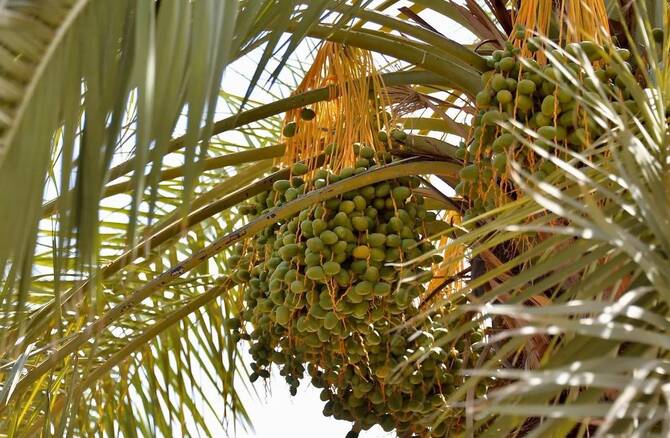
Qassim shines as date harvest fills local markets

1 / 2
Qassim region is abuzz as the early date harvest begins, yielding more than 50 varieties and filling local markets. (SPA)
2 / 2
Qassim region is abuzz as the early date harvest begins, yielding more than 50 varieties and filling local markets. (SPA)
Short Url
Updated 06 July 2025
Follow

Qassim shines as date harvest fills local markets

  • Qassim contributes more than 390,000 tonnes annually to Saudi Arabia’s total date production
  • With more than 11 million palm trees, Qassim produces popular varieties such as sukari, barhi, saggi, ajwa, khalas, mabroom, safawi and anbari

JEDDAH: Qassim region is abuzz as the early date harvest begins, yielding more than 50 varieties and filling local markets, reaffirming the region’s role as a major center for date cultivation and marketing in the Kingdom.

According to the Ministry of Environment, Water and Agriculture, Qassim contributes more than 390,000 tonnes annually to Saudi Arabia’s total date production.

This output strengthens its leadership in food security and boosts Saudi agricultural exports, the Saudi Press Agency reported.

With more than 11 million palm trees, Qassim produces popular varieties such as sukari, barhi, saggi, ajwa, khalas, mabroom, safawi and anbari.

This abundance supports local food security and supplies dates to more than 100 countries worldwide, the SPA added.

Date farmer Abdulaziz Al-Baridi praised the support farmers receive from the ministry branch in Qassim, including education on irrigation techniques and pest control, and preparation of markets for date trade.

As the harvest gains momentum, preparations are underway for the Buraidah Dates Festival. It is expected to boost economic activity, raise nutritional awareness, and strengthen market links between farmers and consumers.

The festival aligns with the Kingdom’s Vision 2030 by promoting agricultural sustainability and diversifying the economy.


Foreign ministers chair Saudi-Omani coordination council meeting in Muscat

Updated 23 December 2025
Follow

Foreign ministers chair Saudi-Omani coordination council meeting in Muscat

MUSCAT: Saudi Foreign Minister Prince Faisal bin Farhan met with Oman’s Foreign Minister Sayyid Badr bin Hamad Al-Busaidi on Monday.

They reviewed bilateral relations between their nations and ways to enhance and develop them across various fields. Additionally, they discussed regional and international developments.

The ministers co-chaired the third meeting of the Saudi-Omani Coordination Council in the Omani capital, Muscat, with the participation of the heads of the Council’s subsidiary committees and the two heads of the Council’s General Secretariat teams.

The meeting comes as an affirmation of the keenness of Saudi and Omani leaders to strengthen ties and advance them toward greater prosperity for both nations.

In his remarks during the meeting, Prince Faisal affirmed that gathering builds on the previous council meeting, held last year in AlUla, and on its positive and fruitful outcomes within the framework of the approved recommendations and initiatives. 

He stressed the importance of continuing the work of the council’s subsidiary committees to complete the necessary procedures to implement the remaining initiatives, and of the General Secretariat’s role in follow-up and in addressing any challenges that may hinder implementation.

He also underscored the importance of developing and enhancing trade relations, stimulating investment, and strengthening cooperation between the public and private sectors.

He also praised the ongoing work to establish and launch the Coordination Council’s electronic platform, which aims to connect all committee work and initiatives to facilitate follow-up on the Council’s progress. 

Al-Busaidi affirmed in his remarks the qualitative progress in relations between the two countries and the notable development witnessed across numerous sectors toward achieving economic integration and enhancing intra-trade and joint investments. 

The Omani foreign minister also highlighted deeper cooperation in the security and judicial fields, as well as the cultural and tourism sectors, noting the advanced and continuous political cooperation, consultation, and coordination on regional and international issues.