

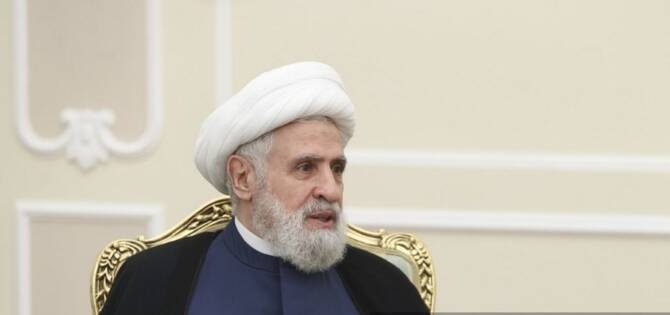
Hezbollah chief says will not surrender under threat from Israel
Lebanese authorities say they have been dismantling Hezbollah’s military infrastructure in the south
Updated 06 July 2025
AFP
BEIRUT: Hezbollah leader Naim Qassem said Sunday his group would not surrender or lay down its weapons in response to Israeli threats, despite pressure on the Lebanese militants to disarm.
“This threat will not make us accept surrender,” Qassem said in a televised speech to thousands of his supporters in the southern suburbs of Beirut, a Hezbollah stronghold, during the Shiite Muslim religious commemoration of Ashura.
Lebanese leaders who took office in the aftermath of a war between Israel and Hezbollah last year have repeatedly vowed a state monopoly on bearing arms while demanding Israel comply with a November ceasefire that ended the fighting.
Qassem, who succeeding longtime leader Hassan Nasrallah after Israel killed him in September, said the group’s fighters would not abandon their arms and asserted that Israel’s “aggression” must first stop.
His speech came as US envoy Tom Barrack was expected in Beirut on Monday.
Lebanese authorities are due to deliver a response to Barrack’s request for Iran-backed Hezbollah to be disarmed by the end of the year, according to a Lebanese official who spoke on condition of anonymity.
Lebanese authorities say they have been dismantling Hezbollah’s military infrastructure in the south, near the Israeli border.
Israel has continued to strike Lebanon despite the November ceasefire, claiming to hit Hezbollah targets and accusing Beirut of not doing enough to disarm the group.
According to the ceasefire agreement, Hezbollah is to pull its fighters back north of the Litani river, some 30 kilometers from the Israeli frontier.
Israel was to withdraw its troops from all of Lebanon, but has kept them deployed in five points it deemed strategic.
Gaza hospital says receives fuel but only for about two days
Updated 2 sec ago
KHAN YUNIS: A major Gaza hospital that had suspended several services due to diesel shortages said it resumed some operations on Friday after receiving fuel but warned the supplies would only last about two days. Ravaged by more than two years of war, the Al-Awda Hospital in central Gaza’s Nuseirat district cares for around 60 in-patients and receives nearly 1,000 people seeking medical treatment each day. Earlier Friday, a senior official involved in managing the hospital, Ahmed Mehanna, said “most services have been temporarily stopped due to a shortage of the fuel needed for the generators.” “Only essential departments remain operational: the emergency unit, maternity ward and paediatrics,” he had told AFP, adding that the hospital rented a small generator to keep those services running. He had warned that a prolonged fuel shortage “would pose a direct threat to the hospital’s ability to deliver basic services.” Under normal conditions, Al-Awda Hospital consumes between 1,000 and 1,200 liters of diesel per day, but it only had some 800 liters available. Later Friday, Mehanna said that “this evening, 2,500 liters of fuel arrived from the World Health Organization, and we immediately resumed operations.” “This quantity of fuel will last only two and a half days, but we have been promised an additional delivery next Sunday.” Mohammed Salha, the hospital’s acting director, accused Israeli authorities of deliberately restricting fuel supplies to hospitals in Gaza. “We are knocking on every door to continue providing services, but while the occupation allows fuel for international institutions, it restricts it for local health facilities such as Al-Awda,” Salha told AFP. Health hard hit Despite a fragile truce observed since October 10, the Gaza Strip remains engulfed in a severe humanitarian crisis. While the ceasefire agreement stipulated the entry of 600 aid trucks per day, only 100 to 300 carrying humanitarian assistance can currently enter, according to the United Nations and non-governmental organizations. The remaining convoys largely transport commercial goods that remain inaccessible to most of Gaza’s 2.2 million people. Earlier Friday, Khitam Ayada, 30, who has taken refuge in Nuseirat, said she had gone to Al-Awda hospital after days of kidney pain. But “they told me they didn’t have electricity to perform an X-ray... and that they couldn’t treat me,” the displaced woman said. “We lack everything in our lives, even the most basic medical services,” she told AFP. Gaza’s health sector has been among the hardest hit by the war. During the fighting, the Israeli miliary repeatedly struck hospitals across Gaza, accusing Hamas of operating command centers there, an allegation the group denied. International medical charity Doctors Without Borders now manages roughly one-third of Gaza’s 2,300 hospital beds, while all five stabilization centers for children suffering from severe malnutrition are supported by international NGOs. The war in Gaza was sparked by an unprecedented Hamas attack on Israel on October 7, 2023 that resulted in the deaths of 1,221 people, most of them civilians, according to an AFP tally based on official Israeli figures. In Israel’s ensuing military campaign in Gaza, at least 70,942 people — also mostly civilians — have been killed, according to the health ministry in the Hamas-run territory. These figures are considered reliable by the United Nations.