

Death toll from Pakistan building collapse climbs to 27 

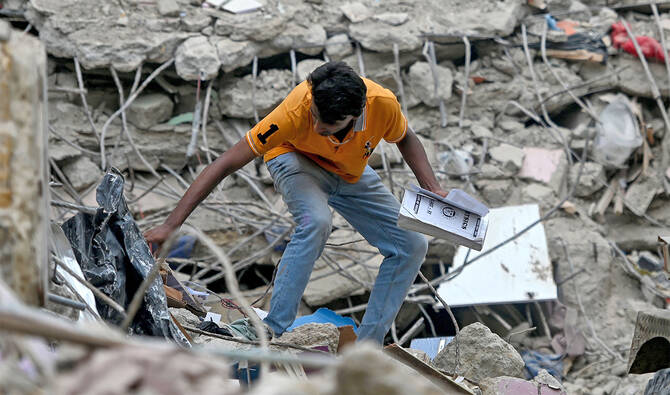
A victim retrieves his belongings from debris of a collapsed building in Karachi on July 5, 2025. (AFP)
Short Url
Updated 06 July 2025
Follow

Death toll from Pakistan building collapse climbs to 27 

  • Final search operation underway, most of the debris cleared, says rescue official
  • Collapse exposes issue of unsafe housing in city, home to over 20 million people

KARACHI: The death toll from a five-story building collapse in the southern Pakistani city of Karachi has risen to 27, a police surgeon confirmed on Sunday after rescuers pulled more bodies from the rubble.

Pakistan’s leading rescue emergency services, including Rescue 1122, continued to recover bodies from the Fotan Mansion residential building. Several families were said to be living in the building, which crumbled around 10 am on Friday in the impoverished Lyari neighborhood of the city.

The building collapse has once again laid bare the issue of unsafe housing in Karachi, Pakistan’s largest city by population. 

“With more bodies recovered from the debris this morning, the death toll has risen further,” Dr. Summaiya Syed, a police surgeon, told Arab News. “So far, we have received 27 bodies.”

Hasaan Khaan, a spokesperson for the Rescue 1122 services, said most of the debris has been cleared at the site.

“Clearance and the final search operation is now underway and will be completed in the next couple of hours,” Khan said.

‘DANGEROUS’ BUILDING

Many of the building occupants were members of the low-income Hindu minority community and residents estimated that around 40 people were inside when the building collapsed.

According to the Sindh Building Control Authority (SBCA), Fotan Mansion had been declared unsafe three years ago.

“This building was declared dangerous by the SBCA in 2022 and had been served multiple notices over the years,” SBCA spokesperson Shakeel Dogar told Arab News on Saturday.

“Before the recent rains, public announcements were also made in the area, but unfortunately, no one was willing to vacate.”

Friday’s incident is the latest in a string of deadly building collapses in Karachi.

In February 2020, a five-story building collapsed in Rizvia Society, killing at least 27 people. The following month, another residential structure came down in Gulbahar, claiming 16 lives. In June 2021, a three-story building in Malir collapsed, killing four. And just last year, in August, a building collapse in Qur’angi led to at least three deaths.

Mayor Wahab said on Friday evening that rescue efforts remained the city government’s top priority, with accountability and investigation to follow.

“Once we’re done with the rescue aspect, we will focus on who was responsible for this negligence or omission,” he added.


Pakistan, global crypto exchange discuss modernizing digital payments, creating job prospects 

Updated 05 December 2025
Follow

Pakistan, global crypto exchange discuss modernizing digital payments, creating job prospects 

  • Pakistani officials, Binance team discuss coordination between Islamabad, local banks and global exchanges
  • Pakistan has attempted to tap into growing crypto market to curb illicit transactions, improve oversight

ISLAMABAD: Pakistan’s finance officials and the team of a global cryptocurrency exchange on Friday held discussions aimed at modernizing the country’s digital payments system and building local talent pipelines to meet rising demand for blockchain and Web3 skills, the finance ministry said.

The development took place during a high-level meeting between Finance Minister Muhammad Aurangzeb, Pakistan Virtual Assets Regulatory Authority (PVARA) Chairman Bilal bin Saqib, domestic bank presidents and a Binance team led by Global CEO Richard Teng. The meeting was held to advance work on Pakistan’s National Digital Asset Framework, a regulatory setup to govern Pakistan’s digital assets.

Pakistan has been moving to regulate its fast-growing crypto and digital assets market by bringing virtual asset service providers (VASPs) under a formal licensing regime. Officials say the push is aimed at curbing illicit transactions, improving oversight, and encouraging innovation in blockchain-based financial services.

“Participants reviewed opportunities to modernize Pakistan’s digital payments landscape, noting that blockchain-based systems could significantly reduce costs from the country’s $38 billion annual remittance flows,” the finance ministry said in a statement. 

“Discussions also emphasized building local talent pipelines to meet rising global demand for blockchain and Web3 skills, creating high-value employment prospects for Pakistani youth.”

Blockchain is a type of digital database that is shared, transparent and tamper-resistant. Instead of being stored on one computer, the data is kept on a distributed network of computers, making it very hard to alter or hack.

Web3 refers to the next generation of the Internet built using blockchain, focusing on giving users more control over their data, identity and digital assets rather than big tech companies controlling it.

Participants of the meeting also discussed sovereign debt tokenization, which is the process of converting a country’s debt such as government bonds, into digital tokens on a blockchain, the ministry said. 

Aurangzeb called for close coordination between the government, domestic banks and global exchanges to modernize Pakistan’s payment landscape.

Participants of the meeting also discussed considering a “time-bound amnesty” to encourage users to move assets onto regulated platforms, stressing the need for stronger verifications and a risk-mitigation system.

Pakistan has attempted in recent months to tap into the country’s growing crypto market, crack down on money laundering and terror financing, and promote responsible innovation — a move analysts say could bring an estimated $25 billion in virtual assets into the tax net.

In September, Islamabad invited international crypto exchanges and other VASPs to apply for licenses to operate in the country, a step aimed at formalizing and regulating its fast-growing digital market.