BEIRUT: It’s as if the whole weight of Israel’s war in Gaza has fallen on Amr Al-Hams. The 3-year-old has shrapnel in his brain from an Israeli strike on his family’s tent. His pregnant mother was killed. His father is paralyzed by grief over the death of his longtime sweetheart.
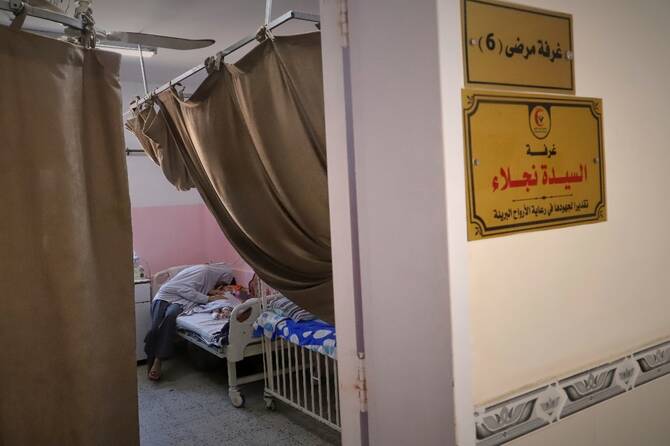
Now the boy is lying in a hospital bed, unable to speak, unable to move, losing weight, while doctors don’t have the supplies to treat his brain damage or help in his rehabilitation after a weekslong blockade and constant bombardment.
Recently out of intensive care, Amr’s frail body twists in visible pain. His wide eyes dart around the room. His aunt is convinced he’s looking for his mother. He can’t speak, but she believes he is trying to say “mom.”
“I am trying as much as I can. It is difficult,” said his aunt Nour Al-Hams, his main caregiver, sitting next to him on the bed in Khan Younis’ Nasser Hospital in southern Gaza. “What he is living through is not easy.”
To reassure him, his aunt sometimes says his mother will be back soon. Other times, she tries to distract him, handing him a small ball.
The war has decimated the health system
The war began Oct. 7, 2023, when Hamas-led militants stormed into Israel and killed some 1,200 people, mostly civilians, and took 251 people captive. Israel’s retaliatory campaign has killed over 57,000 Palestinians, according to Gaza’s Health Ministry, which says women and children make up most of the dead but does not specify how many were fighters or civilians.
Nearly 21 months into the conflict that displaced the vast majority of Gaza’s 2.3 million people, it is nearly impossible for the critically wounded to get the care they need, doctors and aid workers say.
The health care sector has been decimated: Nearly half of the territory’s 36 hospitals have been put out of service. Daily bombings and strikes overwhelm the remaining facilities, which are operating only partially. They struggle with shortages of anything from fuel, gauze and sutures to respirators or scanners that have broken down and can’t be replaced.
Israeli forces have raided and besieged medical facilities, claiming Hamas militants have used them as command centers. Doctors have been killed or were displaced, unable to reach hospitals because of continued military operations.
For more than 2 1/2 months, Israel blocked all food, medicine and other supplies from entering Gaza, accusing Hamas of siphoning off aid to fund its military activities, though the UN said there was no systematic diversion. The population was pushed toward famine.
Since mid-May, Israel has allowed in a trickle of aid, including medical supplies.
Gaza’s Health Ministry estimates that 33,000 children have been injured during the war, including 5,000 requiring long-term rehabilitation and critical care. Over 1,000 children, like Amr, are suffering from brain or spinal injuries or amputated limbs.
“Gaza will be dealing with future generations of kids living with all sorts of disabilities, not just brain, but limb disabilities that are consequences of amputation that could have been prevented if the health system was not under the pressures it is under, wasn’t systematically targeted and destroyed as it was,” said Tanya Hajj-Hassan, a pediatric intensive care specialist who has volunteered multiple times in Gaza with international medical organizations.
A fateful journey north
In April, one week before her due date, Amr’s mother, Inas, persuaded her husband to visit her parents in northern Gaza. They trekked from the tent they lived in on Gaza’s southern coast to the tent where her parents live.
They were having an evening meal when the strike hit. Amr’s mother and her unborn baby, his grandfather and his brother and sister were killed.
Amr was rushed to the ICU at Indonesian Hospital, the largest in northern Gaza. A scan confirmed shrapnel in his brain and reduced brain function. A breathing tube was inserted into his throat.
“He is 3. Why should he bear the weight of a rocket?” his aunt asked.
His father, Mohammed, was too stunned to even visit the ICU. His wife had been the love of his life since childhood, the aunt said. He barely spoke.
Doctors said Amr needed advanced rehabilitation. But while he was at the hospital, Israeli forces attacked the facility — encircling its premises and causing damage to its communication towers, water supplies and one of its wards. Evacuation orders were issued for the area, and patients were transferred to Shifa Hospital in Gaza City.
Another treacherous journey
But Shifa was overwhelmed with mass casualties, and staff asked the family to take Amr south, even though no ambulances or oxygen tanks could be spared.
The father and aunt had to take Amr, fresh out of ICU with the tube in his throat, in a motorized rickshaw for the 25-kilometer (15-mile) drive to Nasser Hospital.
Amr was in pain, his oxygen levels dropped. He was in and out of consciousness. “We were reading the Qur’an all along the road,” said his aunt, praying they would survive the bombings and Amr the bumpy trip without medical care.
About halfway, an ambulance arrived. Amr made it to Nasser Hospital with oxygen blood levels so low he was again admitted to ICU.
Unable to get the care he needs
Still, Nasser Hospital could not provide Amr with everything he needed. Intravenous nutrients are not available, Nasser’s head of pediatrics, Dr. Ahmed Al-Farra, said. The fortified milk Amr needed disappeared from the market and the hospital after weeks of Israel’s blockade. He has lost about half his weight.
When he came out of the ICU, Nour shared his bed with him at night and administered his medication. She grinds rice or lentils into a paste to feed him through a syringe connected to his stomach.
“We have starvation in Gaza. There is nothing to eat,” said his aunt, who is a trained nurse. “There is nothing left.”
The care Amr has missed is likely to have long-term effects. Immediate care for brain injuries is critical, Hajj-Hassan said, as is follow-up physical and speech therapy.
Since the Israeli blockade on Gaza began in March, 317 patients, including 216 children, have left the territory for medical treatment alongside nearly 500 of their companions, according to the World Health Organization.
Over 10,000 people, including 2,500 children, await evacuation.
Amr is one of them.
COGAT, the Israeli military body in charge of civilian affairs in Gaza, coordinates medical evacuations after receiving requests from countries that will take the patients and security screenings. In recent weeks, over 2,000 patients and their companions have left for treatment, COGAT said, without specifying the time period.
Tess Ingram, spokesperson for the UN children’s agency, said the only hope for many critically injured who remain in Gaza is to get out. Countries need to “open their hearts, open their doors and open their hospitals to children who survived the unimaginable and are now languishing in pain,” she said.
Amr’s aunt reads his every move. He is unhappy with his diapers, she said. He outgrew them long ago. He was a smart kid, now he cries “feeling sorry for himself,” said Nour. He gets seizures and needs tranquilizers to sleep.
“His brain is still developing. What can they do for him? Will he be able to walk again?” Nour asked. “So long as he is in Gaza, there is no recovery for him.”


![]()

A boy in Gaza with brain damage fights for his life amid blockade
Short Url
https://arab.news/zfpar
A boy in Gaza with brain damage fights for his life amid blockade
- Nearly 21 months into the conflict, it is nearly impossible for the critically wounded to get the care they need, doctors and aid workers say
- Since the Israeli blockade on Gaza began in March, 317 patients, including 216 children, have left the territory for medical treatment alongside nearly 500 of their companions, according to the World Health Organization


Latest updates




© 2026 SAUDI RESEARCH & PUBLISHING COMPANY, All Rights Reserved And subject to Terms of Use Agreement.