

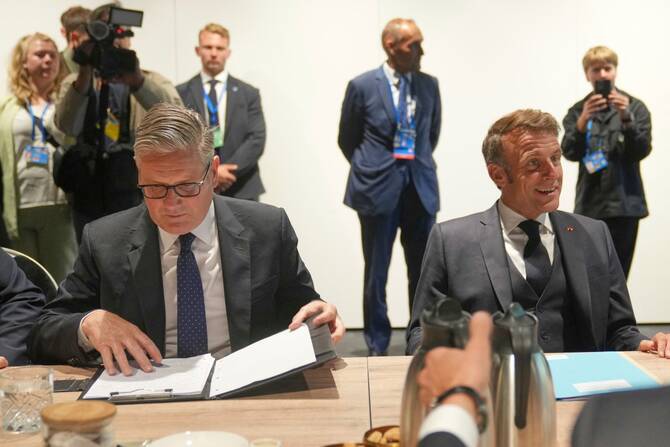
Macron to press Starmer on recognizing Palestinian state during UK visit

Emmanuel Macron is expected to urge Prime Minister Sir Keir Starmer to formally recognize Palestinian statehood during his upcoming state visit to the UK, it was reported on Saturday. (AFP/File Photo)
Short Url
Updated 05 July 2025
Follow

Macron to press Starmer on recognizing Palestinian state during UK visit

  • French leader’s trip comes as Paris pushes for relaunch of UN-led process on the issue to be hosted with Saudi Arabia
  • Macron also expected to discuss ‘one-in, one-out’ migrant return deal to curb Channel crossings

LONDON: Emmanuel Macron is expected to urge Prime Minister Sir Keir Starmer to formally recognize Palestinian statehood during his upcoming state visit to the UK, it was reported on Saturday.

The French president arrives in London on Tuesday for a three-day trip, which will include a summit with Starmer, an address to both Houses of Parliament, and a state banquet hosted by King Charles at Windsor Castle.

While the centerpiece of the visit is expected to be a new “one-in, one-out” migrant returns deal aimed at curbing Channel crossings, sources say Macron will also raise the issue of Palestinian statehood during private talks with the UK leader.

“The French are trying to get us back on board with recognition. We’re reticent,” a Whitehall insider told The Telegraph.

“You do it when you think you can achieve something from it, not for the sake of saying ‘we’ve done it.’”

Downing Street and the Elysee Palace are said to be at odds over the pace and conditions under which recognition should take place, though both governments publicly support the idea in principle at the “right time.”

Paris views recognition as a possible catalyst for a two-state solution and is pushing to relaunch a proposed UN-led process to discuss the matter to be hosted with Saudi Arabia.

However, UK officials fear the move could be largely symbolic without commitments from Hamas, including disarmament and withdrawal from leadership roles.

Israel has strongly opposed unilateral recognition, warning it would amount to “rewarding” Hamas for its Oct. 7 attacks.

The bilateral summit will also cover joint civil nuclear projects and coordination on a European peacekeeping force in Ukraine.

Macron’s visit will be marked by pageantry, including a carriage procession through Windsor and a tour of the Royal Collection. The French president will also be presented with Fabuleu de Maucour, a horse he gifted the late Queen Elizabeth II in 2022.


Australian Prime Minister Albanese proposes tougher national gun laws after mass shooting in Sydney

Updated 3 sec ago
Follow

Australian Prime Minister Albanese proposes tougher national gun laws after mass shooting in Sydney

  • He said Monday he would propose new restrictions including limiting the number of guns a licensed owner can obtain

SYDNEY: Australian Prime Minister Anthony Albanese on Monday proposed tougher national gun laws after a mass shooting targeted a Hanukkah celebration on Sydney’s Bondi Beach, leaving at least 15 people dead.
Albanese said he would propose new restrictions, including limiting the number of guns a licensed owner can obtain. His proposals were announced after the authorities revealed that the older of the two gunmen — who were a father and son — had amassed his six guns legally.
“The government is prepared to take whatever action is necessary. Included in that is the need for tougher gun laws,” Albanese told reporters.
“People’s circumstances can change. People can be radicalized over a period of time. Licenses should not be in perpetuity,” he added.
At least 38 people were being treated in hospitals after the massacre on Sunday, when the two shooters fired indiscriminately on the beachfront festivities. Those killed included a 10-year-old girl, a rabbi and a Holocaust survivor.
The horror at Australia’s most popular beach was the deadliest shooting in almost three decades in a country with strict gun control laws primarily aimed at removing rapid-fire rifles from circulation. Albanese called the massacre an act of antisemitic terrorism that struck at the heart of the nation.
He pledged swift change, planning on Monday afternoon to present his gun law proposals to a national cabinet meeting that includes state leaders. Some of the measures would also require state legislation.
“Some laws are commonwealth and some laws are implemented by the states,” the Australian leader said. “What we want to do is to make sure that we’re all completely on the same page.”
Australia’s gun laws were revised after a 1996 massacre in the Tasmanian town of Port Arthur, where a lone gunman killed 35 people.
Jewish leaders lambast antisemitism measures
Meanwhile, the massacre provoked questions about whether Albanese and his government had done enough to curb rising antisemitism. Jewish leaders and the massacre’s survivors expressed fear and fury as they questioned why the men hadn’t been detected before they opened fire.
“There’s been a heap of inaction,” said Lawrence Stand, a Sydney man who raced to a Bar Mitzvah celebration in Bondi when the violence erupted to find his 12-year-old daughter. “But the people were warned about this. ... And still not enough has been done by our government.”
“I think the federal government has made a number of missteps on antisemitism,” Alex Ryvchin, spokesperson for the Australian Council of Executive Jewry, told reporters gathered on Monday near the site of the massacre. “I think when an attack such as what we saw yesterday takes place the paramount and fundamental duty of government is the protection of its citizens, so there’s been an immense failure.”
An investigation was needed, Ryvchin said, into “how that was allowed to take place.” Those investigations were beginning to unfold Monday.
More details about the shooters emerge
Little was publicly confirmed about the men. Police said they were a father and son but wouldn’t supply their names.
The father, 50, who was shot dead, had a gun license that allowed him to legally acquire the six firearms recovered from his property and also held a gun club membership, said Mal Lanyon, Police Commissioner for New South Wales state, where Sydney is located.
The particular gun license he held entitled an adult with a “genuine reason” to own a rifle or shotgun. Accepted reasons include target shooting, recreational hunting and vermin control, but self-defense is not an accepted reason.
The man arrived in Australia in 1998 on a student visa, authorities said, and was an Australian resident when he died. Officials wouldn’t confirm what country he had migrated from.
His 24-year-old Australian-born son, who was shot and wounded, is being treated at a hospital. Lanyon said the man “may well” face criminal charges and police wouldn’t divulge what they knew about him to avoid marring a prosecution case against him.
Victims included children and the elderly
None of the dead or wounded victims have been formally named by the authorities. Identities of those killed, who ranged in age from 10 to 87, began to emerge in news reports Monday.
Among them was Rabbi Eli Schlanger, assistant rabbi at Chabad of Bondi and an organizer of the family Hanukkah event that was targeted, according to Chabad, an Orthodox Jewish movement that runs outreach worldwide and sponsors events during major Jewish holidays.
Israel’s Foreign Ministry confirmed the death of an Israeli citizen, but gave no further details. French President Emmanuel Macron said a French citizen, identified as Dan Elkayam, was among those killed.
Larisa Kleytman told reporters outside St. Vincent’s Hospital that her husband, Alexander Kleytman, was among the dead. The couple were both Holocaust survivors, according to The Australian newspaper.
The violence erupted at the end of a summer day when thousands had flocked to Bondi Beach, an icon of Australia’s cultural life. They included hundreds gathered for the Chanukah by the Sea event celebrating the start of the eight-day Hanukkah festival with food, face painting and a petting zoo.
On Monday, hundreds arrived near the scene to lay flowers at a growing pile of floral tributes. There were words of pride, too, for a man who was captured on video appearing to tackle and disarm one gunman, before pointing the man’s weapon at him, then setting the gun on the ground.
The man was identified by Home Affairs Minister Tony Burke as Ahmed al Ahmed. The 42-year-old fruit shop owner and father of two was shot in the shoulder by the other gunman and survived.
Massacre followed a surge in antisemitic crimes
Australia, a country of 28 million people, is home to about 117,000 Jews, according to official figures. Over the past year, the country was rocked by antisemitic attacks in Sydney and Melbourne. Synagogues and cars were torched, businesses and homes graffitied and Jews attacked in those cities, where 85 percent of the nation’s Jewish population lives.
Israel’s Prime Minister Benjamin Netanyahu said Sunday that he warned Australia’s leaders months ago about the dangers of failing to take action against antisemitism. He claimed Australia’s decision, in line with scores of other countries, to recognize a Palestinian state “pours fuel on the antisemitic fire.”
Albanese on Monday vowed the violence would be met with “a moment of national unity where Australians across the board will embrace their fellow Australians of Jewish faith.”
“There is no place in Australia for antisemitism,” he said.
Albanese in August blamed Iran for two of the previous attacks and cut diplomatic ties to Tehran. Authorities have not suggested Iran was linked to Sunday’s massacre.