

Artists push the boundaries of technology in new media arts residency in Riyadh

1 / 10
DAF Director Haytham Nawar. (AN Photo/Huda Bashatah)
2 / 10
Mizuho Yamazaki, an Independent Writer and Scholar, who is part of this year's Mazra’ah Media Arts Residency cohort. (AN Photo/Huda Bashatah)
3 / 10
Attendees joined an Open Studio Preview with Dr. Stanza, a Media Artist and Mazra’ah resident. (AN Photo/Huda Bashatah)
4 / 10
Attendees joined an Open Studio Preview with Dr. Stanza, a Media Artist and Mazra’ah resident. (AN Photo/Huda Bashatah)
5 / 10
Dr. Stanza, a Media Artist and Mazra’ah resident. (AN Photo/Huda Bashatah)
6 / 10
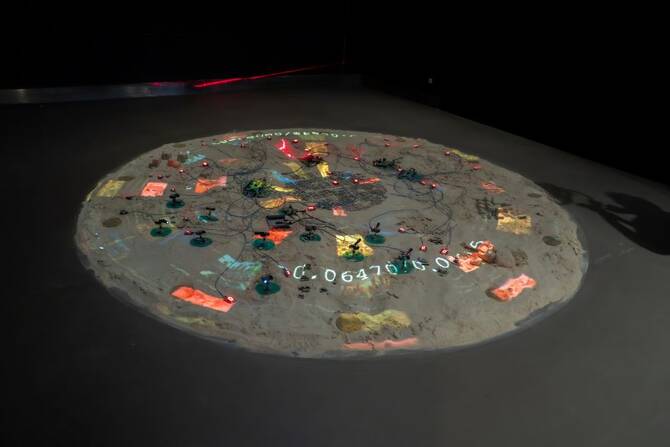
Machine Cities connects 90 cities and towns across the Kingdom as it tracks them in real-time, giving a visualization that the public can engage with. (AN Photo/Huda Bashatah)
7 / 10
Arwa Al-Neami’s work explores themes of acceptance, identity, and societal transformation. (AN Photo/Huda Bashatah)
8 / 10
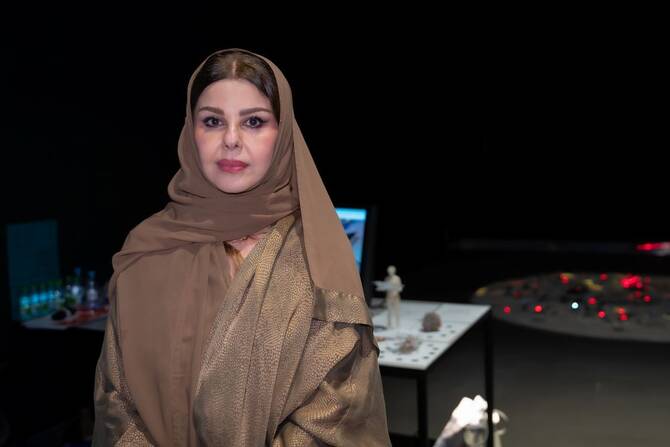
Prominent Saudi visual artist Lulwah AI-Hamoud, attending the Mazra'ah New Media Arts Residency open studio. (AN Photo/Huda Bashatah)
9 / 10
Arwa Al-Neami’s Into the Future is an immersive sensory experience that delves into both the micro and metaphysical realms, transforming microscopic grains of sand into digital portals where myth and technology intersect, sparking the imagination. (AN Photo/Huda Bashatah)
10 / 10
Indian artist Harshit Agrawal displayed his work at the residency. (AN Photo/Huda Bashatah)
Short Url
Updated 07 July 2025
Follow

Artists push the boundaries of technology in new media arts residency in Riyadh

  • Residency displays futuristic artwork inspired by the natural landscape and culture of the Kingdom
  • Diriyah Art Futures brings together artists from around the world, combining art, science and technology

RIYADH: Diriyah Art Futures opened a new residency displaying cutting-edge artwork in Riyadh on Wednesday evening.

The Mazra’ah Media Art Residency spring/summer 2025 open studio displays work that combines art, science and technology.

It is a three-month program designed for artists and scholars working across new media and digital art.

The theme, “High-Resolution Dreams of Sand,” explored the evolving relationships between humans, nature and technology in rapidly changing environments, informed by the distinctive contexts of Diriyah and Riyadh.

The evening’s open studio offered a behind-the-scenes look at work in progress from the spring/summer 2025 residents, alongside talks and studio discussions.

In the studios, Arab News met with various artists including Saudi Arwa Al-Neami whose creations explore themes of acceptance, identity and societal transformation.

During the residency, she undertook an artistic investigation of Saudi Arabia’s landscapes, collecting sand samples from various regions across the Kingdom.

Through nano microscopy and advanced imaging techniques, she created an immersive sensory experience that transforms microscopic grains of sand into pieces of art in the form of films, virtual reality and 3D-printed sculptures.

She told Arab News: “I am currently researching seven different areas in the Kingdom, where I’m exploring the sound of the sun using specialized sensors during sunrise and sunset. The resulting sound waves are translated into frequencies that create audible sounds.

“By analyzing the sound of the sun and the atomic structure of sands, I produce artwork that highlights the differences across various regions of Saudi Arabia.”

For 90 days, artist Dr. Stanza has been creating a whole body of work based on Saudi Arabia using real-time data including weather forecasts, pollution stats and news feeds.

Using an AI prompt, he created the series “Sons of Time” — an interactive Internet installation inspired by cybernetics and the future.

His other work, “Machine Cities,” connects 90 cities and towns across the Kingdom and tracks them in real time, presenting a visualization that the public can engage with.

The London-based artist has exhibited worldwide and earned numerous awards for his use of the Internet as an art medium.

“While I’ve been here, what I’ve really learned about Saudi Arabia is it’s a very warm and inclusive country that’s moving forward toward 2030.

“There’s a whole series of ideas about AI and agency that (are) also incorporated within my artworks. I look forward to presenting some of these works here in the future,” he told Arab News.

Indian artist Harshit Agrawal has taken his time at the residency to contemplate the juxtaposition of Diriyah’s rich heritage with its exponential development in the past few years.

Set against Diriyah’s historic farms and Riyadh’s evolving environment, the participants were encouraged to consider the impact of technology on natural and constructed landscapes.

“While I was here, I was quite fascinated, in my early days by the cultural richness, the different practices of culture, but also Diriyah as a city in transition in this beautiful time where it’s developing into something else with all these constructions and all these new things that are happening,” Agrawal told Arab News.

In “Machinic Meditations,” the artist was particularly fascinated with subhas, or prayer beads, that are commonly used in Saudi Arabia.

This prompted his research, where he also found electronic subhas. “It’s quite fascinating to move from this kind of manual device to an electronic version of it,” he said.

“I started thinking — because I work a lot with machine learning, AI data— what is the extreme scenario of that? So, I created these devices, which are motorized systems that rotate these beads autonomously, and they keep doing that continuously.

“And with each rotation, they pick up new human data to meditate on. It’s kind of the machine’s version of meditating, but on human data and climate data.”

In “Data Excavations: The New Soil,” the artist takes inspiration from construction and excavation machinery, using its mobility as a way to write out words in a choreographed manner using light strips.

“It’s been a really exciting time to be here, because it’s a great intersection between deep cultural practices that are here that I can kind of see in the city, but also really cutting-edge studios and facilities that I’ve had and (been) exposed through the material residency,” he said.

The open studio event welcomed a number of artists and prominent figures in the art scene, aiming to introduce them to the findings and research of this year’s cohort around new media arts in the region.

“Having Saudi Arabia attracting so many different cultures right now is a great thing, for artists to meet and research in the new media and technology is a great thing because they can implement their culture’s ideas in so many different ways and that’s what we see here — it’s a great cultural bridge,” visual artist Lulwah AI-Hamoud, who was attending the event, told Arab News.

DAF Director Haytham Nawar and DAF Director of Education Dr. Tegan Bristow delivered opening remarks, followed by talks from Dr. Anett Holzheid, an ZKM science and art researcher and curator, and Mizuho Yamazaki, an independent writer and scholar.

Attendees then enjoyed an open studio preview with Dr. Stanza, before a break for networking and a tour of the fabrication lab, sound lab and prototypes.

The evening concluded with studio discussions featuring Arwa Alneami, Harshit Agrawal and Reem Alnasser, all media artists.


Saudi designer Njoud Alghamdi: ‘We want to sustain our cultural identity in a new form’ 

Updated 18 December 2025
Follow

Saudi designer Njoud Alghamdi: ‘We want to sustain our cultural identity in a new form’ 

  • The Saudi designer on revamping the date-serving experience with Muntj Studio 

DUBAI: Saudi product designer Njoud Alghamdi brought a culturally rooted product to last month’s Dubai Design Week with “Nawat” — showcased under the Designed in Saudi initiative by the Saudi Architecture and Design Commission. 

Alghamdi is the co-founder and lead product designer of Muntj Studio, which she describes as “a cultural design studio where we focus on sustaining our cultural identity.” 

But Alghamdi isn’t interested in simply reproducing products from the past. “I am passionate about cultural innovation,” she told Arab News.  

“Nawat” — which she describes as the studio’s “signature piece” — is a perfect example of that innovation. It was created to address an issue that occurs in gatherings across Saudi Arabia and the Gulf. 

“Nawat” is the studio’s “signature piece,” according to Njoud Alghamdi. (Supplied) 

 “As you know, dates hold a very special place for us,” she said. But Alghamdi and her team identified a common concern. “Usually when people eat dates, they are embarrassed dealing with the pits themselves,” she explained. “So usually, they hide it in their pockets or in a tissue.  

“We asked ourselves, ‘How we can solve this problem to make the experience easier for the users?’” she continued. The elegant result is “Nawat,” a rounded wooden vessel with openings designed to store date pits out of sight.  

Those openings were inspired by traditional Najdi architectural elements, with a particular focus on the motifs used in old Najdi doors. During the research phase, she and her team reviewed a range of patterns but chose not to use the sharper shapes found in older houses.  

“We didn’t want to use motifs like the triangle,” she said. “So, we found the perfect circular motif and used that. Najdi doors are also a symbol of welcoming.” 

This connection aligned naturally with the social role of dates in Khaleeji culture. “The date pit holds a very special place for us at every table,” she said. “We hope that reflects how friendly this object is.” 

The final product was crafted in Riyadh by local artisans, she explained. “They used natural wood with natural finishes as well.”  

The final product was crafted in Riyadh by local artisans. (Supplied) 

The studio is now developing an entire “Nawat” range, Alghamdi said, explaining that the collection will include different sizes and dimensions to fit a wider range of occasions.  

Alghamdi described the studio’s broader focus as creating contemporary objects that sustain cultural identity. “Most of our products reflect our Saudi identity in a new format,” she said. “We want to sustain our cultural identity in a new form that can share our story with the whole world.” 

Current projects include an incense burner inspired by the camel hump, intended to “support a more comfortable daily incense ritual.” She added that the studio is also working on “cultural games,” which she described as ways to express Saudi identity in an interactive way.  

“Playing a game is the perfect way to communicate,” she said. “We believe that by expressing our identities through these games, it will help us to spread our identity and culture to the whole world.” 

Dubai Design Week was a small step towards that goal.  

“Actually, this is one of my proudest moments, to be honest,” Alghamdi said. “Exhibiting with the Architecture and Design Commission is something really special to me. 

“We’re always grateful for all the support and empowerment that (the commission is) giving us,” she continued. “As a Saudi designer, they always ensure that we get the best (opportunities) to present our work. This is something that makes every Saudi designer super-excited to come up with the best designs, because (we have the chance to) reflect our identity and the (wider design) scene.”