

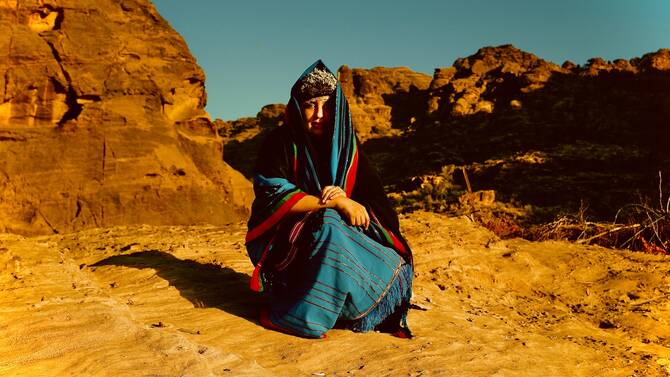
Saudi artist Reem Al-Nasser discusses her Diriyah Art Futures Residency 

Reem Al-Nasser has been selected for the inaugural Mazra’ah Media Arts Residency. (Credit: Jawad Tabatabai)
Short Url
Updated 16 May 2025
Follow

Saudi artist Reem Al-Nasser discusses her Diriyah Art Futures Residency 

  • Al-Nasser says she is inspired by area’s ‘natural beauty’ 

DUBAI: Saudi artist Reem Al-Nasser has been selected for the inaugural Mazra’ah Media Arts Residency, a new initiative from Diriyah Art Futures.  

The residency, which runs until July, brings together artists and scholars to explore emerging ecologies, speculative futures, and the evolving relationship between technology, nature and cultural heritage. 

Organized by the Museums Commission under the Saudi Ministry of Culture, the residency supports experimental research and production in the field of digital and new media art.  


Al-Nasser, one of three Saudi artists participating, described being selected as both an honor and a milestone in her artistic journey. (Supplied)

Participants are provided with a production budget and technical support, as well as access to labs and studios. The spring cohort includes artists and scholars from Saudi Arabia, India, Japan, France, Germany and the UK. 

Al-Nasser, one of three Saudi artists participating, described being selected as both an honor and a milestone in her artistic journey.  

“I felt immense happiness and deep honor,” she told Arab News. “Being chosen for such a prestigious residency was a validation of my artistic journey and gave me a sense of responsibility and excitement.” 

The theme of the inaugural residency is “High-Resolution Dreams from the Sands.” Artists are encouraged to examine the intersections of land and technology. Al-Nasser’s interpretation of the theme centers on the flower known in Arabic as Al-Samh — a plant native to Saudi Arabia, which she uses as a symbol of resilience, healing and shelter.  


Sketch of her upcoming work for the residency. (Supplied)

“I’m working on archiving the ancient behaviors associated with this flower as a symbol of defense and protection, incorporating its intricate details into digital artworks that simulate its essence,” she said.  

Al-Nasser is developing a series of interactive digital installations that integrate visual projection, augmented reality and artificial intelligence to animate the symbolic qualities of the flower and bring them into a contemporary digital art context. Her goal is to create a multi-sensory experience that immerses viewers in the story of the flower, blending visual detail with conceptual depth. 

“These tools allow me to present the intricate details of the Samh flower in a stunning and unprecedented way,” she said. 

Al-Nasser often draws inspiration from traditional storytelling and behavioral patterns, using art to reframe these ideas through a modern lens. “My style is a blend of digital and physical media, with a focus on storytelling — restructuring and connecting ancient knowledge with modern elements,” she said. “Being in Diriyah opened my eyes to the importance of drawing inspiration from local elements and presenting them in a contemporary manner. It’s also encouraged me to experiment with modern techniques I haven’t used before.  


Sketch of her upcoming work for the residency. (Supplied)

“Diriyah has also inspired me with its natural beauty, palm gardens and ancient forts, which have become a central focus in my work,” she continued. “The environment here encouraged me to deeply reflect on the relationship between nature and art and to celebrate its elements through technology. I hope people feel the profound connection between environmental science and the Desert Samh Flower and appreciate the power of nature in creating symbols that inspire art and creativity. I want them to reflect on the relationship between heritage and technology and how art can bridge the two.” 

As the Kingdom invests more heavily in cultural infrastructure and platforms such as DAF, Al-Nasser believes local artists are increasingly positioned to shape the global conversation around digital and new media art. 

“Saudi artists are producing remarkable works that are rooted in cultural heritage while integrating modern technologies,” she said. “They have the potential to revolutionize the global art scene by highlighting the beauty of local nature, like the Samh flower, in innovative ways.” 


'Bakila Recipe,' 2024, presented in Paris. (Supplied)

Al-Nasser’s journey into art began in her teenage years, driven by a fascination with creative expression and storytelling. “Art became my way of understanding the world and sharing my perspective,” she said, adding that her creative inspirations often stem from historical and behavioral patterns.  

“Ancient storytelling and understanding personal experiences were my primary sources of inspiration,” she explained. “I’ve always been fascinated by the beauty of subtle details in behaviors, their connection to time, and how art can highlight and center them in storytelling.” 


Review: Netflix’s ‘The New Yorker at 100’

Updated 14 December 2025
Follow

Review: Netflix’s ‘The New Yorker at 100’

  • Directed by Marshall Curry, the documentary opened the doors to the publication’s meticulous world, offering viewers a rare look inside the issues within the magazine’s issues

Out this month, Netflix’s “The New Yorker at 100” documentary marks the centennial of the weekly that has brought forth arguably some of the most compelling long-form journalism in my lifetime.

As a ferocious reader with an insatiable appetite for print, I vividly recall picking-up a copy of The New Yorker in Saudi Arabia after school as a teen, determined to read it cover-to-cover — only to find myself mentally, intellectually and physically exhausted after deciphering a single lyrical and Herculean-sized long-form piece.

Reading The New Yorker still makes one both feel smarter — and perhaps not smart enough — at the very same time. Just like the documentary.

Much like Vogue’s 2009 documentary, “The September Issue,” which followed (now retired) editor-in-chief Anna Wintour as she prepared for the September 2007 issue; this documentary largely centered on the making of the Feb. 17 & 24, 2025 multi-cover edition.

A quintessentially New York staple that readers either love or loathe — or both — the magazine has long been seen as a highbrow publication for the “elite.”

But The New Yorker is in on the joke. It never did take itself too seriously.

Directed by Marshall Curry, the documentary opened the doors to the publication’s meticulous world, offering viewers a rare look inside the issues within the magazine’s issues.

Narrated by actress Julianne Moore, it included sit-down interviews with famous figures, largely offering gushing testimonials.

It, of course, included many cameos from pop culture references such as from “Seinfeld,” “The Good Place” and others.

It also mentioned New Yorker’s famed late writers Anthony Bourdain and Truman Capote, and Ronan Farrow.

As a journalist myself, I enjoyed the behind-the-scenes peeks into staff meetings and editing discussions, including the line-by-line fact-checking process.

While lovingly headquartered in New York — and now based at One World Trade Center after decades in the heart of Times Square — the magazine has long published dispatches from elsewhere in the country and around the world.

I wish there had been more airtime dedicated to Jeanette “Jane” Cole Grant, who co-founded the magazine with her husband-at-the-time, Harold Ross, during the Roaring Twenties.

Ironically, neither founder hailed from New York — Grant arrived from Missouri at 16 to pursue singing before becoming a journalist on staff at The New York Times — and Ross came from a Colorado mining town.

Perhaps more bizarrely, Ross, who served as the first editor-in-chief of The New Yorker — known today for its intricate reporting and 11 Pulitzer Prizes — had dropped out of school at 13. He served as lead editor for 26 years until his death, guided by instinct and surrounded by talented writers he hired.

As the Pulitzer Prize-winning journalist and the magazine’s fifth editor-in-chief, David Remnick has held the role since 1998. “It is a place that publishes a 15,000-word profile of a musician one week, a 9,000-word account from Southern Lebanon, with gag cartoons interspersed in them,” he said in one scene.

It also offered a glimpse of the leadership of his predecessor, the vivacious and provocative Tina Brown, who served as editor-in-chief for six years starting in 1992.

No woman has held the top editor position before or since her tenure.

Some of the most compelling moments in the documentary, for me, showed journalists scribbling in reporter notebooks in darkened movie theaters, rocking-out in dingy punk shows, and reporting from political rallies while life unfolded around them.

These journalists were not sitting in diners, merely chasing the money or seated in corner offices; they were on the ground, focused on accuracy and texture, intent on portraying what it meant to be a New Yorker who cared about the world, both beyond the city’s borders and within them.

While Arab bylines remain limited, the insights from current marginalized writers and editors showed how the magazine has been trying to diversify and include more contributors of color. They are still working on it.

A century in, this documentary feels like an issue of The New Yorker — except perhaps easier to complete.