LA PAZ: Bolivia’s long-serving socialist former leader, Evo Morales, reappeared Thursday in his political stronghold of the tropics after almost seven weeks of unexplained absence, endorsing candidates for upcoming regional elections and quieting rumors he had fled the country in the wake of the US seizure of his ally, Venezuela’s ex-President Nicolás Maduro.
The weeks of hand-wringing over Morales’ fate showed how little the Andean country knows about what’s happening in the remote Chapare region, where the former president has spent the past year evading an arrest warrant on human trafficking charges, and how vulnerable it is to fears about US President Donald Trump’s potential future foreign escapades.
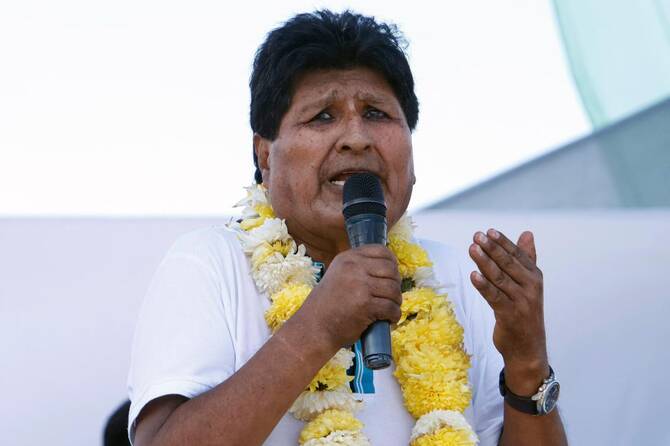
The media outlet of Morales’ coca-growing union, Radio Kawsachun Coca, released footage of Morales smiling in dark sunglasses as he arrived via tractor at a stadium in the central Bolivian town of Chimoré to address his supporters.
Morales, Bolivia’s first Indigenous president who served from 2006 until his fraught 2019 ouster and subsequent self-exile, explained that he had come down with chikungunya, a mosquito-borne ailment with no treatment that causes fever and severe joint pain, and suffered complications that “caught me by surprise.”
“Take care of yourselves against chikungunya — it is serious,” the 66-year-old Morales said, appearing markedly more frail than in past appearances.
He dismissed rumors fueled by local politicians and fanned by social media that he would try to flee the country, vowing to remain in Bolivia despite the threat of arrest under conservative President Rodrigo Paz, whose election last October ended nearly two decades of rule by Morales’ Movement Toward Socialism party.
“Some media said, ‘Evo is going to leave, Evo is going to flee.’ I said clearly: I am not going to leave. I will stay with the people to defend the homeland,” he said.
Paz’s revival of diplomatic ties with the US and recent efforts to bring back the Drug Enforcement Administration — some 17 years after Morales expelled American anti-drug agents from the Andean country while cozying up to China, Russia, Cuba and Iran — have rattled the coca-growing region that serves as Morales’ bastion of support.
Paz on Thursday confirmed that he would meet Trump in Miami on March 7 for a summit convening politically aligned Latin American leaders as the Trump administration seeks to counter Chinese influence and assert US dominance in the region.
Before proclaiming the candidates he would endorse in Bolivia’s municipal and regional elections next month, Morales launched into a lengthy speech reminiscent of his once-frequent diatribes against US imperialism.
“This is geopolitical propaganda on an international scale,” he said of Trump’s bid to revive the Monroe Doctrine from 1823 in order to reassert American dominance in the Western Hemisphere. “They want to eliminate every left-wing party in Latin America.”


After nearly 7 weeks and many rumors, Bolivia’s ex-leader reappears in his stronghold
https://arab.news/w2z3z
After nearly 7 weeks and many rumors, Bolivia’s ex-leader reappears in his stronghold

- Morales was Bolivia’s first Indigenous president who served from 2006 until his fraught 2019 ouster and subsequent self-exile
- He dismissed rumors fueled by local politicians and fanned by social media that he would try to flee the country


Airlines hike ticket prices as war against Iran propels fuel costs
- Conflict deals double blow to Indian airlines already hit by Pakistan airspace ban
CANBERRA, NEW DELHI: Australia’s Qantas Airways, Scandinavia’s SAS and Air New Zealand announced airfare hikes on Tuesday, blaming an abrupt spike in the cost of fuel caused by the Middle East conflict.
Jet fuel prices, which were around $85 to $90 per barrel before US-Israeli strikes on Iran, have soared to between $150 and $200 per barrel in recent days, New Zealand’s flag carrier said as it suspended its financial outlook for 2026 due to uncertainty over the conflict. The war, which disrupted shipping via the world’s most vital oil export route, has sent oil prices surging, upending global travel, pushing airline tickets on some routes sky-high, and sparking fears of a deep travel slump that could lead to widespread grounding of planes.
FASTFACT
Flight disruptions due to the Middle East conflict add to problems at IndiGo whose CEO Pieter Elbers stepped down on Tuesday.
“Increases of this magnitude make it necessary to react in order to maintain stable and reliable operations,” an SAS spokesperson said in a statement, adding it had implemented a “temporary price adjustment.”
The largest Scandinavian airline said last year it had temporarily adjusted its fuel hedging policy due to uncertain market conditions and that it had no fuel consumption hedged for the following 12 months. Several Asian and European airlines, including Lufthansa and Ryanair, have oil hedging in place, securing a part of their fuel supplies at fixed prices. Finnair, which had hedged over 80 percent of its first quarter fuel purchases, warned, however, that even the availability of fuel could be at risk if the conflict dragged on.
Qantas said in addition to increasing international fares, it was exploring redeploying capacity to Europe as airlines and passengers seek to evade disruptions in the Middle East
Airspace restrictions in the Middle East have dealt another blow to Indian airlines, which count the region as a corridor for flights to Europe and the US since Pakistan banned Indian carriers from its airspace last year.
As war in the Middle East forces flight rescheduling and re-routing, Indian airlines have limited options because they can’t fly over Pakistan either.
The country’s biggest international carriers Air India and IndiGo did not operate 64 percent of their 1,230 scheduled flights to the Middle East, Europe and North America in the last 10 days, Cirium data shows.
“It is a double whammy for Indian airlines which fly international routes,” said Amit Mittal, an independent aviation expert.
Pakistan has banned Indian carriers from its airspace since last April following military tensions between the two neighbors.