

Shock in Jakarta, MPs demand action after Israel assassinates Indonesian hospital director

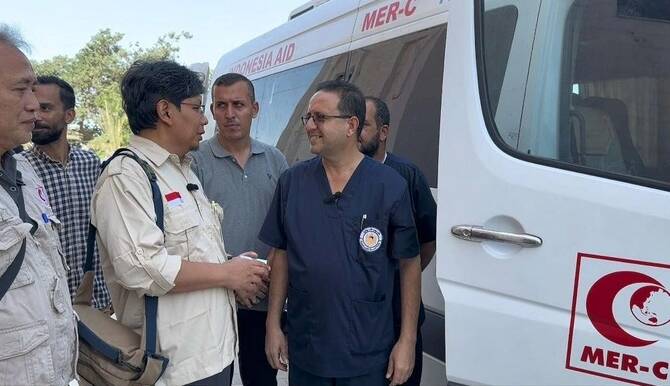
Dr. Marwan Al-Sultan, director of the Indonesia Hospital in Gaza, right, receives Indonesian medical volunteers from the Jakarta-based Medical Emergency Rescue Committee in Gaza, Sept. 10, 2024. (MER-C)
Short Url
Updated 03 July 2025
Follow

Shock in Jakarta, MPs demand action after Israel assassinates Indonesian hospital director

  • Dr. Marwan Al-Sultan, renowned cardiac surgeon, was killed in targeted Israeli airstrike
  • Israel has killed at least 492 doctors and health workers in Gaza since October 2023

JAKARTA/DUBAI: Israel’s assassination of Dr. Marwan Al-Sultan, director of the Indonesian hospital in northern Gaza, has sparked shock in Jakarta, with parliamentarians calling for new international accountability mechanisms to hold Israel legally responsible for its crimes in Gaza.

A renowned cardiac surgeon and one of Palestine’s most senior doctors, Dr. Al-Sultan graduated from Liaquat University of Medical and Health Sciences in Hyderabad, Pakistan, in 2001.

He was killed along with his wife and children in an Israeli airstrike on their temporary residence in northern Gaza on Wednesday.

His surviving daughter, Lubna, told the media that the missile “targeted his room exactly, right where he was.” Her testimony confirmed statements from the Gaza Ministry of Health and the Jakarta-based Medical Emergency Rescue Committee — which funded the Indonesia Hospital in Beit Lahia — that the attack was a targeted assassination.

“The attack on Dr. Marwan was utterly savage and barbaric,” Dr. Sarbini Abdul Murad, chairman of MER-C’s board of trustees, told Arab News.

“It was a shock to hear the news. I couldn’t believe it. He was the only heart specialist left in the north. This is a huge loss.”

The Indonesia Hospital in Beit Lahia, one of the biggest health facilities in Gaza, was one of the first targeted by Israel when it started its deadly war on the Palestinian enclave in October 2023.

Dr. Al-Sultan had never left his post, remaining with patients through multiple Israeli offensives on the hospital and personally overseeing repairs to restore essential services, MER-C said in a statement recalling how in December 2024, he evacuated the facility while under Israeli siege.

The moment was recorded on a mobile phone, showing Dr. Al-Sultan leaving only after he had ensured the safety of every patient.

The Indonesia Hospital opened in late 2015. Coordinated by MER-C, its construction and equipment were financed from donations of the Indonesian people, with dozens of engineers and builders volunteering to design and build the facility and to prepare its operations.

The killing of Dr. Al-Sultan has spurred outcry in Indonesia, with the government issuing an official condemnation and lawmakers from the Committee for Inter-Parliamentary Cooperation calling on parliamentarians around the world to “push for international accountability mechanisms” to ensure that “crimes against humanity be immediately brought to international forums, including global parliamentary bodies, so that Israel can be held legally and morally accountable for its actions in Gaza.”

Israel has killed more than 56,000 Palestinians and wounded more than 133,000 others, since October 2023. The true death toll is feared to be much higher, with research published in The Lancet medical journal in January estimating an underreporting of deaths by 41 percent.

The study says the death toll may be even higher, as it does not include deaths caused by starvation, injury and lack of access to health care, caused by the Israeli military’s destruction of most of Gaza’s infrastructure and the blocking of medical and food aid.

Data from the UN and international health organizations shows that Israel has killed at least 492 doctors and medics in Gaza since October 2023.

Dr. Al-Sultan is the 70th health care worker to be killed in the last 50 days, according to Healthcare Workers Watch.

“He was a prominent medical figure, both as a heart specialist and director of the Indonesia Hospital,” Dr. Hadiki Habib, chairman of MER-C’s executive committee, told Arab News.

“We had feared that this could happen, but he had said that he would remain in Gaza and, if he were to be martyred, it would be in his homeland.”


Zelensky presses EU to tap Russian assets at crunch summit

Updated 3 sec ago
Follow

Zelensky presses EU to tap Russian assets at crunch summit

  • “Russian assets must be used to defend against Russian aggression and rebuild what was destroyed by Russian attacks. It’s moral. It’s fair. It’s legal,” Zelensky said
  • German Chancellor Friedrich Merz was among those agreeing strongly as he said there was “no better option“

Brussels: Ukrainian President Volodymyr Zelensky told EU leaders Thursday they had the “moral” and legal right to use frozen Russian assets to fund Kyiv — as pressure grew on key player Belgium to drop its opposition at a summit showdown.
The 27-nation bloc is scrambling to bolster its ally Ukraine, as US President Donald Trump pushes for a deal with President Vladimir Putin to end the fighting.
Officials have insisted leaders’ talks in Brussels will last as long as it takes to hammer out an agreement, saying both Ukraine’s survival — nearly four years into the war — and Europe’s credibility are at stake.
“We will not leave the European summit without a solution for the funding of Ukraine,” European Commission head Ursula von der Leyen said.
The EU’s executive wants to fund a loan to Ukraine by using frozen assets from Russia’s central bank, though it is holding on to a back-up plan for the bloc to raise the money itself.
The EU estimates Ukraine needs an extra 135 billion euros ($159 billion) to stay afloat over the next two years — with the cash crunch set to start in April.
Zelensky said Kyiv needed a decision on its financing by the end of the year and that the move could give it more leverage in talks to end the war.
“Russian assets must be used to defend against Russian aggression and rebuild what was destroyed by Russian attacks. It’s moral. It’s fair. It’s legal,” Zelensky said.
German Chancellor Friedrich Merz was among those agreeing strongly as he said there was “no better option.”
But Belgium’s Prime Minister Bart De Wever — who held talks with Zelensky on the sidelines — seemed unconvinced so far.
“I have not seen a text that could persuade me to give Belgium’s agreement,” he told Belgian lawmakers before the summit kicked off.
The vast bulk of the assets are held by international deposit organization Euroclear in Belgium, and the government fears it could face crippling financial and legal reprisals from Moscow.
EU officials say they have gone out of their way to allay Belgian worries and that multiple layers of protection — including guarantees from other member states — mean the risks are minimal.
“At this stage, the guarantees offered by the Commission remain insufficient,” De Wever said.

- Ukraine’s looming cash crunch -

In a bid to plug Kyiv’s yawning gap, the Commission has proposed tapping 210 billion euros of frozen assets, initially to provide Kyiv 90 billion euros over two years.
The unprecedented scheme would see the funds loaned to the EU, which would then loan them on to Ukraine.
Kyiv would then only pay back the “reparations loan” once the Kremlin compensates it for the damage.
In theory, other EU countries could override Belgium and ram the initiative through with a weighted majority, but that would be a nuclear option that few see as likely for now.
De Wever insisted that the EU should go for its alternative plan of raising money itself — but diplomats said that option had been shelved as it needed unanimity and Hungary was firmly against.
Bubbling close to the surface of the EU’s discussion are the US efforts to forge a deal to end the war.
Zelensky said Ukrainian and US delegations would hold new talks on Friday and Saturday in the United States.
He said he wanted Washington to give more details on the guarantees it could offer to protect Ukraine from another invasion.
“What will the United States of America do if Russia comes again with aggression?” he asked. “What will these security guarantees do? How will they work?“
