

Pakistan dismisses Indian rights abuse claims, accuses New Delhi of persecuting minorities

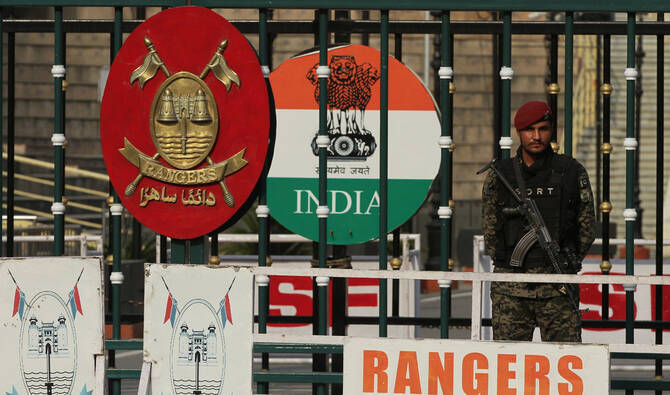
A Pakistan Ranger stands guard at the Pakistan-India joint check post at Wagah border, near Lahore, Pakistan on May 14, 2025. (REUTERS/File)
Short Url
Updated 03 July 2025
Follow

Pakistan dismisses Indian rights abuse claims, accuses New Delhi of persecuting minorities

  • The exchange between the two countries took place during at the United Nations General Assembly
  • Pakistan says New Delhi has ‘weaponized hate’ and ‘codified discrimination’ against its own people

ISLAMABAD: Pakistan has strongly rejected Indian allegations of minority rights violations, accusing New Delhi of persecuting its own citizens and “exporting chaos abroad,” the state-owned Associated Press of Pakistan (APP) news agency reported on Thursday.

The exchange took place during a debate in the United Nations General Assembly on the Responsibility to Protect (R2P), a global commitment aimed at preventing genocide, war crimes, ethnic cleansing and crimes against humanity.

Addressing the session, Pakistan’s Deputy Permanent Representative to the UN, Ambassador Usman Jadoon, criticized what he described as the selective application of the R2P doctrine, saying it had become “meaningless” in the face of the international community’s failure to prevent mass atrocities in Palestine and Indian-administered Kashmir.

India responded by accusing Pakistan of violating the rights of its minorities and being complicit in a recent militant attack in Pahalgam, in Indian-administered Kashmir.

Exercising her right of reply, Pakistani delegate Rabia Ijaz, a second secretary at Pakistan’s UN Mission, dismissed the accusations as “a textbook case of the perpetrator posturing as a victim.”

“A state that has weaponized hate, normalized mob violence and codified discrimination against its own citizens – and against those it occupies – has no moral standing to speak on the Responsibility to Protect,” the APP quoted her as saying.

Ijaz went on to describe India as a “majoritarian autocracy,” where minorities, particularly Muslims, Christians and Dalits, face discrimination.

“Lynching is met with silence,” she continued. “Bulldozers become tools of collective punishment. Mosques are razed. Citizenship is denied based on religion.”

“This is not the protection of people,” she added. “This is their persecution, sanctified by law and celebrated by power.”

Ijaz maintained India had launched an “unprovoked and deliberate” cross-border attack on civilian areas in Pakistan earlier this year in May, killing 35 people.

“R2P cannot become a slogan for serial violators to hide behind,” she said. “It cannot be invoked by those who deny rights at home and export chaos abroad.”

India and Pakistan have long been at odds with each other, though diplomatic tensions have intensified in recent years.

The two nuclear-armed neighbors have repeatedly traded barbs at international forums particularly after their relationship deteriorated following the recent four-day military standoff, one of the most serious flare-ups in several decades.


UN says 270,000 Afghans have returned from Iran, Pakistan this year

Updated 10 March 2026
Follow

UN says 270,000 Afghans have returned from Iran, Pakistan this year

  • UNHCR says 110,000 Afghans returned from Iran while 160,000 returned from Pakistan since start of 2026
  • Return numbers seem to have risen since Gulf war erupted on Feb. 28, says UNHCR official in Afghanistan

GENEVA: Some 270,000 Afghans have returned to their country from Pakistan and Iran so far this year, the UN said Tuesday, warning that the escalating Middle East war risked pushing the numbers higher.

UNHCR, the United Nations’ refugee agency, said that 110,000 Afghans had returned from Iran and another 160,000 had returned from Pakistan since the start of 2026.

And the numbers seem to have risen since the Middle East erupted on February 28, with the United States and Israel unleashing a barrage of strikes on Iran, and Tehran responding with drone and missile strikes on Israeli and US interests across the region.

Since then, there have been some 1,700 returns from Iran to Afghanistan each day, Arafat Jamal, UNHCR’s representative in Afghanistan, told reporters in Geneva.

Speaking from Islam Qala, on the Afghan-Iranian border, he said the situation there was “deceptively calm.”

“Returns are orderly but freighted with tension and apprehension,” he said, adding that with the hostilities elsewhere escalating, “I do fear there is more to come.”

“We are preparing for massive returns.”

He pointed out that Afghanistan was “facing the ramifications of what is happening with Iran,” while clashes have erupted along the Afghan border with Pakistan.

The new Middle East war, he warned, was “layering itself on top of an existing war on another frontier,” Jamal said.

UNHCR highlighted that the latest crises came after returns to Afghanistan had already been “exceptionally high” in recent years.

More than five million Afghans had returned from neighboring countries in the past two years, including 1.9 million returning from Iran last year alone.

Jamal warned that “many Afghan families are now facing cycles of displacement: first forced to flee Afghanistan, later displaced again inside Iran due to conflict, and now returning once more to Afghanistan.”

“And upon return in Afghanistan, the triply-displaced enter a spiral of precarity and uncertainty.”
Returns from Pakistan had meanwhile stabilized in recent weeks, as the main crossing point at Torkham remained closed due to the tensions there, Jamal said.

But he warned that “movements could increase sharply once the border reopens.”

UNHCR and the UN children’s agency UNICEF said Tuesday they were working to strengthen their capacity to operate at the borders and within Afghanistan.

But “given the scale of returns and the financial constraints facing humanitarian operations, additional support will be needed if arrivals increase,” UNHCR said, without specifying the amount needed.