

Pakistan PM Sharif in Azerbaijan for ECO summit focused on climate, trade

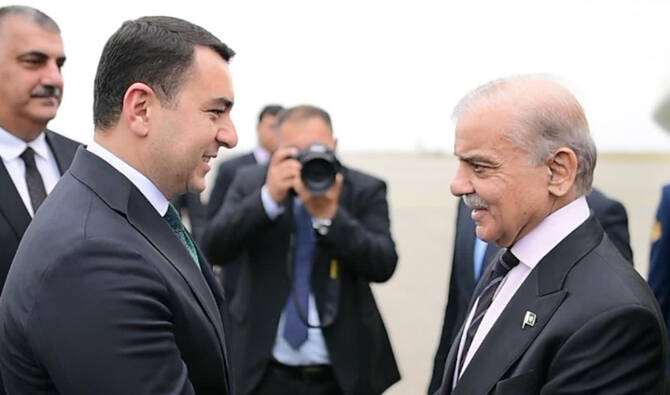
Azerbaijan Minister of Culture Adil Karimli (left) receives Pakistan Prime Minister Shehbaz Sharif upon his arrival at Fuzuli Airport in Shusha, Azerbaijan, on July 3, 2025, for a two-day official visit to attend the 17th ECO Summit. (Handout/PMO)
Short Url
Updated 03 July 2025
Follow

Pakistan PM Sharif in Azerbaijan for ECO summit focused on climate, trade

  • Regional leaders gather in Baku to discuss sustainable development, connectivity
  • PM Sharif expected to reaffirm Pakistan’s commitment to ECO Vision 2025

ISLAMABAD: Pakistani Prime Minister Shehbaz Sharif will be in Azerbaijan from today, Thursday, to attend the two-day 17th Economic Cooperation Organization (ECO) summit in Baku, where regional leaders will meet to discuss sustainable growth, climate resilience and increased intra-regional trade.

The theme of this year’s summit is “New ECO Vision for a Sustainable and Climate Resilient Future.” The ECO is a 10-member regional bloc comprising countries from Central and South Asia, the Caucasus, and the Middle East.

According to a report published in state broadcaster Radio Pakistan, Sharif will lead the Pakistani delegation and “share Pakistan’s perspective on key regional and global challenges.”

The report said he will also “reaffirm Pakistan’s commitment to the ECO Vision 2025 and advocate for enhanced intra-regional trade, transport connectivity, energy cooperation, and sustainable development.”

On the sidelines of the summit, Sharif is scheduled to hold bilateral meetings with other ECO leaders to discuss matters of mutual interest.

This marks Sharif’s second visit to Azerbaijan this year. He last traveled to Baku in May 2025, where he met with Azerbaijani President Ilham Aliyev and discussed deepening bilateral cooperation in energy and trade.

The ECO was established in 1985 by Iran, Turkiye, and Pakistan, and was expanded later to include Afghanistan, Azerbaijan, Kazakhstan, Kyrgyzstan, Tajikistan, Turkmenistan, and Uzbekistan. The organization aims to promote economic, technical, and cultural cooperation among member states.


Pakistan, China ink 24 agreements to develop digital corridor for IT cooperation

Updated 4 sec ago
Follow

Pakistan, China ink 24 agreements to develop digital corridor for IT cooperation

  • Both countries sign one government-to-government, seven government-to-business and 16 business-to-business MoUs
  • Digital corridor will create new avenues for Pakistani tech companies, expand cooperation with China in ICT, says state media

ISLAMABAD: Pakistan and China have signed 24 agreements to develop a digital corridor aimed at enhancing information technology (IT) cooperation between the two states, state-run media reported on Monday. 

The memoranda of understanding between the two sides were signed in Beijing, according to the state-owned Associated Press of Pakistan (APP). 

The MoUs include one government-to-government, seven government-to-business and 16 business-to-business agreements.

“The initiative focuses on developing an innovative and pragmatic digital corridor to enhance cooperation in the IT industry,” APP reported. 

APP said the digital corridor will create new avenues for Pakistani tech companies and expand bilateral cooperation with China in the information and communication technology infrastructure development.

The development is in line with Pakistan’s recent efforts to boost IT exports and enhance digital cooperation with regional allies. 

In November, Pakistan highlighted the “Digital Silk Road” as the next major phase of the China–Pakistan Economic Corridor (CPEC) while proposing new technology partnerships with Beijing, including joint ventures in 5G/6G, hardware manufacturing and ICT components. 

Launched in 2015, CPEC is a multibillion-dollar connectivity program linking western China to the Arabian Sea. The initiative has historically focused on energy projects, highways, power plants and the Gwadar port, with committed investments estimated at around $60 billion. 

As the two countries enter CPEC’s second phase, cooperation is expanding beyond physical infrastructure into technology, digital governance, manufacturing and skills development.

The Digital Silk Road is Beijing’s framework for cross-border connectivity in fiber, cloud services, data routing, smart manufacturing and emerging technologies. It is increasingly positioned as the backbone of CPEC’s next stage.