

Hindu pilgrimage begins at Kashmir site where April attack triggered brief war with Pakistan

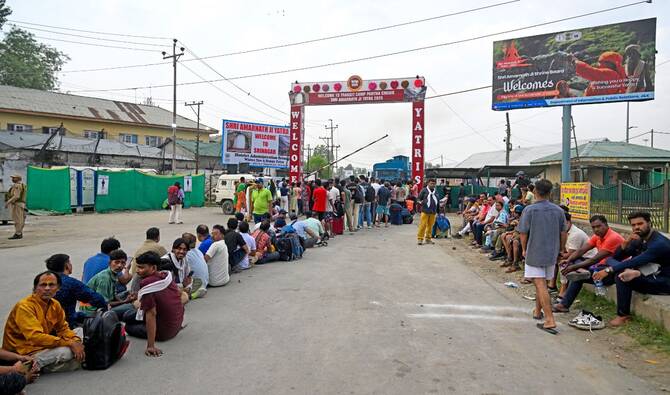
Hindu pilgrims await their registration at a transit camp in Pantha Chowk on the outskirts of Srinagar on July 2, 2025, ahead of the annual Amarnath pilgrimage. (AFP)
Short Url
Updated 03 July 2025
Follow

Hindu pilgrimage begins at Kashmir site where April attack triggered brief war with Pakistan

  • Last year, half a million devotees took part in the Amarnath pilgrimage to a cave above the town of Pahalgam
  • Pahalgam is site where April 22 attack killed 26 tourists, unleashing brief but intense war with neighboring Pakistan

PAHALGAM, India: Hindus began a vast month-long pilgrimage in contested Indian Kashmir on Thursday, with many of the faithful starting from near the site where a deadly April attack triggered conflict with Pakistan.

Last year, half a million devotees took part in the Amarnath pilgrimage to a sacred ice pillar located in a cave in the forested Himalayan hills above the town of Pahalgam.

Pahalgam is the site where gunmen on April 22 killed 26 mostly Hindu tourists.

New Delhi said the gunmen were backed by Pakistan, claims Islamabad rejected — triggering a series of tit-for-tat diplomatic measures that escalated into a four-day conflict.

It was the worst standoff by the nuclear-armed nations since 1999, with more than 70 people killed in missile, drone and artillery fire on both sides, before a May 10 ceasefire.

But pilgrim Muneshwar Das Shashtri, who traveled from Uttar Pradesh state, told AFP “there is no fear of any kind.”

“Our army is standing guard everywhere. No one can raise a finger toward us,” he said.

India has ramped up security for the event, deploying 45,000 troops with high-tech surveillance tools overseeing the grueling trek to reach the high-altitude cave, dedicated to the Hindu deity of destruction Shiva.

“We have multi-layered and in-depth security arrangements so that we can make the pilgrimage safe and smooth for the devotees,” said VK Birdi, police chief for the Muslim-majority territory.

At Pahalgam, soldiers have turned a tented base camp into a fortress encircled by razor wire.

Troops in newly deployed armored cars, or from gun positions behind sandbags, keep a close watch — efforts boosted by facial recognition cameras.

“High-quality surveillance cameras have been installed at all major points along the route,” said Manoj Sinha, the Indian-appointed top administrator for Jammu and Kashmir.

All pilgrims must be registered and travel in guarded vehicle convoys, until they start out to walk.

Camouflaged bunkers have been erected in the forests along the route, where dozens of makeshift kitchens provide free food.

Electronic radio cards pinpoint their location.

Pilgrims can take several days to reach the cave, perched at 3,900 meters (12,800 feet) high, around 30 kilometers (18 miles) uphill from the last easily motorable track.

“Whatever the attack that was carried out here, I am not afraid. I have come to get a glimpse of baba (the ice formation)” said Ujwal Yadav, 29, from India’s Uttar Pradesh state, undertaking his first pilgrimage to the shrine.

“Such are the security arrangements here that no one can be hurt.”

Sinha has said that “public confidence is returning,” but admits that pilgrim registration had dipped by 10 percent this year.

Once a modest, little-known ritual, attended by only a few thousand mainly local devotees, the pilgrimage has grown since an armed insurgency erupted in 1989.

India’s government has since heavily promoted the annual event, which runs until August 9.

Rebels fighting against India’s control of Kashmir have said the pilgrimage is not a target, but have warned they would act if it was used to assert Hindu dominance.

In 2017, suspected rebels attacked a pilgrim bus, killing 11 people.

The gunmen who carried out the April 22 killings remain at large, despite the manhunt by security forces in Kashmir where India has half a million soldiers permanently deployed.

On June 22, India’s National Investigation Agency said two men had been arrested from the Pahalgam area who they said had “provided food, shelter and logistical support” to the gunmen.

Indian police have issued wanted notices for three of the gunmen, two of whom they said were Pakistani citizens. Pakistani has rejected the claim.


Pakistan, Japan discuss boosting trade, investment and cooperation in key sectors

Updated 17 January 2026
Follow

Pakistan, Japan discuss boosting trade, investment and cooperation in key sectors

  • The Pakistani side highlighted various opportunities in sectors minerals and mining, agricultural and agri-food products, and IT sectors
  • The development comes as Pakistan steps up economic diplomacy to expand trade, investment ties after emerging from a financial crisis

ISLAMABAD: Pakistan and Japan have held talks on improving bilateral trade and investment and expanding cooperation in key sectors, Pakistan’s Press Information Department said on Saturday.

Both countries held the 8th Pakistan–Japan Government–Business Joint Dialogue and the Pakistan Business Forum in Tokyo on Friday, marking the first convening of the dialogue in the Japanese capital since Dec. 2018.

The dialogue was co-chaired by Prime Minister Shehbaz Sharif’s aide on commerce Rana Ihsaan Afzal Khan and Takuo Komori, Japan’s parliamentary vice-minister of economy, trade and industry, according to the PID.

The two sides exchanged views on strengthening bilateral economic relations, with a focus on improving the trade and investment environment and advancing practical cooperation.

“The Pakistani side outlined Pakistan’s economic priorities and highlighted opportunities for collaboration in sectors such as minerals and mining, agricultural and agri-food products, and information technology,” the PID said in a statement.

“The Japanese side shared perspectives on the operating environment for Japanese companies in Pakistan and discussed areas where continued engagement and follow-up could further facilitate business activity.”

Pakistan steps up economic diplomacy to expand trade ties and attract foreign capital after emerging from a prolonged financial crisis that nearly pushed it into default in mid-2023. Islamabad has since set up the Special Investment Facilitation Council (SIFC), a civil-military body designed to cut red tape and provide a one-window operation for businesses, as it navigates a long path to economic recovery under a $7 billion International Monetary Fund (IMF) program.

Pakistan and Japan established diplomatic and economic relations in 1952. Since then, Japan has been a major development partner, financing infrastructure such as roads, power plants and water systems, while extending technical assistance and yen loans.

The Pakistan–Japan Government–Business Joint Dialogue brought together senior officials and private-sector representatives from both countries, including members of the Pakistan–Japan Business Forum (PJBF) and the Japan–Pakistan Business Co-operation Committee (JPBCC).

Participants reaffirmed the importance of sustained government-to-government engagement, supported by close coordination with the private sector, to advance mutually beneficial economic cooperation between Pakistan and Japan, according to the statement.

Following the Joint Dialogue, the Pakistan Business Forum, co-organized by the Embassy of Pakistan in Tokyo and the Japan External Trade Organization (JETRO), was held in Tokyo that was attended by Japanese and Pakistani business leaders.

The Forum featured selected sectoral presentations highlighting practical cooperation between Japanese and Pakistani partners. It included a presentation by the Trade and Investment Counsellor of the Embassy of Pakistan in Tokyo on “From Trade to Investment: Building Japan–Pakistan Joint Value Chains.”

“The Forum concluded with closing remarks by Mr. Abdul Hameed, Ambassador of Pakistan to Japan, who highlighted the importance of sustained engagement, trust-building, and long-term partnership in advancing Pakistan–Japan economic cooperation,” the PID added.