Pakistan says citizens can register for Hajj 2026 through online portal, 15 designated banks

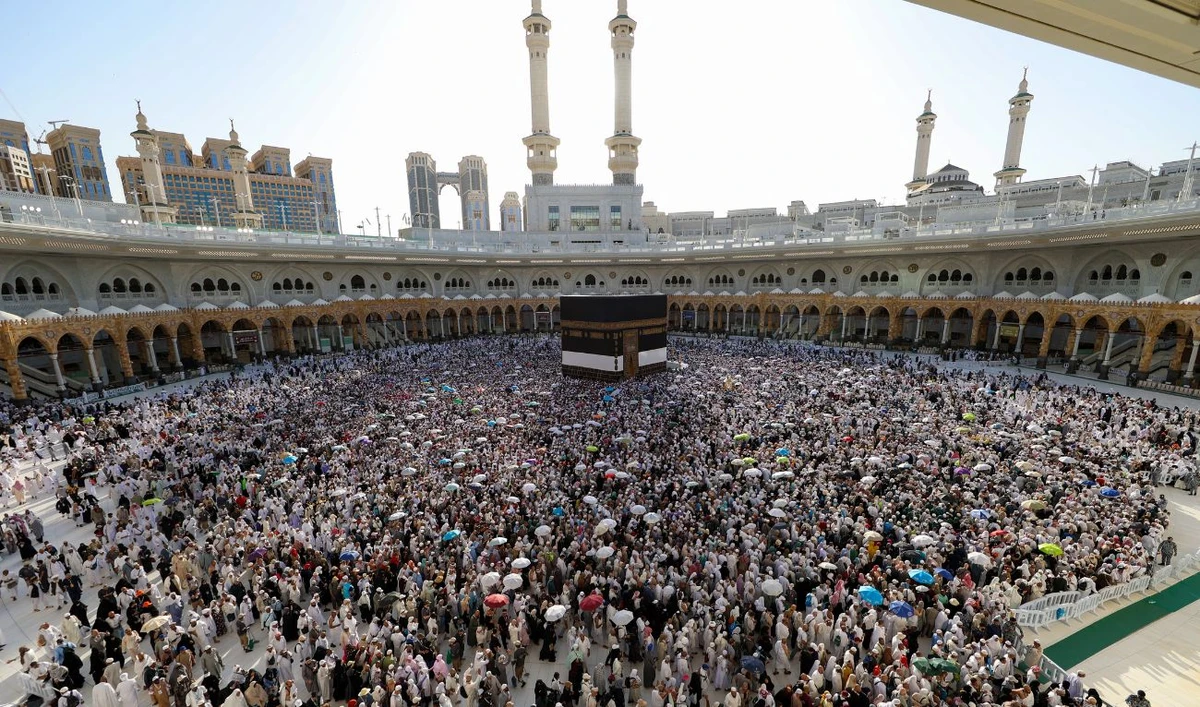
Muslims pray around the Kaaba, Islam's holiest shrine, at the Grand Mosque complex in in the holy city of Mecca on the first day of Eid Al-Adha, the feast of the sacrifice, early on June 6, 2025. (AFP/ file)
Short Url
Updated 02 July 2025
Follow

Pakistan says citizens can register for Hajj 2026 through online portal, 15 designated banks

  • Religion ministry advises overseas Pakistanis holding Pakistani passport to complete registration through online portal at the earliest
  • Pilgrims can register for Hajj next year till July 9, says ministry, after which they can choose to opt for government or private scheme

ISLAMABAD: The registration process for Hajj 2026 is underway, Pakistan’s religion ministry said on Wednesday, informing citizens that they can do so via its online portal and 15 designated banks across the country. 

Pakistan’s Ministry of Religious Affairs (MoRA) said last week it has begun the registration process for next year’s Hajj pilgrimage. After the registration, which will continue till July 9, pilgrims will be able to opt for government or private Hajj scheme. No fee will have to be paid for Hajj registration.

“Overseas Pakistanis holding a valid Pakistani passport are also advised to complete their registration through the online portal as soon as possible,” MoRA said in a statement. 

The ministry further said it was mandatory for anyone who intended to travel from Pakistan for the pilgrimage to get themselves registered.

“The costs of the Hajj package and other terms and conditions will be announced separately in accordance with the Hajj Policy 2026,” the statement said. 

Pakistan received a quota of 179,210 pilgrims from Saudi Arabia for Hajj 2025, which was evenly divided between government and private Hajj operators.

While the government filled its full allocation of over 88,000 pilgrims, a major portion of the private quota remained unutilized due to delays by companies in meeting payment and registration deadlines.

Last month, Prime Minister Shehbaz Sharif directed the religious affairs ministry to begin preparations for the 2026 Hajj immediately, calling for urgent reforms to the country’s private Hajj scheme.

IMF board to meet tomorrow to consider $1.2 billion disbursement for Pakistan

Updated 11 sec ago
Follow

IMF board to meet tomorrow to consider $1.2 billion disbursement for Pakistan

  • Pakistan, IMF reached a Staff-Level Agreement for second review of $7 billion loan program 
  • Economists view disbursement crucial for cash-strapped Pakistan as it tackles economic crisis

ISLAMABAD: The International Monetary Fund’s (IMF) Executive Board will meet tomorrow, Monday, to consider and approve a $1.2 billion disbursement for Pakistan, according to the global lender’s official schedule. 

The meeting takes place nearly two months after the Fund reached a Staff-Level Agreement (SLA) with Pakistan for the second review of its $7 billion Extended Fund Facility (EFF) and the first review of its $1.4 billion Resilience and Sustainability Facility (RSF). 

The SLA followed a mission led by IMF’s Iva Petrova, who held discussions with Pakistani authorities during a Sept. 24–Oct. 8 visit to Karachi, Islamabad and Washington, DC.

“The International Monetary Fund’s (IMF) Executive Board will convene on Dec. 8 to consider Pakistan’s request for a $1.2 billion disbursement under the Extended Fund Facility (EFF) and the Resilience and Sustainability Facility (RSF), according to the Fund’s updated schedule,” the state-run Pakistan TV reported on Sunday.

Economists view IMF’s bailout packages as crucial for cash-strapped Pakistan, which has relied heavily on financing from bilateral partners such as Saudi Arabia, China and the United Arab Emirates, as well as multilateral lenders including the IMF, World Bank, Asian Development Bank and Islamic Development Bank. 

The South Asian country has been grappling with a prolonged macroeconomic crisis that has drained its financial resources and triggered a balance of payments crisis. Islamabad, however, has recorded some financial gains since 2022, which include recording a surplus in its current account and bringing inflation down considerably. 

Speaking to Arab News last month, Pakistan’s former finance adviser Khaqan Najeeb said the $1.2 billion disbursement will further stabilize Pakistan’s near-term external position and unlock additional official inflows. 

“Continued engagement also reinforces macro stability, as reflected in recent improvements in inflation, the current account, and reserve buffers,” Najeeb said. 

Pakistan came close to sovereign default in mid-2023, when foreign exchange reserves fell below three weeks of import cover, inflation surged to a record 38 percent in May, and the country struggled to secure external financing after delays in its IMF program. Fuel shortages, import restrictions, and a rapidly depreciating rupee added to the pressure, while ratings agencies downgraded Pakistan’s debt and warned of heightened default risk.

The crisis eased only after Pakistan reached a last-minute Stand-By Arrangement with the IMF in June 2023, unlocking emergency support and preventing an immediate default.