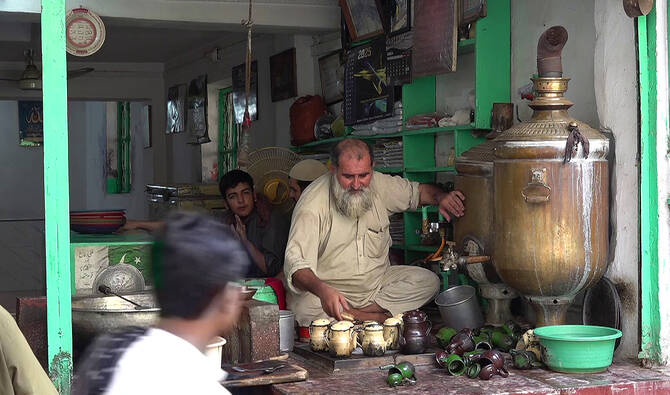

PESHAWAR: In a narrow alley of Peshawar’s ancient Qissa Khwani Bazaar, the scent of cardamom lingers in the air, mingling with curls of steam rising from a pair of brass samovars.
Inside a dimly lit tea shop, surrounded by chipped green and yellow teapots, 68-year-old Fazl Rehman tends to his regulars — and to history.
Known locally as Qehwa Khana, this modest establishment has been serving green tea, or qehwa, to traders, travelers, and townsfolk for more than a century. Oral tradition suggests the shop is 120 to 130 years old, one of the last remaining tea houses in what was once a vital rest stop for merchants journeying between India and Central Asia.
“First, my father ran this [tea house],” Rehman said.
“He died at 120 years of age, then I started working here. Now, I have run this business for 58 years.”

A man pours tea at a 120-year-old tea house at ancient Qissa Khwani Bazaar in Peshawar, Pakistan, on June 28, 2025. (AN photo)
The Qissa Khwani Bazaar, or the “Storytellers’ Bazaar,” harks back to a time when tea houses like Rehman’s were gathering spots where storytellers would recite fables and news by lamplight to caravans camped for the night behind Peshawar’s once-gated walls.
As Rehman recalled, in those days trade caravans from India and Afghanistan would reach Peshawar just before the city gates were locked at dusk. They would camp nearby, sip qehwa into the early hours and listen to stories from traveling bards.
“With the morning prayer, the gates would open and the caravans would move on to Lahore, then Amritsar, and into India,” Rehman said.
“In the past, this hall would be covered with grass or dry pine needles. We would bring it from our village, Mohmand. We would place the grass or pine needles on the ground for people to sit on.”
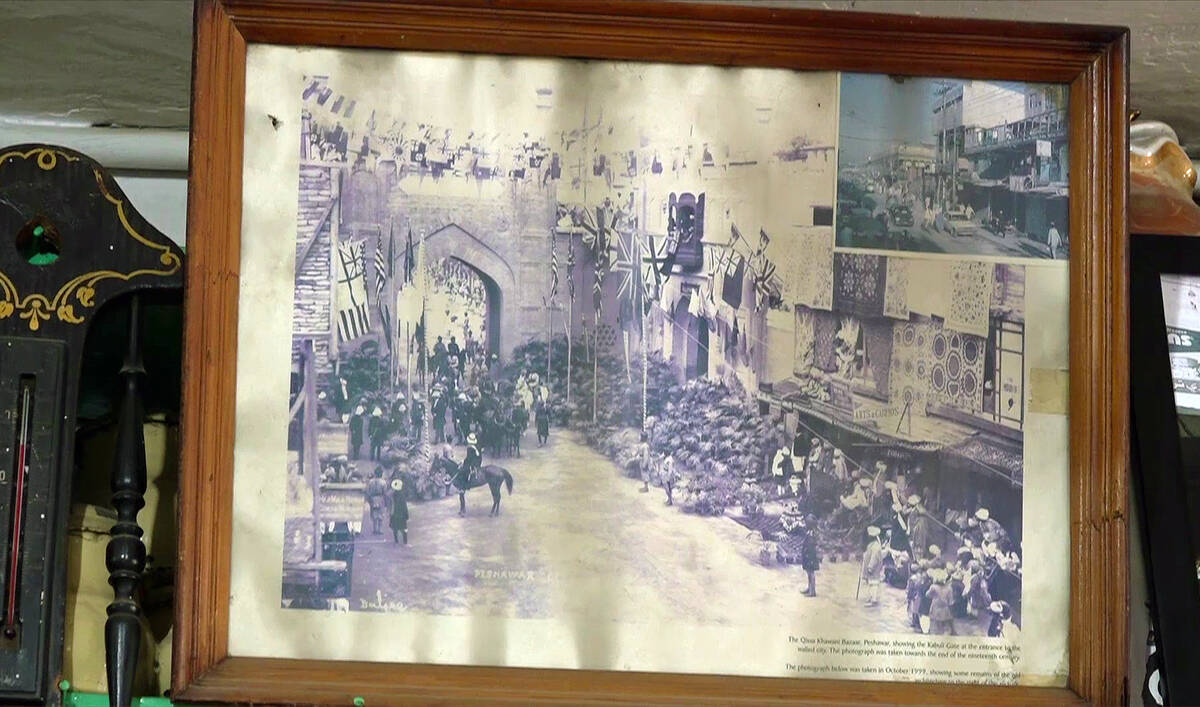
An old picture of Qissa Khwani Bazaar hangs at the Qehwa Khana in Peshawar, Pakistan, on June 28, 2025. (AN photo)
Today, the storytellers are gone, but Qehwa Khana endures, its appeal now extending far beyond Peshawar.
Rehman said tourists from countries as distant as Japan, England, Holland, and Indonesia have visited his shop to experience the unique atmosphere and sample its tea, brewed in large kettles using an age-old method.
“It is prepared through a process,” explained Muhammad Amir, a 55-year-old teamaker.
“This brass samovar is used to heat water and when the water boils, we fill the teapot... then we place it here [on the stove], boil it further, and add qehwa leaves, sugar, and cardamom. And the qehwa is ready.”
A regular teapot, typically enough for two cups, costs about Rs50 ($0.18), making it not only a cultural staple, but also one of the most affordable pleasures in the city.
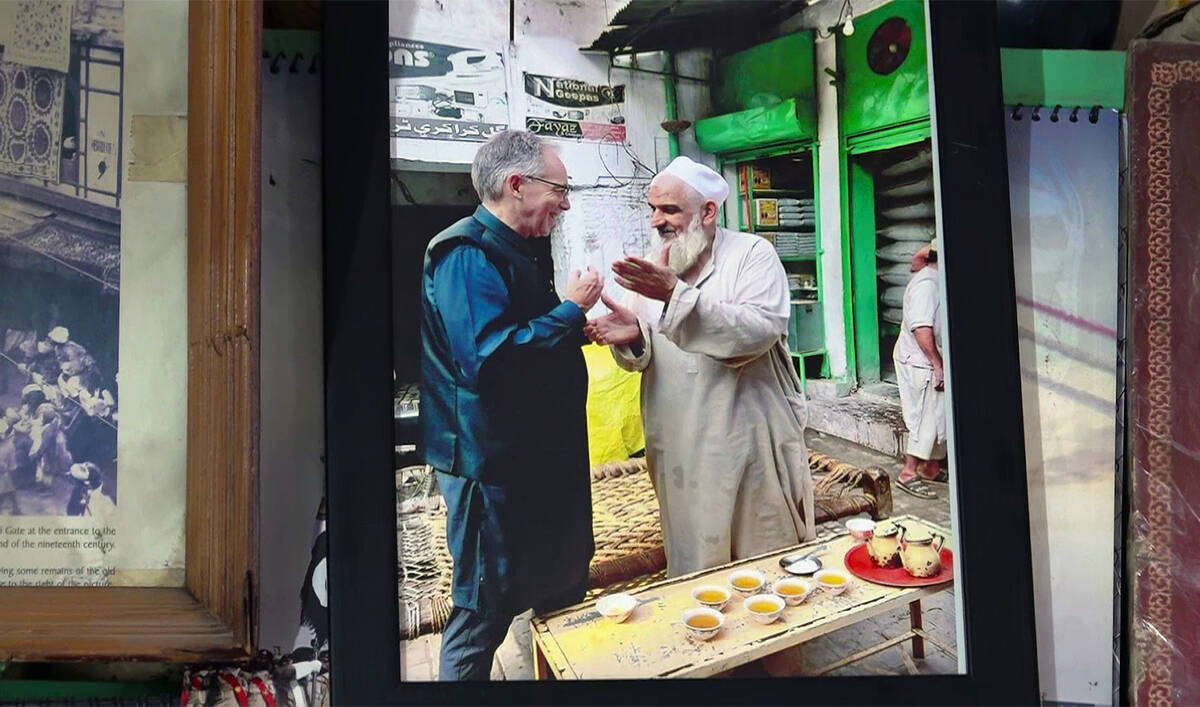
A picture of a foreign visitor to the Qehwa Khana hangs at the tea house in Peshawar, Pakistan, on June 28, 2025. (AN photo)
SYMBOL OF HOSPITALITY
Tea culture holds deep roots in Pakistan, particularly in the northwestern Khyber Pakhtunkhwa province, where green tea, often sweetened and spiced, is a daily ritual for many. Peshawar’s old city is especially famous for its qehwa culture, where gatherings over tea are woven into the social and political fabric of everyday life.
Qehwa also remains a symbol of hospitality, often served to guests as a sign of respect, and visitors continue to trickle into Qehwa Khana, some drawn by nostalgia, others by curiosity.
Said Maluk, a native of Kurram now living in Peshawar, brought a friend recently after shopping at the market.
“I told him [friend] we would go to the famous Qehwa Khana in Qissa Khwani… we had tea and felt relaxed. Now we will go on our way,” Maluk said.
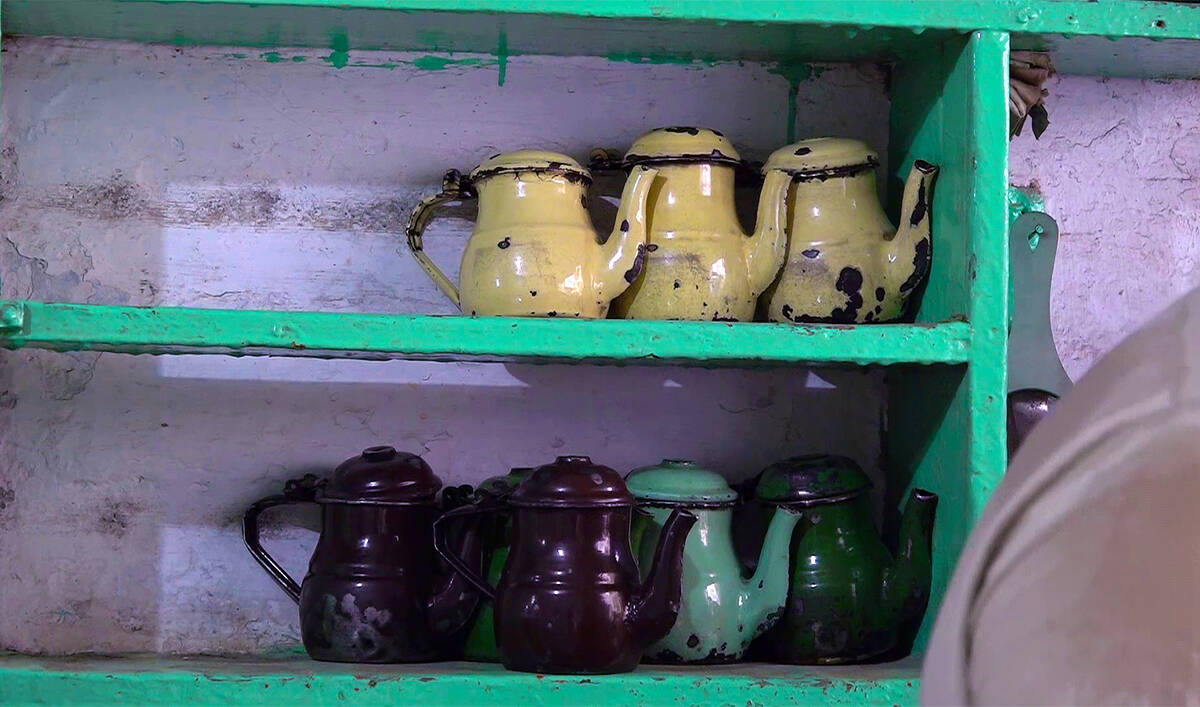
Tea pots are stacked at the Qehwa Khana in Peshawar, Pakistan, on June 28, 2025. (AN photo)
For many, sipping qehwa in the bazaar is about more than refreshment, but a return to simpler times.
“I have been coming here since childhood,” said Nargas Khan, a 65-year-old resident of the city. “I used to ride a rickshaw and do labor work in the city. After finishing my work, I would come here and drink tea. I would buy sweets from a nearby place and eat them here.”
“Now, when I come, it reminds me of my childhood and youth. We would place our cap here, coming happily. We have spent a quality life here.”