

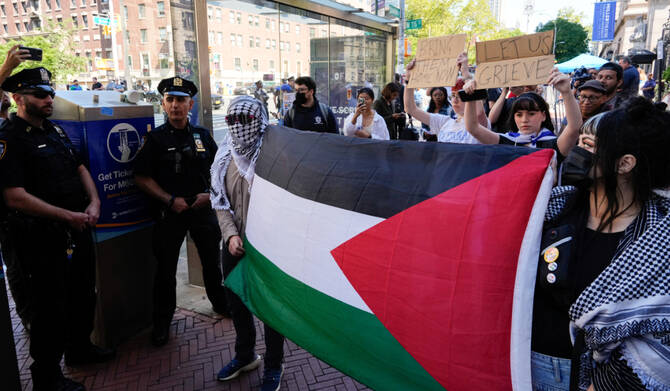
Pro-Palestinian Georgetown student can remain free, US appeals court rules

Human rights advocates have raised free speech and due process concerns over the administration’s actions toward these students. (REUTERS)
Short Url
Updated 02 July 2025
Follow

Pro-Palestinian Georgetown student can remain free, US appeals court rules

  • Suri, 41, was arrested in Virginia in March and then moved by the US government to Texas, where he was released in May after the ruling by Giles
  • The Trump administration has attempted to deport foreign pro-Palestinian student protesters while accusing them of being antisemitic, threats to American foreign policy and extremist sympathizers

WASHINGTON: A pro-Palestinian Georgetown University student from India, detained by President Donald Trump’s administration but then released on a judge’s order, can remain free while fighting deportation efforts, a US appeals court ruled on Tuesday.
A three-judge panel of the Richmond, Virginia-based 4th US Circuit Court of Appeals ruled 2-1 against the administration’s request that Badar Khan Suri be returned to immigration detention. The 4th Circuit said it found no grounds to overturn the decision by US District Judge Patricia Tolliver Giles to order Suri’s release.
“To allow the government to undermine habeas jurisdiction by moving detainees without notice or accountability reduces the writ of habeas corpus to a game of jurisdictional hide-and-seek,” Judge James Andrew Wynn wrote on Tuesday.
Habeas corpus refers to a procedure under which the legality of a person’s incarceration can be challenged in court.
Suri, 41, was arrested in Virginia in March and then moved by the US government to Texas, where he was released in May after the ruling by Giles. Suri is a postdoctoral fellow at Georgetown’s Alwaleed Bin Talal Center for Muslim-Christian Understanding, part of the Jesuit university’s School of Foreign Service.
The Trump administration has attempted to deport foreign pro-Palestinian student protesters while accusing them of being antisemitic, threats to American foreign policy and extremist sympathizers. Suri has denied the US government’s allegations that he spread Palestinian militant propaganda and antisemitism on social media. Protesters, including some Jewish groups, have said the US government has conflated criticism of Israel’s military assault in Gaza with antisemitism and advocacy for Palestinian rights with support for extremism. Human rights advocates have raised free speech and due process concerns over the administration’s actions toward these students. Other pro-Palestinian students who were arrested by the government and subsequently released under judicial orders include Columbia University students Mahmoud Khalil and Mohsen Mahdawi and Tufts University student Rumeysa Ozturk.
Suri’s wife, Mapheze Saleh, is a US citizen. Saleh is from Gaza, according to the Georgetown University website, which said she has written for Al Jazeera and Palestinian media outlets and worked with the foreign ministry in Gaza. Saleh was not arrested.


Teenage preacher to alleged mass killer: Bondi attack suspect’s background emerges

Updated 5 sec ago
Follow

Teenage preacher to alleged mass killer: Bondi attack suspect’s background emerges

SYDNEY/MANILA: Standing in the rain outside a suburban Sydney train station, seventeen-year-old Naveed Akram stares into the camera and urges those watching to spread the word of Islam.
“Spread the message that Allah is One wherever you can ... whether it be raining, hailing or clear sky,” he said.
Another since-deleted video posted in 2019 by Street Dawah Movement, a Sydney-based Islamic community group, shows him urging two young boys to pray more frequently.
Authorities are now trying to piece together what happened in the intervening six years that led a teenager volunteering to hand out pamphlets for a non-violent community group to allegedly carry out Australia’s worst mass shooting in decades.
Akram, who remains under heavy guard in hospital after being shot by police, was briefly investigated by Australia’s domestic intelligence agency in 2019 for links to individuals connected to Islamic State, but authorities found he did not have extremist tendencies at the time.
“In the years that followed, that changed,” Home Affairs Minister Tony Burke said on Tuesday.
Police have not formally identified Naveed Akram, 24, as one of the alleged gunmen who killed 15 people at a Jewish event on a Sydney beach on Sunday. His father Sajid Akram, 50, is the other gunman who was shot and killed by police, local media reported.
Officials have said the second gunman is the deceased man’s son and is in a critical condition in hospital.

MOTIVATED BY DAESH
Prime Minister Anthony Albanese said on Tuesday the attack was likely motivated by the ideology of Daesh, but that the two men appeared to have acted alone.
Homemade Daesh flags were found in the suspects’ car after Sunday’s attack, and police said on Tuesday the pair had last month visited the Philippines, where offshoots of the militant group have a presence.
A spokesperson for the Philippines Bureau of Immigration said Akram, an Australian national, arrived in the country on November 1 with his father, who was traveling on an Indian passport.
Both reported Davao as their final destination, the main city on Mindanao island, which has a history of Islamist insurgency. A months-long conflict on the island in 2017 between armed forces and two militant groups linked to IS left over a thousand dead and a million displaced, though the country’s military says these groups are now fragmented and weakened.
The pair left the Philippines on November 28, two weeks before Sunday’s attack using high-powered shotguns and rifles.

’NEVER DID ANYTHING UNUSUAL’
Local media reported that Akram, an unemployed bricklayer, attended high school in Cabramatta, a suburb around 30 kilometers by road from Sydney’s central business district and close to the family’s current home in Bonnyrigg, which was raided by police after the attacks.
“I could have never imagined in 100 years that this could be his doing,” former classmate Steven Luong told The Daily Mail.
“He was a very nice person. He never did anything unusual. He never even interrupted in class.”
After leaving school, Akram showed a keen interest in Islam, seeking tutoring and attending several Street Dawah Movement events. The group confirmed he appeared in the videos.
“We at Street Dawah Movement are horrified by his actions and we are appalled by his criminal behavior,” the group said in a statement, adding Akram had attended several events in 2019 but was not a member of the organization.
Months after the videos were posted, Akram approached tutor Adam Ismail seeking tuition in Arabic and the Qur'an, studying with him for a combined period of one year.
Ismail’s language institute posted a photo in 2022, since deleted, showing Akram smiling while holding a certificate in Qur'anic recitation.
“Not everyone who recites the Qur'an understands it or lives by its teachings, and sadly, this appears to be the case here,” Ismail said in a video statement late on Monday.
“I condemn this act of violence without hesitation.”

EARLIER TIES TO DAESH NOT PROVEN
Two of the people he was associated with in 2019 were charged and went to jail but Akram was not seen at that time to be a person of interest, Albanese said.
However he was radicalized, Akram’s journey from a teenager interested in Islam to one of Australia’s worst alleged killers has taken not just the public, but also law enforcement by surprise.
“We are very much working through the background of both persons,” New South Wales Police Commissioner Mal Lanyon told reporters on Monday.
“At this stage, we know very little about them.”