KARACHI: Pakistan has reported 14th case of polio virus this year in the northwestern Khyber Pakhtunkhwa (KP) province, the country’s polio program said on Tuesday, amid intensifying efforts to eradicate the disease.
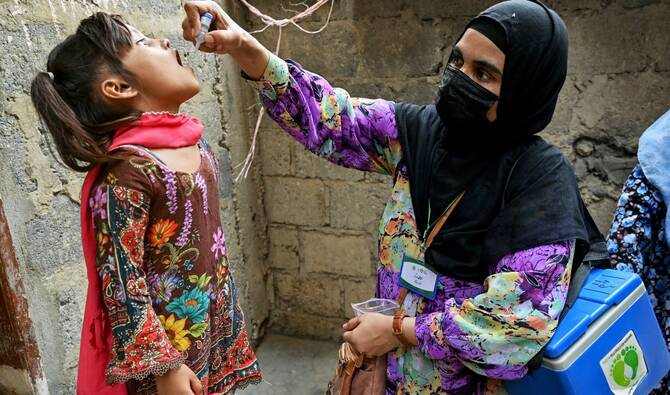
Polio is a highly infectious and incurable disease that can cause lifelong paralysis. The only effective protection is through repeated doses of the oral polio vaccine (OPV) for every child under five during each campaign, along with timely completion of all essential immunizations.
The virus was detected in a 19-month-old boy in Miranshah-3 union council of KP’s North Waziristan district, according to a reference laboratory at the National Institute of Health (NIH) in Islamabad. KP has reported eight cases of the virus this year, followed by four from Sindh, and one each from Punjab and Gilgit-Baltistan.
The northwestern region, which borders Afghanistan, has long been affected by militancy, with militant groups frequently targeting security forces, government officials and anti-polio vaccination teams.
“While nationwide efforts to eradicate polio continue to improve the quality of vaccination campaigns, the southern districts of Khyber Pakhtunkhwa remain a major concern due to limited access and challenges in conducting house-to-house vaccination,” the polio program said.
“These obstacles result in missed opportunities, leaving thousands of children unvaccinated and vulnerable to poliovirus.”
Pakistan and Afghanistan are the only two countries where polio remains endemic. Islamabad made significant progress in curbing the virus, with annual cases dropping from around 20,000 in the early 1990s to just eight in 2018. Pakistan reported six cases in 2023 and only one in 2021, however, the country witnessed an intense resurgence of the poliovirus in 2024, with 74 cases reported.
Efforts to eradicate the virus have been repeatedly undermined by vaccine misinformation and resistance from some religious hard-liners who claim that immunization is a foreign plot to sterilize Muslim children or a cover for Western espionage.
Militant groups have frequently targeted polio vaccination teams and the security personnel assigned to protect them, particularly in KP and Balochistan.
The polio program said it had conducted a special vaccination activity in six union councils of KP’s Bannu district last month and inoculated 17,485 children, and a similar targeted vaccination drive was being planned in 11 union councils of North Waziristan.
“Additionally, preparations are underway for a large-scale special vaccination campaign in South Khyber Pakhtunkhwa, scheduled for August,” it said, urging parents to ensure their children receive the vaccine.
“Recent polio cases in South KP are a stark reminder that children missed during vaccination campaigns remain at serious risk. While the program is making every effort to reach every child, the role of parents is critical.”


Pakistan reports 14th polio case of this year in troubled northwest
https://arab.news/5sub2
Pakistan reports 14th polio case of this year in troubled northwest

- Polio program says recent polio cases in Khyber Pakhtunkhwa remind that children missing vaccination remain at serious risk
- Preparations are underway for a large-scale special vaccination campaign in southern Khyber Pakhtunkhwa, scheduled for August

Turkish agents capture senior Daesh member on Afghanistan-Pakistan border
- The Turkish citizen was allegedly tasked with suicide bombings in Turkiye, Pakistan, Afghanistan and Europe
- It was not clear when the operation took place or whether Afghan and Pakistani authorities were involved
ANKARA: Turkish intelligence agents have captured a senior member of the Daesh (Islamic State) group in an area along the Afghanistan-Pakistan border, allegedly thwarting planned suicide attacks in Turkiye and elsewhere, Turkiye’s state-run news agency reported Monday.
Anadolu Agency said the suspect was identified as Mehmet Goren and a member of the group’s Afghanistan-based Daesh-Khorasan (IS-K) branch. He was caught in a covert operation and transferred to Turkiye.
It was not clear when the operation took place or whether Afghan and Pakistani authorities were involved.
The report said the Turkish citizen allegedly rose within the organization’s ranks and was given the task of carrying out suicide bombings in Turkiye, Pakistan, Afghanistan and Europe.
Daesh has carried out deadly attacks in Turkiye, including a shooting at an Istanbul night club on Jan. 1, 2017, which killed 39 people.
Monday’s report said Goren’s capture allegedly also exposed the group’s recruitment methods and provided intelligence on its planned activities.


