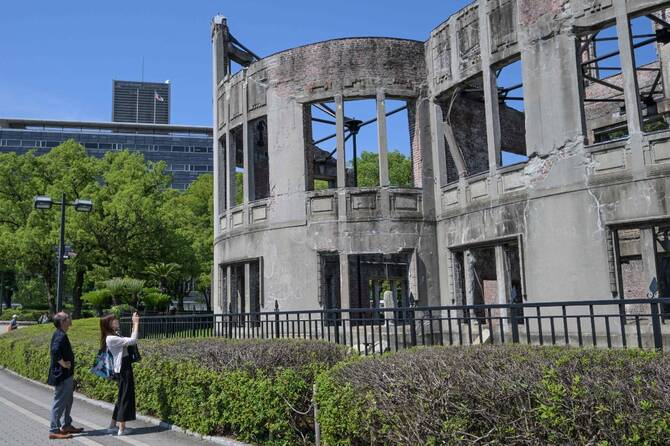
TOKYO: A Nobel Prize-winning anti-nuclear group launched an online memorial Tuesday for the 38,000 children who died in the US atomic bombings of Hiroshima and Nagasaki, ahead of the 80th anniversary next month.
It features more than 400 profiles with details of the children’s lives, “their agonizing deaths and the grief of surviving family members,” said the International Campaign to Abolish Nuclear Weapons (ICAN) in a statement.
“By sharing their heart-wrenching stories, we hope to honor their memories and spur action for the total abolition of nuclear weapons — an increasingly urgent task given rising global tensions,” it said.
The United States dropped an atomic bomb on each Japanese city on August 6 and 9, 1945 — the only times nuclear weapons have been used in warfare. Japan surrendered days later.
Around 140,000 people died in Hiroshima and around 74,000 others in Nagasaki, including many who survived the explosions but died later from radiation exposure.
Out of around 210,000 victims, around 38,000 were children, said the ICAN, citing Hiroshima and Nagasaki officials.
Washington has never apologized for the bombings.
Clicking a crane icon, visitors to the online platform can read the children’s profiles, with photos of 132 children out of 426, ranging in age from infants to teenagers.
Among them is Tadako Tameno, who died in agony aged 13 in the arms of her mother two days after the Hiroshima atomic bombing.
Six children in the Mizumachi family were killed in the Nagasaki atomic bombing. Only one girl, Sachiko, 14, survived.
The initiative comes after US President Donald Trump last week likened Washington’s strike on Iran’s nuclear facilities to the Hiroshima and Nagasaki bombs.
“Actually, if you look at Hiroshima, if you look at Nagasaki, you know that ended a war too,” Trump said in The Hague.
This prompted anger from survivors and a small demonstration in Hiroshima. The city’s assembly passed a motion condemning remarks that justify the use of atomic bombs.
Israel’s ambassador to Japan, Gilad Cohen, will attend this year’s ceremony in Nagasaki, local media reported.
Cohen, together with the envoys of several Western nations including the United States, boycotted last year’s event after comments by the city’s mayor about Gaza.
Russia’s ambassador will attend the Nagasaki ceremony, the first time its representative has been invited since the invasion of Ukraine in 2022, NHK reported.
However, Nikolay Nozdrev will not attend the 80th anniversary event in Hiroshima three days earlier on August 6, the broadcaster said, citing the Russian embassy.
ICAN won the Nobel Peace Prize in 2017. Last year, it was awarded to Nihon Hidankyo, a grassroots movement of Hiroshima and Nagasaki survivors.
Data from the Japanese health ministry released Tuesday meanwhile showed that the number of survivors from the bombings had fallen below 100,000 for the first time.
The number stood at 99,130 as of March 2025, with the average age at 86.13 years, according to the ministry.


![]()

Online memorial for children dead in Hiroshima, Nagasaki
Short Url
https://arab.news/67c9b
Online memorial for children dead in Hiroshima, Nagasaki
- The United States dropped an atomic bomb on each Japanese city on August 6 and 9, 1945
- Out of around 210,000 victims, around 38,000 were children


Latest updates




© 2026 SAUDI RESEARCH & PUBLISHING COMPANY, All Rights Reserved And subject to Terms of Use Agreement.