LONDON: British Prime Minister Keir Starmer marks a year in office this week, fighting a rebellion from his own party over welfare reform and reckoning with a sluggish economy and rock-bottom approval ratings.
It’s a long way from the landslide election victory he won on July 4, 2024, when Starmer’s center-left Labour Party took 412 of the 650 seats in the House of Commons to end 14 years of Conservative government.
In the last 12 months Starmer has navigated the rapids of a turbulent world, winning praise for rallying international support for Ukraine and persuading US President Donald Trump to sign a trade deal easing tariffs on UK goods.
But at home his agenda has run onto the rocks as he struggles to convince British voters — and his own party — that his government is delivering the change that it promised. Inflation remains stubbornly high and economic growth low, frustrating efforts to ease the cost of living. Starmer’s personal approval ratings are approaching those of Conservative Prime Minister Liz Truss, who lasted just 49 days in office in 2022 after her tax-cutting budget roiled the economy.
John Curtice, a political scientist at the University of Strathclyde, said Starmer has had “the worst start for any newly elected prime minister.”
Rebellion over welfare reform
On Tuesday, Starmer faces a vote in Parliament on welfare spending after watering down planned cuts to disability benefits that caused consternation from Labour lawmakers. Many balked at plans to raise the threshold for the payments by requiring a more severe physical or mental disability, a move the Institute for Fiscal Studies think tank estimated would cut the income of 3.2 million people by 2030.
After more than 120 Labour lawmakers said they would vote against the bill, the government offered concessions, including a guarantee that no one currently getting benefits will be affected by the change. It pledged to consult with disability groups about the changes, and do more to help sick and disabled people find jobs.
Some rebels said they would back the bill after the concessions, but others maintained their opposition.
The welfare U-turn is the third time in a few weeks that the government has reversed course on a policy under pressure. In May, it dropped a plan to end winter home heating subsidies for millions of retirees. Last week, Starmer announced a national inquiry into organized child sexual abuse, something he was pressured to do by opposition politicians — and Elon Musk.
“It’s a failure of leadership for a prime minister with such a big majority to not be able to get their agenda through,” said Rob Ford, professor of politics at the University of Manchester. “I can’t think of many examples of a prime minister in postwar politics suffering such a big setback when presiding over such a strong position in the Commons.”
It also makes it harder for the government to find money to invest in public services without raising taxes. The government estimated the welfare reforms would save 5 billion pounds ($7 billion) a year from a welfare bill that has ballooned since the COVID-19 pandemic. After the concessions, it’s only likely to save about half that amount.
Starmer acknowledges errors
The government argues that it has achieved much in its first year: It has raised the minimum wage, strengthened workers’ rights, launched new social housing projects and pumped money into the state-funded health system. But it has also raised taxes for employers and farmers, as well as squeezing benefits, blaming previous Conservative governments for the need to make tough choices. That downbeat argument has done little to make Starmer popular.
In recent days Starmer has acknowledged mistakes. He told the Sunday Times that he was “heavily focused on what was happening with NATO and the Middle East” while the welfare rebellion was brewing at home.
“I’d have liked to get to a better position with colleagues sooner than we did — that’s for sure,” he said.
UK politics is in flux
Starmer’s struggles are all the more ignominious because the opposition Conservative Party had its worst-ever election result in 2024, reduced to only 121 lawmakers.
But British politics is in unpredictable flux. A big chunk of Conservative support – and some of Labour’s – shifted in this year’s local elections to Reform UK, a hard-right party led by veteran political pressure-cooker Nigel Farage. Reform has just five legislators in the House of Commons but regularly comes out on top in opinion polls, ahead of Labour and pushing the right-of-center Conservatives into third place. If the shift continues it could end a century of dominance by the two big parties.
Starmer’s key asset at the moment is time. He does not have to call an election until 2029.
“There’s still plenty of time to turn things around,” Ford said. But he said the Labour lawmakers’ rebellion “will make things harder going forward, because it’s not like this is the end of difficult decisions that he’s going to have to make in government.
“Barring some magical unexpected economic boom … there’s going to be a hell of a lot more fights to come,” he said.


![]()

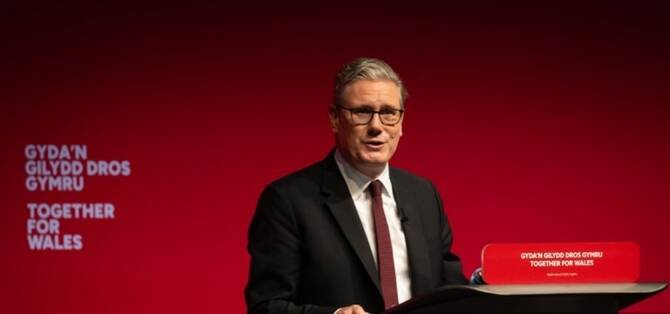
Starmer faces down a revolt over welfare reform after a troubled first year in office
Short Url
https://arab.news/v39f7
Starmer faces down a revolt over welfare reform after a troubled first year in office
- On Tuesday, Starmer faces a vote in Parliament on welfare spending after watering down planned cuts to disability benefits that caused consternation from Labour lawmakers
- The welfare U-turn is the third time in a few weeks that the government has reversed course on a policy under pressure


Latest updates


© 2026 SAUDI RESEARCH & PUBLISHING COMPANY, All Rights Reserved And subject to Terms of Use Agreement.