Early date harvest begins in Al-Ahsa

1 / 4
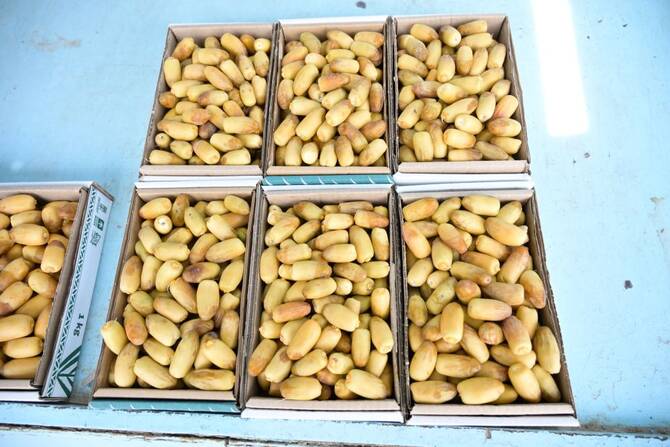
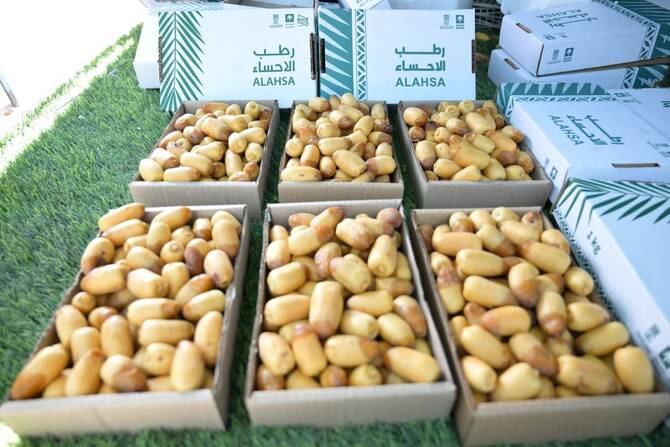
Al-Ahsa is witnessing the early signs of its annual date harvest, with farmers beginning to reap the season’s first rutab. (Supplied)
2 / 4
Al-Ahsa is witnessing the early signs of its annual date harvest, with farmers beginning to reap the season’s first rutab. (Supplied)
3 / 4
Al-Ahsa is witnessing the early signs of its annual date harvest, with farmers beginning to reap the season’s first rutab. (Supplied)
4 / 4
Al-Ahsa is witnessing the early signs of its annual date harvest, with farmers beginning to reap the season’s first rutab. (Supplied)
Short Url
Updated 30 June 2025
Follow

Early date harvest begins in Al-Ahsa

  • Harvest typically spans May 20 to July 20, marking an important period for both local agriculture and the national date market
  • Markets across Saudi Arabia are preparing to welcome over 20 varieties of premium dates cultivated in Al-Ahsa

JEDDAH: As temperatures rise, Al-Ahsa is witnessing the early signs of its annual date harvest, with farmers beginning to reap the season’s first rutab — dates in the soft, early-ripening stage of dates.

The harvest typically spans May 20 to July 20, marking an important period for both local agriculture and the national date market.

This year, markets across Saudi Arabia are preparing to welcome over 20 varieties of premium dates cultivated in Al-Ahsa, including the highly favored Khalas, Shishi, and Ghar varieties.

The Ministry of Environment, Water and Agriculture has confirmed the 2025 rutab season in Al-Ahsa signals a promising yield, with initial quantities already making their way across the Kingdom. 

Varieties such as Rutab Al-Tayyar, Majnaz, Ghar, Khneizi, Shishi and Khalas are expected to arrive at different stages throughout the harvest period, offering a steady flow of fresh produce. The harvest of the late-season rutab is set to begin in early July and will continue until mid-August, featuring prized varieties like Um Rahim, Zamli, Shahl, and Hilali.

Following the rutab season, Al-Ahsa will move into the full date (tamr) harvest from mid-August to early October, with popular varieties such as Shishi, Khalas and Raziz forming the core of this stage. 

In addition to fresh dates, Al-Ahsa is also known for producing some of the finest varieties for molasses (dibs), including varieties like Marzban, Hatemi and Shahl, highly valued for their rich flavor and syrupy texture.

Al-Ahsa, recognized as the largest palm oasis in the world and a UNESCO World Heritage Site, is home to more than 2 million palm trees. Each year, the region produces over 120,000 tons of dates, making it a cornerstone of Saudi Arabia’s agricultural landscape.

With its unique blend of fertile land, deep-rooted heritage, and diverse produce, it continues to be a global center for date cultivation and a vital contributor to the Kingdom’s cultural and economic identity.


US firm plans world’s first commercial space station

Updated 11 sec ago
Follow

US firm plans world’s first commercial space station

  • Project developed by VAST Space company for 2027
  • Plan for short missions and research in microgravity

RIYADH: A US firm plans to launch the world’s first commercial space station for astronauts in 2027, the company’s CEO said at a Riyadh conference.

VAST Space’s CEO Max Haot outlined the company’s plans for the Haven-1 station at the Space Debris Conference 2026, the Saudi Press Agency reported on Wednesday.

Haot explained that Haven-1 represents the first phase of a long-term vision to develop commercial space stations, which will support a sustainable human presence in low Earth orbit.

This is in line with the global transition toward commercial operating models as the International Space Station approaches the end of its operational life, expected at the end of 2030.

The ISS, a partnership between NASA and the Russian, European, Japanese and Canadian space agencies, was first launched into orbit in 1998.

Haven-1 is designed to host a crew of four astronauts on short-duration missions, while supporting scientific research, technology demonstrations and commercial applications in a microgravity environment.

Haot added that the station’s design places strong emphasis on safety and sustainability, including the integration of debris protection systems, as well as dedicated processes for safe deorbiting.

The company aims to achieve operational revenues through four crewed missions, supported by scientific and commercial payloads and strategic partnerships, from 2027 to 2030.

Haot expressed confidence in his company’s progress and testing during 2025.