

Madinah farmers begin date harvest as season nears peak ripeness of fruit

1 / 5
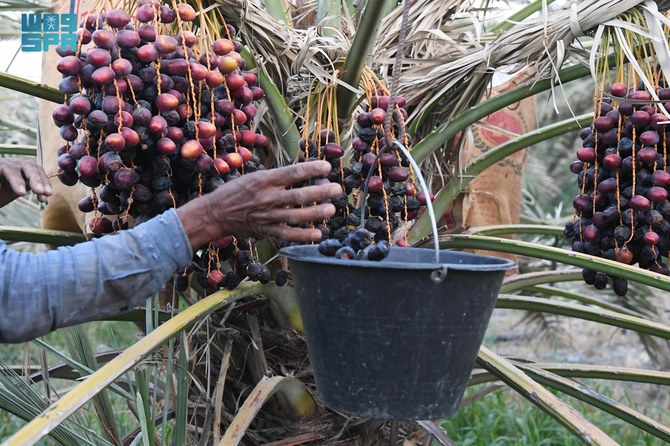
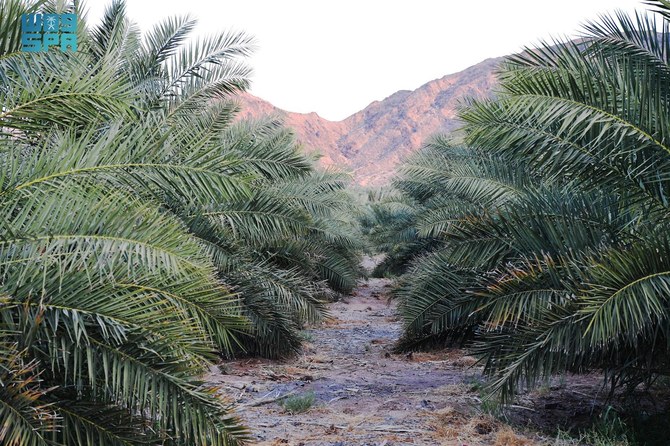
Farmers in Madinah have begun to harvest dates as the palm fruit reached optimum ripeness this agricultural season. (SPA)
2 / 5
Farmers in Madinah have begun to harvest dates as the palm fruit reached optimum ripeness this agricultural season. (SPA)
3 / 5
Farmers in Madinah have begun to harvest dates as the palm fruit reached optimum ripeness this agricultural season. (SPA)
4 / 5
Farmers in Madinah have begun to harvest dates as the palm fruit reached optimum ripeness this agricultural season. (SPA)
5 / 5
Farmers in Madinah have begun to harvest dates as the palm fruit reached optimum ripeness this agricultural season. (SPA)
Short Url
Updated 02 August 2024
Follow

Madinah farmers begin date harvest as season nears peak ripeness of fruit

MADINAH: Farmers in Madinah have begun to harvest dates as the palm fruit reached optimum ripeness this agricultural season, the Saudi Press Agency reported.

The process of ripening date palms involves several stages, starting with pollination and moving on to thinning, where excess fruit is removed to support optimal growth. The dates are carefully bagged in palm fronds to shield them from the sun’s heat before being harvested.

Abdullah bin Abdulaziz Al-Radadi, chairman of the Madinah Dates Cooperative Association, highlighted the significance of post-harvest practices in ensuring the quality of the final product.

Al-Radadi said recent studies indicate that storing dates at 4 degrees Celsius for six months preserves the fruit and boosts its nutritional value by enhancing phenols (an antiseptic and disinfectant that can protect against a wide range of micro-organisms including some fungi and viruses); this process also maintains and improves antioxidants in dates, which helps to double the nutritional value after a year of preservation.

Speaking on the unique qualities of dates, Al-Radadi emphasized their consumption at different ripening stages: the “khalal” stage, when the fruit changes colour to yellow or red based on the variety; the “rutab” stage, when the fruit softens; and the “tamr” stage, when the date is fully ripe, soft and can be eaten either moist or dry.

He said that because of the intense sunshine in the Kingdom, scientific research has proven that dates develop more phenols to survive harsh conditions. These polyphenols offer protection against various diseases.

He also pointed out that the various dates currently available include ajwa, sukkari and medjool, while safawi, anbarah, barni and shalaby dates will be available later in the season.


Saudi-Yemen program provides $81.2m to operate more than 70 power plants

Updated 21 January 2026
Follow

Saudi-Yemen program provides $81.2m to operate more than 70 power plants

  • Grant will improve reliability of electrical power to critical facilities, including hospitals, medical centers, roads, schools, airports and ports
  • Move follows last week’s announcement by the SDRPY of a larger aid package totaling $506 million to support Yemen

LONDON: A tripartite agreement was signed on Wednesday between the Saudi Development and Reconstruction Program for Yemen, the oil company Petromasila, and Yemen’s Ministry of Energy and Electricity to supply petroleum derivatives for the country’s power plants.

SDRPY is supporting the Yemeni government with an $81.2 million grant to purchase 339 million liters of diesel and mazut from Petromasila to operate more than 70 power plants across various Yemeni governorates.

The grant follows last week’s announcement by the SDRPY of a $506 million aid package to support Yemen’s education, health, government and infrastructure sectors.

The SDRPY highlighted that the grant will improve the reliability of electrical power to critical facilities, including hospitals, medical centers, roads, schools, airports and ports. Additionally, the funding will stimulate the Yemeni economy and support the Central Bank of Yemen by easing the pressure on foreign exchange reserves.

It reduces the Ministry of Finance’s fuel-related financial burden and supports the Ministry of Electricity and Energy in improving the efficiency of power plants in Yemen, the SDRPY said.

In 2018, the SDRPY provided $180 million, in addition to $422 million in 2021 and another $200 million in 2022, as grants to Yemen to purchase oil derivatives and operate vital sectors of the country.