

Saudi Ministry of Energy, UN ink deal to propel regional emissions cooperation 

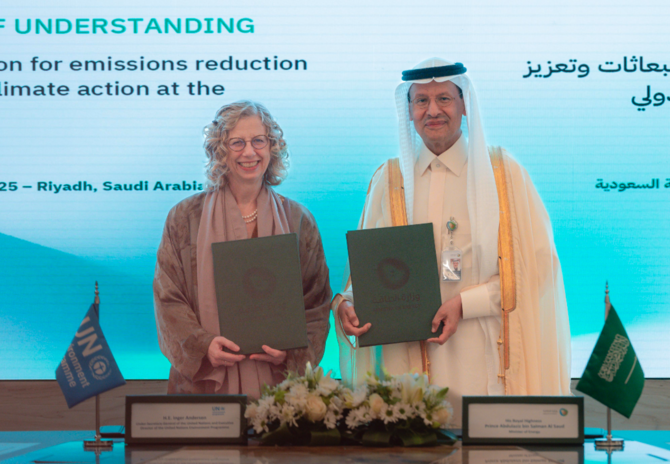
Energy Minister Prince Abdulaziz bin Salman and UNEP Executive Director Inger Andersen. Ministry of Energy
Short Url
Updated 30 June 2025
Follow

Saudi Ministry of Energy, UN ink deal to propel regional emissions cooperation 

  • Deal seeks to support MENA nations promote clean energy technologies

RIYADH: Middle East and North Africa countries are set to benefit from enhanced clean energy cooperation following an agreement between Saudi Arabia and the UN Environment Programme to accelerate emissions reduction. 

The memorandum of understanding, signed in Riyadh by Energy Minister Prince Abdulaziz bin Salman and UNEP Executive Director Inger Andersen, seeks to support MENA nations through the promotion of clean energy technologies, development of climate policy frameworks, and knowledge exchange to advance sustainable development, according to an official release. 

The initiative aligns with Saudi Arabia’s Middle East Green Initiative, a regional platform launched to combat climate change and reduce emissions by over 60 percent from hydrocarbon production across participating countries. The initiative aims to cut 670 million tonnes of carbon dioxide, equivalent to 10 percent of global nationally determined contributions when first announced in 2021. 

The ministry release stated: “The MoU reflects shared goals to enhance resource efficiency and lower carbon emissions through a comprehensive, balanced and sustainable approach.” 

It added: “Areas of cooperation include policy research and recommendations, partnerships with international organizations, participation in climate and CCE-related events, exchange of knowledge and best practices, and the development of climate policy frameworks, supported by regional and global climate networking activities.” 

During the meeting, the two sides also held talks over advancing the objectives of the UN Framework Convention on Climate Change and the Paris Agreement. 

“The two sides also discussed Saudi Arabia’s climate initiatives, including the Saudi Green Initiative and the Middle East Green Initiative, as well as other efforts undertaken by the Kingdom to expand renewable energy and reduce emissions through the Circular Carbon Economy framework,” the release added.

The MoU supports wider regional efforts to unlock renewable potential. MENA currently contributes less than 8 percent of global emissions from power and heat generation and is aiming to grow its clean energy capacity from under 50 gigawatts in 2022 to 200 GW by 2030, according to a June 2024 report by the International Energy Agency. 

The IEA report also highlighted that the region — led by Saudi Arabia, Egypt, and Algeria — is experiencing the fastest relative growth in renewable energy, scaling at 4.5 times its current base due to ambitious national targets. 

The MENA region holds substantial hydrocarbon reserves alongside significant renewable energy potential, positioning it as a strategically important player in the global shift toward sustainable energy, according to the Natural Resource Governance Institute. 

Governments across the region are adopting a dual-energy strategy — leveraging both fossil fuels and renewables — to reduce emissions while bolstering energy security. 

Enhanced regional collaboration is critical to developing interconnected energy systems, boosting economic competitiveness, and securing reliable access to international energy markets. 


Saudi Arabia leads outcome-based education to prepare future-ready generations: Harvard Business Review

A Harvard sign is seen at the Harvard University campus in Boston, Massachusetts, on May 27, 2025. (AFP)
Updated 10 February 2026
Follow

Saudi Arabia leads outcome-based education to prepare future-ready generations: Harvard Business Review

  • The Riyadh-based school group developed a strategy that links every classroom activity to measurable student competencies, aiming to graduate learners equipped for the digital economy and real-world contexts

RIYADH: Saudi Arabia’s education system is undergoing a sweeping transformation aligned with Vision 2030, shifting from traditional, input-focused methods to outcome-based education designed to equip students with future-ready skills, Harvard Business Review Arabic reported.

The transformation is being adopted and spearheaded by institutions such as Al-Nobala Private Schools, which introduced the Kingdom’s first national “learning outcomes framework,” aimed at preparing a generation of leaders and innovators for an AI-driven future, the report said.

Al-Nobala has leveraged international expertise to localize advanced learning methodologies.

The Riyadh-based school group developed a strategy that links every classroom activity to measurable student competencies, aiming to graduate learners equipped for the digital economy and real-world contexts. The school’s group approach combines traditional values with 21st-century skills such as critical thinking, communication, innovation and digital fluency.

According to the report, the shift addresses the growing gap between outdated models built for low-tech, resource-constrained environments and today’s dynamic world, where learners must navigate real-time information, virtual platforms, and smart technologies.

“This is not just about teaching content, it’s about creating impact,” the report noted, citing how Al-Nobala’s model prepares students to thrive in an AI-driven world while aligning with national priorities.

The report noted that Saudi Arabia’s Ministry of Education has paved the way for this shift by transitioning from a centralized controller to a strategic enabler, allowing schools such as Al-Nobala to tailor their curriculum to meet evolving market and societal needs. This is part of the long-term goal to place the Kingdom among the top 20 global education systems.

Al-Nobala’s work, the report stated, has succeeded in serving the broader national effort to link education outcomes directly to labor market demands, helping to fulfill the Vision 2030 pillar of building a vibrant society with a thriving economy driven by knowledge and innovation.

Last February, Yousef bin Abdullah Al-Benyan, Saudi Arabia’s minister of education, said that the Kingdom was making “an unprecedented investment in education,” with spending aligned to the needs of growth and development. He said that in 2025, education received the second-largest share of the state budget, totaling $53.5 billion.