

Saudi Arabia, China sign deal to boost cultural collaboration

1 / 2
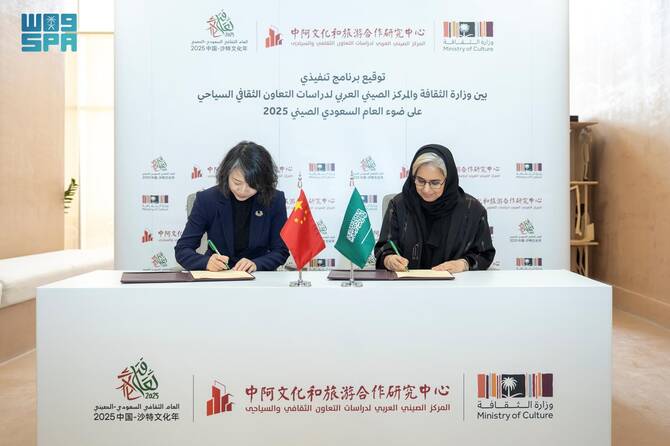
Program in Diriyah to enhance cultural collaboration between Saudi Arabia and China was signed by Deputy Minister for Research and Cultural Heritage Affairs Maha Abdullah Alsenan and Cheng Wei, vice president of Beijing International Studies University. (SPA)
2 / 2
Program in Diriyah to enhance cultural collaboration between Saudi Arabia and China was signed by Deputy Minister for Research and Cultural Heritage Affairs Maha Abdullah Alsenan and Cheng Wei, vice president of Beijing International Studies University. (SPA)
Short Url
Updated 30 June 2025
Follow

Saudi Arabia, China sign deal to boost cultural collaboration

  • The program, aligned with the 2025 Saudi-Chinese Cultural Year, focuses on joint cultural initiatives
  • Both sides will carry out research projects to improve quality of cultural studies and collaborate on identifying and compiling cultural materials from national archives

RIYADH: The Ministry of Culture and the China-Arab Cultural and Tourism Cooperation Research Center have signed an executive program in Diriyah to enhance cultural collaboration between Saudi Arabia and China.

The program, aligned with the 2025 Saudi-Chinese Cultural Year, focuses on joint cultural initiatives, the Saudi Press Agency reported.

It was signed by Deputy Minister for Research and Cultural Heritage Affairs Maha Abdullah Alsenan and Cheng Wei, vice president of Beijing International Studies University and member of the joint committee of the China-Arab research center.

Both sides will carry out joint research projects to improve the quality of cultural studies and collaborate on identifying and compiling cultural materials from national archives.

The ministry will also work with the Chinese to organize joint conferences and facilitate visits and exchanges between cultural researchers to discuss shared cultural topics.

The agreement supports research exchange activities, enabling Saudi researchers to visit Chinese universities and research centers and vice versa. It also provides access to cultural experts, supports fellowship programs and offers consultative assistance.

This initiative aligns with the ministry’s efforts to promote international cultural exchange, a goal of the National Culture Strategy under Vision 2030.


Saudi Arabia looks to become carbon trading hub for Global South

Updated 6 sec ago
Follow

Saudi Arabia looks to become carbon trading hub for Global South

  • Kingdom eyes partnerships with Asian companies

TOKYO: Saudi Arabia is looking to become a carbon trading hub for the Global South and is eyeing partnerships with Asian companies to trade on its exchange, Japan’s Nikkei newspaper has reported.

Saudi Arabia’s Voluntary Carbon Market recently signed a memorandum of understanding with Japanese trading house Marubeni “for collaboration on carbon markets,” and has also linked up with Climate Bridge International, a Singapore-headquartered carbon finance company, as an advisory partner.

Fadi Saadeh, acting CEO of Saudi Arabia’s Voluntary Carbon Market company, said it was important for Saudi Arabia to have a market to trade carbon credits that arise from the phasing out of coal.

A carbon credit represents a tonne of CO2 or CO2-equivalent greenhouse gases reduced or removed by verified projects like reforestation or carbon removal schemes. In the voluntary carbon market, companies can buy the credits to offset their emissions to meet their net-zero goals, while the sellers of the credits can use the funds received to invest in more green projects.

VCM was set up in 2022 by Saudi Arabia’s Public Investment Fund and the Saudi Tadawul Group, the country's exchange operator.

Saadeh said VCM was geographically well located to capture demand from the Global South and could leverage existing relationships and investments that companies like Saudi Aramco have forged over the years.

“In Saudi Arabia three years ago there were zero project developers for carbon credits,” Saadeh said. “Today, because of VCM and the ecosystem around the world, we have more than 25 project developers in Saudi Arabia.” He added that the energy transition would take time.