

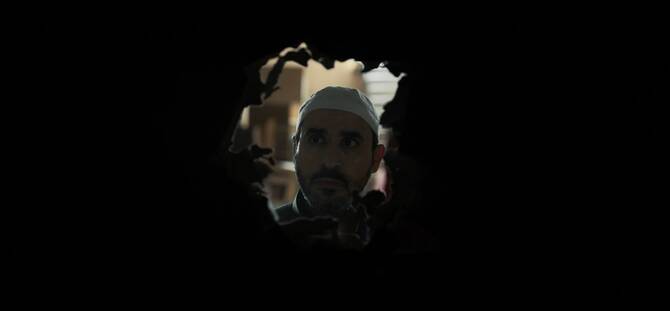

DHAHRAN: Saudi film “Holes” continues to make its mark with screenings at film festivals around the world. The quietly arresting drama follows Rakan, a man in his mid-40s, as he returns to his hometown to be with his wife, Reem. He struggles to re-enter a society that no longer trusts him — and one that he also does not fit into.
The film starts with a literal clock — which we don’t see — persistently ticking in the otherwise vacant interior of a residence, the loud but constant sound in the midst of silence sets the tone.
With a fiery but contained temper, eyes welling with sadness, we find out that Rakan is prone to fits of rage. He is portrayed as only having a soft spot for his aging mother and his wife, all while dodging men from his past who haunt him.
The film doesn’t linger on the specifics — there are many gaping holes in the story. Instead, it centers on how the weight of reputation, judgment and suffocating silence shapes a person trying to begin again.
It stars Mariam Abdulrahman and Meshal Almutairi and was produced by Ayman Alnaqeeb and Abdulrahman Altikhais.
Abdulmohsen Aldhabaan, the director of “Holes,” is an independent Saudi writer and filmmaker. He co-founded Talashi Films in 2008 and has directed several shorts and a TV series.
Aldhabaan‘s debut feature film, “Last Visit” (2019), gained international recognition, becoming the first Arab film selected for the East of the West Competition at the Karlovy Vary International Film Festival. It also earned the Jury Award at the Marrakech International Film Festival.
With “Holes,” Aldhabaan continues his signature style of quiet, impactful storytelling marked by restraint and emotional depth.
In “Holes,” Aldhabaan crafts a slow, thoughtful narrative. Rather than relying on heavy dialogue or exposition, the film builds its emotional landscape through atmosphere — solitary walks at night, avoiding tiny puddles in the alleyways, prolonged pauses and distant glances — to explore isolation and inner conflict. The pacing may feel slow to some, but it seems deliberate — offering space for reflection and tension to build.
A persistent image in the film is a literal hole in the wall of Rakan and Reem’s new home. It is never ignored but also never fixed, and that choice is telling. At one point, it gushes water as Reem tries to stuff pretty-colored cloths to stop it — to no avail. It floods their bedroom and the couple tries to contain it together.
The hole becomes a powerful metaphor representing wounds that haven’t healed, things left unresolved, and the parts of a life that remain open to scrutiny or misunderstanding. It defines the space around it — the hole is a character all its own.


