

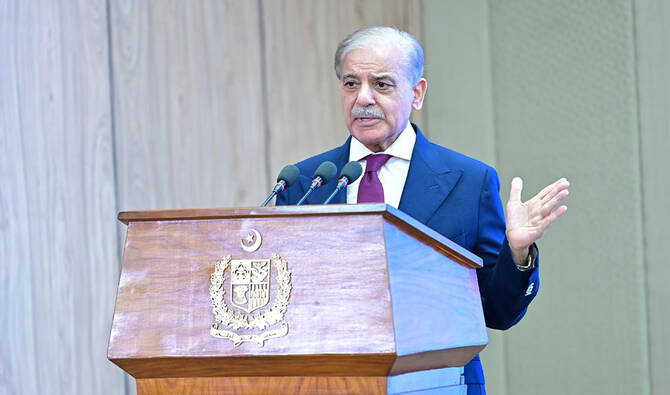

ISLAMABAD: Prime Minister Shehbaz Sharif on Sunday inaugurated a mobile application that allows power consumers in Pakistan to record and submit their meter readings themselves, with the government saying the initiative will introduce more transparency in the electricity system and reduce overbilling.
Electricity bills are generated in Pakistan every month by readings obtained from power meters installed at homes and businesses. These readings show the number of electricity units consumed during a monthly cycle and are taken by meter readers employed by power companies.
Pakistani power consumers have frequently complained of overbilling and incorrect readings taken by meter readers. To include power consumers in the process and to bring more transparency to the electricity system, the Power Division said it had launched the Power Smart App under the government’s “Apna Meter, Apni Reading” (Your Meter, Your Reading) slogan.
“And this app, this technology, this reform, is a revolutionary technological reform whose benefit will reach every consumer in every home,” Sharif told participants at the app’s launching ceremony.
He urged Energy Minister Sardar Awais Leghari and his ministry to strictly monitor the use of the app to ensure power consumers avail its benefits.
“I would want you to introduce this app to every home from Karachi to Peshawar,” the prime minister told the energy minister.
In a press release, the Power Division said consumers can use the app by taking a picture of their meter on a specified date and uploading the image to the app. Based on the picture, their monthly bill will be generated
Highlighting the features of the app, the Power Division said If both the consumer and the meter reader upload the readings, the lower reading will be used to generate the bill.
It further said that if the consumer submits a reading on a designated day, any reading taken by the meter reader after that date will not be accepted.
The Power Division pointed out that this method will prove beneficial for consumers eligible for power subsidies.
“For example, a consumer using up to 200 units typically receives a bill of around Rs2,330 but crossing just one additional unit results in the loss of subsidy, raising the bill to around Rs8,104,” the Power Division said.
“Through this app, it will be ensured that eligible consumers can timely submit readings and continue to benefit from subsidies.”
Pakistan has aggressively pursued reforms in its energy sector recently, which has long struggled with financial strain due to circular debt, power theft and transmission losses. These problems have led to blackouts and high electricity costs throughout the country, especially during the summers when demand peaks.


