

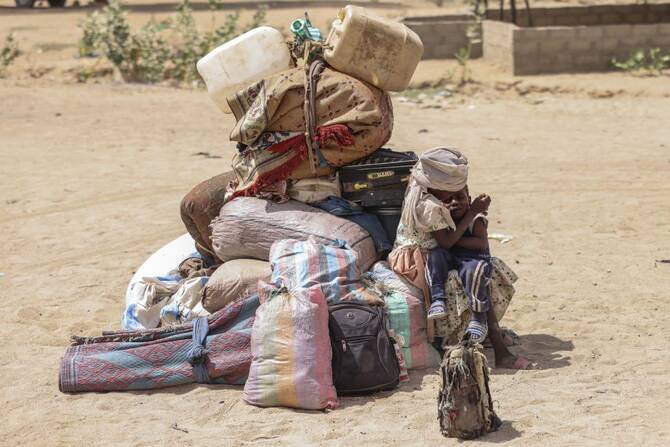

ADRE, Chad: Fatima Omas Abdullah wakes up every morning with aches and pains from sleeping on bare ground for almost two years. She did not expect Sudan’s civil war to displace her for so long into neighboring Chad.
“There is nothing here,” she said, crying and shaking the straw door of her makeshift home. Since April 2023, she has been in the Adre transit camp a few hundred meters from the Sudanese border, along with almost a quarter-million others fleeing the fighting.
Now the US- backed aid system that kept hundreds of thousands like Abdullah alive on the edge of one of the world’s most devastating wars is fraying. Under the Trump administration, key foreign aid has been slashed and funding withdrawn from United Nations programs that feed, treat and shelter refugees.
In 2024, the US contributed $39.3 million to the emergency response in Chad. So far this year, it has contributed about $6.8 million, the UN says. Overall, only 13 percent of the requested money to support refugees in Chad this year has come in from all donors, according to UN data.
In Adre, humanitarian services were already limited as refugees are meant to move to more established camps deeper inside Chad.
Many Sudanese, however, choose to stay. Some are heartened by the military’s recent successes against rival paramilitary forces in the capital, Khartoum. They have swelled the population of this remote, arid community that was never meant to hold so many. Prices have shot up. Competition over water is growing.
Adre isn’t alone. As the fighting inside Sudan’s remote Darfur region shifts, the stream of refugees has created a new, more isolated transit camp called Tine. Since late April, 46,000 people have arrived.
With the aid cuts, there is even less to offer them there.
235,000 Sudanese in a border town
Adre has become a fragile frontline for an estimated 235,000 Sudanese. They are among the 1.2 million who have fled into eastern Chad.
Before the civil war, Adre was a town of about 40,000. As Sudanese began to arrive, sympathetic residents with longtime cross-border ties offered them land.
Now there is a sea of markets and shelters, along with signs of Sudanese intending to stay. Some refugees are constructing multi-story buildings.
Sudanese-run businesses form one of Adre’s largest markets. Locals and refugees barter in Sudanese pounds for everything from produce to watches.
“There is respect between the communities,” said resident Asadiq Hamid Abdullah, who runs a donkey cart. “But everyone is complaining that the food is more expensive.”
Chad is one of the world’s poorest countries, with almost 50 percent of the population living below the poverty line.
Locals say the price of water has quadrupled since the start of Sudan’s civil war as demand rises. Sudanese women told The Associated Press that fights had broken out at the few water pumps for them, installed by the International Committee of the Red Cross and Doctors Without Borders.
Even food aid could run out shortly. The UN World Food Program says funding to support Sudanese refugees in Adre is guaranteed only until July, as the US aid cuts force a 30 percent reduction in staff worldwide. The UN refugee agency has seen 30 percent of its funding cut for this area, eastern Chad.
Samia Ahmed, who cradled her 3-year-old and was pregnant with her second child, said she has found work cleaning and doing laundry because the WFP rations don’t last the month.
“I see a gloomy future,” she said.
Sudanese try to fill aid gaps
Sudanese are trying to fill gaps in aid, running private schools and their own humanitarian area with a health clinic and women’s center.
Local and UN authorities, however, are increasing the pressure on them to leave Adre. There are too many people here, they say.
“A vast city,” said Hamit Hadjer Abdullai with Chad’s National Commission for the Reception and Reintegration of Refugees.
He said crime was increasing. Police warn of the Colombians, a Sudanese gang. Locals said it operates with impunity, though Abdullai claimed that seven leaders have been jailed.
“People must move,” said Benoit Kayembe Mukendi, the UN refugee agency’s local representative. “For security reasons and for their protection.”
As the Chadian population begins to demand their land back, Mukendi warned of a bigger security issue ahead.
But most Sudanese won’t go. The AP spoke to dozens who said they had been relocated to camps and returned to Adre to be closer to their homeland and the transit camp’s economic opportunities.
There are risks. Zohal Abdullah Hamad was relocated but returned to run a coffee stand. One day, a nearby argument escalated and gunfire broke out. Hamad was shot in the gut.
“I became cold. I was immobile,” she said, crying as she recalled the pain. She said she has closed her business.
The latest Sudanese arrivals to Adre have no chance to establish themselves. On the order of local authorities, they are moved immediately to other camps. The UN said it is transporting 2,000 of them a day.
In Tine, arriving Sudanese find nothing
The new and rapidly growing camp of Tine, around 180 kilometers (111 miles) north of Adre, has seen 46,000 refugees arrive since late April from Northern Darfur.
Their sheer numbers caused a UN refugee representative to gasp.
Thousands jostle for meager portions of food distributed by community kitchens. They sleep on the ground in the open desert, shaded by branches and strips of fabric. They bring witness accounts of attacks in Zamzam and El-Fasher: rape, robbery, relatives shot before their eyes.
With the US aid cuts, the UN and partners cannot respond as before, when people began to pour into Adre after the start of the war, UN representative Jean Paul Habamungu Samvura said.
“If we have another Adre here … it will be a nightmare.”


