

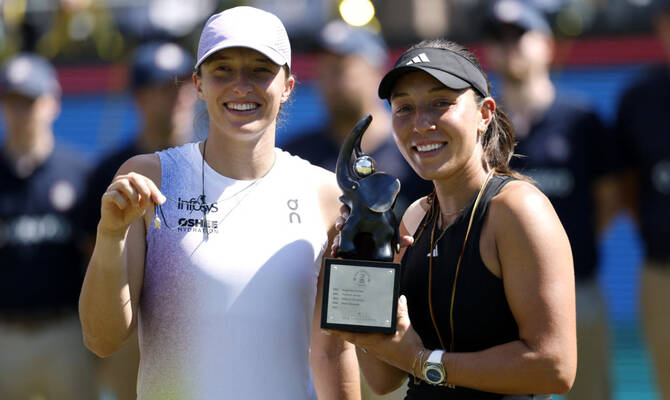
Pegula eases past Swiatek to win Bad Homburg title

Jessica Pegula of the US celebrates with the trophy alongside Poland's Iga Swiatek after winning her women's singles final of Bad Homburg Open on Saturday. (Reuters)
Short Url
Updated 28 June 2025
Follow

Pegula eases past Swiatek to win Bad Homburg title

  • US star denies the Pole her first career title on grass, days before the start of Wimbledon

BAD HOMBURG: Top seed Jessica Pegula contained Iga Swiatek’s heavy topspin game on grass to earn a 6-4 7-5 victory on Saturday and lift the Bad Homburg Open title.

The American held serve throughout and gave up just one breakpoint in the match, denying the Pole her first career title on grass, just two days before the start of Wimbledon.

Swiatek has not won a singles title since her 2024 French Open victory.

“I know you say you can’t play on grass but you are very, very good on grass,” Pegula said, addressing Swiatek after the match. “It was a special week.”

Pegula won a break at 3-3 in the first set to move 5-3 up.

The 31-year-old world No. 3, chasing her third title of 2025 and her first since April, landed the first set soon afterwards when the Pole sent a forehand long.

Swiatek put up a fight in the second set, edging close to a break but failing to carve out a break point.

It was Pegula who earned a breakpoint at 5-5 and she converted it with a sizzling crosscourt forehand.

Pegula held serve to seal her second career title on grass, following last year’s win in Berlin.

For Swiatek, who shed tears while waiting for the trophy ceremony, it was still a successful week after reaching her first career final on the surface.

“You have an amazing game and you showed it throughout the tournament,” Swiatek told Pegula. “Hopefully we will have many more finals together.”

“I feel it is going a good way and thank you for the opportunity to play here. This tournament shows there is hope for me on grass,” Swiatek said.

Separately, world No. 1 Aryna Sabalenka is hoping an outburst after her French Open final defeat to Coco Gauff will prove a turning point in maintaining her emotional control in the biggest matches.

The three-time Grand Slam champion threw away a one-set lead to lose to the American in Paris earlier this month.

Afterwards, Sabalenka described her performance as the “the worst final I’ve ever played.”

The Belarusian later apologized to Gauff for her comments and the pair put their differences aside by performing a dance together on the Wimbledon lawns for social media.

“I was just completely, like, upset with myself, and emotions got over me. I just completely lost it,” said Sabalenka at a pre-Wimbledon press conference on Saturday.

“I believe I get overemotional at the last stages of the tournaments because I have this desire of winning.

“Sometimes it (gets the better of) me and I can lose control over my emotions. So, I would love to improve that at the last stages of the tournament.

“But honestly I’m kind of glad what happened to me at Paris because I was able to learn a lot. I was able to sit back and being open to myself, not just to ignore some things. I think I realized a lot of things about myself in those last stages of the tournaments.”

Sabalenka’s comments after the French Open were fiercely criticized in the US for taking the shine off Gauff’s second Grand Slam title.

“Of course, she got my respect. She knows it,” added Sabalenka.

“I’m happy that she was, like, ‘yeah, it’s all good, don’t worry’. As you saw the (dancing) video, I was talking, we are good, we are friends. I hope the US media can be easy on me right now.”

Sabalenka has never gone beyond the semifinals on the Wimbledon grass and begins her quest for glory against Canadian qualifier Carson Branstine, a player she admitted to having limited knowledge of.


Football’s return to Syrian pitches brings fanfare — and friction

Updated 31 December 2025
Follow

Football’s return to Syrian pitches brings fanfare — and friction

RIYADH: Just 10 days after the first anniversary of Syria’s Liberation Day, and one week after the historic performance of the country’s football team at the 2025 Arab Cup — where they reached the quarterfinals — domestic football returned as the Syrian Premier League kicked off its new season.

While league football has continued intermittently since a one-year suspension in 2011, this season represents a notable shift.

For the first time since 2017, the competition features 16 teams playing a full round-robin format — a return to structural normality after years of disrupted campaigns, withdrawals and operational challenges caused by conflict and deteriorating infrastructure.

Foreign players have also returned in significant numbers. A total of 25 overseas players are registered across the 16 clubs in what is now known as the “Prime TV” Syrian Premier League, following the broadcaster’s acquisition of domestic broadcasting rights for the season.

Yet despite the sense of renewal, the league’s reset has been far from smooth. Average attendances remain well below pre-war levels, while the season itself was delayed multiple times before eventually beginning in mid-December — a schedule that is now expected to extend deep into the summer months.

Concerns over facilities and fan safety have already sparked internal tension. The anticipated Matchday Two fixture between Tishreen and Hottin — also known as the Latakia Derby — was postponed by the Syrian Football Association until further notice. No official explanation was provided, but stadium readiness and crowd safety has been at the core of football discussion in Syria.

Supporters have also voiced their frustration over the newly announced ticket prices. Entry fees increased from 5,000 Syrian pounds ($0.45) to 15,000 SYP, a threefold rise announced by the SFA and widely cited as a factor behind subdued crowds.

Infrastructure remains a pressing issue. Historic venues such as Khalid Ibn Al-Walid Stadium in the city of Homs are still not cleared to host games due to pitch conditions and safety requirements, reinforcing the sense of uneven progress — advances made, but frequently offset by new obstacles.

Operational shortcomings were evident as early as the first game of the season. In the opening fixture between Al-Shorta and Hottin, a formal warning was issued to the former by the Disciplinary and Ethics Committee due to a breach in organizational arrangements for the match, including the failure to provide ball boys, which led to a five-minute delay to kick-off.

Political sensitivities have not been easy to navigate either. Al-Karamah were fined 1,500,000 SYP after fans directed verbal abuse at Al-Wahda player Milad Hamad, due to previous political posts made on his Facebook account.

Five days later, Al-Wahda announced Hamad’s suspension from all sporting activities pending review by the relevant committee at the SFA. “This decision comes in solidarity with all our beloved Syrian fans and as a reaffirmation of our commitment to the unity of our people and our land, and to the fact that the blood of our martyrs in the Syrian Revolution has not been shed in vain,” the club said in a statement posted via their official Facebook page.

Rebuilding a sustainable football system in Syria has proven complex. The league’s return has brought moments of excitement alongside renewed tension — a reminder that restoring domestic football is not simply about restarting competition, but about addressing the structures that support it. The Syrian Football Association was contacted for comment, but did not respond.