Heavy rain hits China’s flood-stricken Guizhou for second time in a week

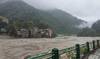
Rescuers help evacuate residents from a flooded street in Rongjiang, in China’s southwest Guizhou province. (AFP)
Short Url
Updated 28 June 2025
Follow

Heavy rain hits China’s flood-stricken Guizhou for second time in a week

  • Authorities raised the city’s flood emergency response level to the highest level on Saturday
  • The amount of rain that fell over 72 hours was double the city’s average for June

SHANGHAI: Heavy rain struck China’s southwestern Guizhou province again on Saturday, half-submerging the already flood-stricken riverside city of Rongjiang for a second time this week and prompting the evacuation of residents to higher ground.

Located at the confluence of three rivers and home to 300,000 residents, Rongjiang was inundated earlier this week by record downpours that left six dead and forced more than 80,000 people to flee their homes. The amount of rain that fell over 72 hours was double the city’s average for June.

In response to the new round of flooding, authorities raised the city’s flood emergency response level to the highest level on Saturday.

The benchmark hydrological station on one of the rivers estimated that the peak water level would hit 253.50 meters (832 ft) at around 5 p.m. (0900 GMT), exceeding the safety threshold by 2 meters, state broadcaster CCTV said.

Earlier this week, the peak water level reached 256.7 meters, the highest since 1954, the Guizhou provincial government said in a statement to Reuters on Friday, blaming “the extreme climate” for the flooding.

The floods in southwest China are set to hit local economies.

Rongjiang was removed from the national poverty list in 2020. It then saw an unexpected tourism boom after a local soccer league nicknamed “Village Super League” became a social media sensation, attracting thousands of fans and tourists. On Tuesday, the soccer pitch was up to seven meters under water.

China has battled with summer floods for millennia, but some scientists say climate change is resulting in heavier and more frequent rain. Massive flooding could set off unforeseen “black swan” events with dire consequences, such as dam collapses, Chinese officials say.

In southern China over the past two days, 13 major rivers in Yunnan, Guizhou, Guangxi and Hainan were hit by storms and had risen above their warning levels, CCTV reported, citing the Ministry of Water Resources on Saturday.


Prabowo, Trump expected to sign Indonesia-US tariff deal in January 2026

Updated 23 December 2025
Follow

Prabowo, Trump expected to sign Indonesia-US tariff deal in January 2026

  • Deal will mean US tariffs on Indonesian products are cut from a threatened 32 percent to 19 percent
  • Jakarta committed to scrap tariffs on more than 99 percent of US goods

JAKARTA: Indonesia expects to sign a tariff deal with the US in early 2026 after reaching an agreement on “all substantive issues,” Jakarta's chief negotiator said on Tuesday.

Indonesia’s Coordinating Minister for Economic Affairs Airlangga Hartarto met with US trade representative Jamieson Greer in Washington this week to finalize an Indonesia-US trade deal, following a series of discussions that took place after the two countries agreed on a framework for negotiations in July.

“All substantive issues laid out in the Agreement on Reciprocal Trade have been agreed upon by the two sides, including both the main and technical issues,” Hartarto said in an online briefing.

Officials from both countries are now working to set up a meeting between Indonesian President Prabowo Subianto and US President Donald Trump. 

It will take place after Indonesian and US technical teams meet in the second week of January for a legal scrubbing, or a final clean-up of an agreement text.

“We are expecting that the upcoming technical process will wrap up in time as scheduled, so that at the end of January 2026 President Prabowo and President Trump can sign the Agreement on Reciprocal Trade,” Hartarto said.  

Indonesian trade negotiators have been in “intensive” talks with their Washington counterparts since Trump threatened to levy a 32 percent duty on Indonesian exports. 

Under the July framework, US tariffs on Indonesian imports were lowered to 19 percent, with Jakarta committing to measures to balance trade with Washington, including removing tariffs on more than 99 percent of American imports and scrapping all non-tariff barriers facing American companies. 

Jakarta also pledged to import $15 billion worth of energy products and $4.5 billion worth of agricultural products such as soybeans, wheat and cotton, from the US. 

“Indonesia will also get tariff exemptions on top Indonesian goods, such as palm oil, coffee, cocoa,” Hartarto said. 

“This is certainly good news, especially for Indonesian industries directly impacted by the tariff policy, especially labor-intensive sectors that employ around 5 million workers.” 

In the past decade, Indonesia has consistently posted trade surpluses with the US, its second-largest export market after China. 

From January to October, data from the Indonesian trade ministry showed two-way trade valued at nearly $36.2 billion, with Jakarta posting a $14.9 billion surplus.