

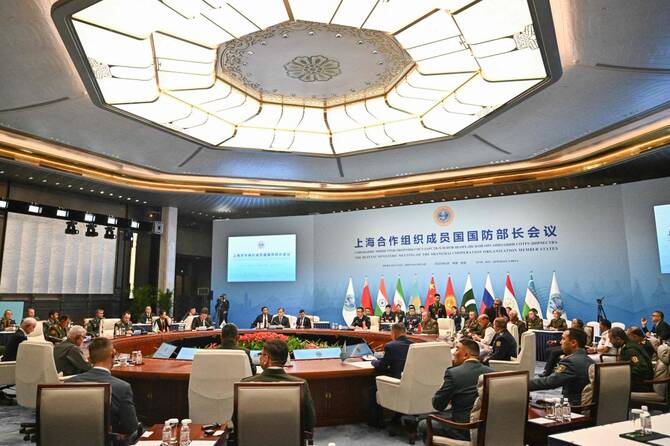

QINGDAO, China: China hosted defense ministers from Iran and Russia for a meeting in its eastern seaside city of Qingdao on Thursday against the backdrop of war in the Middle East and a summit of NATO countries in Europe that agreed to boost military spending.
Beijing has long sought to present the 10-member Shanghai Cooperation Organization (SCO) as a counterweight to Western-led power blocs and has pushed to strengthen collaboration between its member countries in politics, security, trade and science.
The Qingdao meeting of the organization’s top defense officials comes as a fledgling ceasefire between Israel and Iran holds after 12 days of fighting between the arch-foes.
It is also being held the day after a summit of North Atlantic Treaty Organization (NATO) leaders in The Hague, where members agreed to ramp up their defense spending to satisfy US President Donald Trump.
Beijing’s ties with Moscow are also in the spotlight.
China has portrayed itself as a neutral party in Russia’s war with Ukraine, although Western governments say its close ties have given Moscow crucial economic and diplomatic support.
Russian Defense Minister Andrei Belousov painted a bleak picture of a world seeing “worsening geopolitical tensions” when he addressed his counterparts at the meeting.
“The current military and political situation in the world remains difficult and shows signs of further deterioration,” he said, according to a statement by the Russian defense ministry.
His Chinese counterpart Dong Jun also framed Thursday’s meeting in Qingdao, home to a major Chinese naval base, as a counterweight to a world in “chaos and instability.”
“As momentous changes of the century accelerate, unilateralism and protectionism are on the rise,” Dong said as he welcomed defense chiefs from Russia, Iran, Pakistan, Belarus and elsewhere on Wednesday, according to state news agency Xinhua.
“Hegemonic, domineering and bullying acts severely undermine the international order,” he warned.
He urged his counterparts to “take more robust actions to jointly safeguard the environment for peaceful development.”
Recent fighting between Israel, Iran and the United States will likely also be discussed in Qingdao.
Beijing refrained from offering anything more than diplomatic support to its close partner Tehran throughout that conflict, reflecting its limited leverage in the region and reluctance to worsen relations with the United States.
“Public backing for Iran will come in the form of words, rather than deeds,” James Char, an expert on the Chinese army at Nanyang Technological University in Singapore, told AFP.
“Other than condemning the US strikes on Iran, Beijing can be expected to continue treading cautiously in the Middle East’s security issues and would not want to be dragged into the region’s security challenges,” he said.
Iran’s defense minister will likely “discuss with China the supply of weapons but I doubt China would agree,” said Andrea Ghiselli, an expert in China foreign policy and a lecturer at Exeter University.
“It would be seen as provocative by both Israel... and, even more important for China, the US, with which Beijing is trying to stabilize relations,” Ghiselli said.
India’s Defense Minister Rajnath Singh, also in attendance in Qingdao, said SCO members should “collectively aspire to fulfil the aspirations and expectations of our people as well as tackle today’s challenges.”
“The world we live in is undergoing a drastic transformation. Globalization, which once brought us closer together, has been losing momentum,” he said in comments his office posted on social media platform X.


