

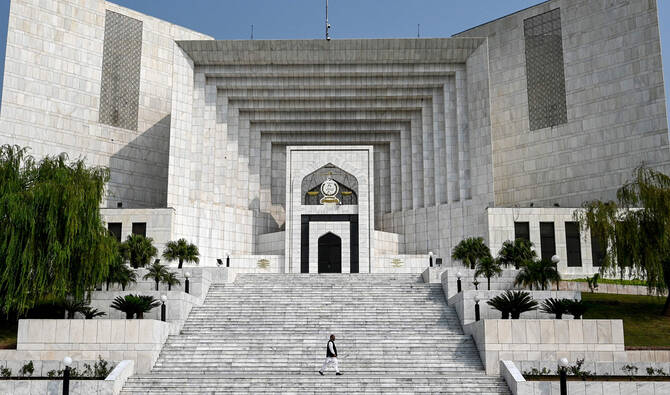

ISLAMABAD: Pakistan’s top court on Friday ruled the Pakistan Tehreek-e-Insaf (PTI) party of jailed former prime minister Imran Khan is not entitled to reserved seats in the national and provincial legislatures, setting aside an earlier judgment that had granted the party its share.
The Supreme Court’s Constitutional Bench dismissed all review petitions filed by PTI and allied petitioners, reinstating the Peshawar High Court’s earlier ruling rejecting the allocation of reserved seats to the party.
“The impugned majority judgment dated 12.07.2024 is set aside… and the judgment rendered by the Peshawar High Court, Peshawar is restored,” the short order read.
The dispute about the reserved seats stems from the February 8 general elections, where PTI candidates contested as independents after the party lost its electoral symbol for not holding valid intra-party elections, as required under the Elections Act.
Despite winning the most general seats in the national polls, the Election Commission of Pakistan (ECP) ruled that PTI was ineligible for reserved seats for women and minorities in parliament, which are allocated based on proportional representation from among the seats won by political parties.
Last year in July, the Supreme Court reversed the ECP’s decision, terming it unconstitutional and ordering the reserved seats to be allocated to PTI.
However, the government subsequently passed amendments to the Elections Act, 2017, in a move widely seen as targeting PTI’s eligibility for reserved seats.
The revised law stipulated that only those candidates who had formally declared their party affiliation before the returning officer — and whose party had submitted lists of nominees for reserved seats within the legal deadline — would be entitled to such allocations.
Since PTI-backed candidates contested the February election as independents, and the party did not submit lists for reserved seats, the amendments effectively barred it from claiming a share.
With Friday’s verdict, the apex court has now ruled that the independents backed by PTI in the February election cannot be treated as party nominees for the purpose of seat allocation.
Responding to the development, Khan’s party described the short order as the “funeral … of justice” in a social media post.
The government, on the other hand, welcomed the decision, with Prime Minister Shehbaz Sharif congratulating its legal team’s “tireless efforts.”
“The decision has upheld the supremacy of the Constitution and law, and ensured correct interpretation of legal provisions,” he said in a statement.
“The opposition should now join the government in playing a constructive role for the country’s development and prosperity,” he added.
The reserved seats in question will now be allocated to other political parties, including Sharif’s Pakistan Muslim League-Nawaz (PML-N) party and its coalition partners.
The top court’s verdict will numerically strengthen the government while dealing yet another blow to Khan’s PTI, which has faced legal and political challenges since the downfall of its administration in a no-confidence vote in April 2022.




