BANGKOK: The US and China have signed an agreement on trade, President Donald Trump said, adding he expects to soon have a deal with India.
Commerce Secretary Howard Lutnick told Bloomberg TV that the deal was signed earlier this week. Neither Lutnick nor Trump provided any details about the agreement.
“We just signed with China the other day,” Trump said late Thursday.
Lutnick said the deal was “signed and sealed” two days earlier.
It follows initial talks in Geneva in early May that led both sides to postpone massive tariff hikes that were threatening to freeze much trade between the two countries. Later talks in London set a framework for negotiations and the deal mentioned by Trump appeared to formalize that agreement.
“The president likes to close these deals himself. He’s the dealmaker. We’re going to have deal after deal,” Lutnick said.
China has not announced any new agreements, but it announced earlier this week that it was speeding up approvals of exports of rare earths, materials used in high-tech products such as electric vehicles. Beijing’s limits on exports of rare earths have been a key point of contention.
The Chinese Commerce Ministry said Thursday that Beijing was accelerating review of export license applications for rare earths and had approved “a certain number of compliant applications.”

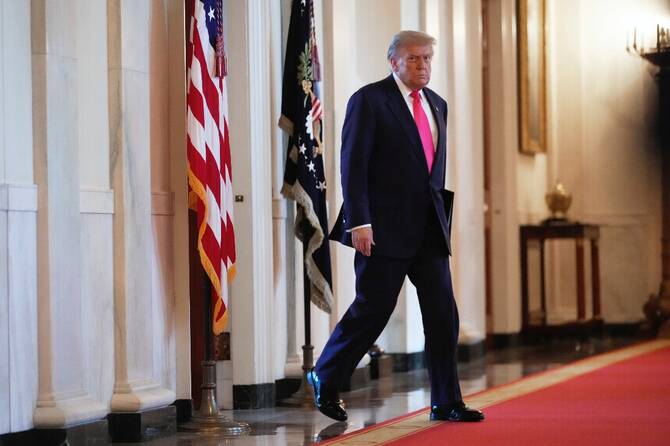
Trump says US has signed a deal with China on trade, without giving details
https://arab.news/j8ncu
Trump says US has signed a deal with China on trade, without giving details
Kremlin welcomes US sanctions waiver says US and Russia share interest in stable energy markets
DUBAI: Russia sees a U.S. sanctions waiver on its oil as an attempt by Washington to stabilise global energy markets, and the two countries have a shared interest in this, Kremlin spokesman Dmitry Peskov said on Friday.
"We see actions by the United States aimed at trying to stabilise energy markets. In this respect, our interests coincide," he said.
US Treasury Secretary Scott Bessent announced a temporary authorisation allowing countries around the world to purchase Russian oil currently stranded at sea on Thursday extending a measure that had previously been granted only to Indian refiners.
Bessent stressed in a post on X that the authorisation would not provide significant financial benefit to the Russian government.
“This narrowly tailored, short-term measure applies only to oil already in transit and will not provide significant financial benefit to the Russian government, which derives the majority of its energy revenue from taxes assessed at the point of extraction,” Bessent said on a post on X.
However, the measure received mix reviews in European capitals, with many fearing it could help replenish Russia's assualt on Ukraine.
"I am concerned that we are further filling Putin's war chest," German Economy Minister Katherina Reiche said in Berlin on Friday.
Reiche said that she saw both sides to the United States' decision to issue a 30-day waiver for the purchase of Russian oil products, understanding the increasing ecnomic and political turnout from the oil crisis, particurlarly in South Korea and Japan.
"It seems to me that domestic political pressure in the United States is very, very high," Reiche said.
German Chancellor Friedrich Merz was more direct, saying on Friday that it was wrong to ease sanctions against Russia for whatever reason. The sentiment was echoed by Norway’s Prime Minister, who also said sanctions should not be eased.
Oil prices held gains above $100 Friday and most equity markets dropped after Iran's leader called for the blocking of the crucial Strait of Hormuz and the opening up of new fronts in the war against the United States and Israel.
With the conflict heading towards its third week and showing no signs of ending, investors are growing increasingly worried about an extended crisis that could fan inflation and hammer the global economy.


