

After NATO deal, how far will EU go for trade peace with Trump?

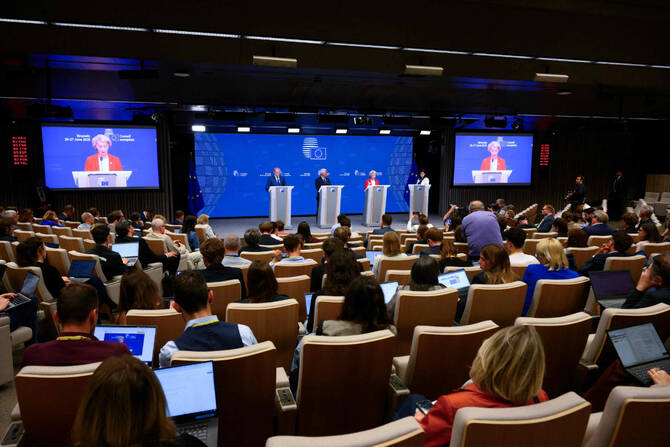
European Commission President Ursula von der Leyen (2nd R), European Council President Antonio Costa (2nd L) and Poland's Prime Minister Donald Tusk (L) give a press conference after working sessions at the European Council in Brussels on June 26, 2025. (AFP)
Short Url
Updated 27 June 2025
Follow

After NATO deal, how far will EU go for trade peace with Trump?

  • France and Germany want Brussels to move fast in search of a deal
  • EU has until July 9 to reach a deal or see swingeing tariffs kick in on a majority of goods

BRUSSELS, Belgium: After satisfying Donald Trump’s calls for Europe to ramp up defense spending in NATO, EU leaders in Brussels turned Thursday to the next big challenge ahead: how to seal a trade deal with the US leader.
Time is running out. The European Union has until July 9 to reach a deal or see swingeing tariffs kick in on a majority of goods, unleashing economic pain.
The European Commission, in charge of EU trade policy, has been in talks with Washington for weeks, and the leaders of Europe’s two biggest economies France and Germany on Thursday urged Brussels to move fast in search of a deal.
“France is in favor of reaching a quick agreement, we don’t want it to drag on forever,” President Emmanuel Macron told reporters after summit talks involving the bloc’s 27 leaders and EU chief Ursula von der Leyen.
While Macron said European nations “do not want a deal at any cost,” Germany’s chancellor has signalled he wants to close a deal fast — even if it means an unbalanced outcome with some level of US tariffs on EU goods.
“It’s better to act quickly and simply than slowly and in a highly complicated way,” Friedrich Merz told a press conference after the talks.
The EU has put a zero-percent tariff proposal on the table — but it’s widely seen as a non-starter in talks with Washington.
Von der Leyen said the commission had just received the latest US counterproposal, adding: “We are assessing it as we write, speak right now.”

‘Swiss cheese’ option

According to several diplomats, the goal at this point is rather to let Trump claim victory without agreeing a deal that would significantly hurt Europe.
One diplomat suggested leaders would be happy with a “Swiss cheese” agreement — with a general US levy on European imports, but enough loopholes to shield key sectors such as steel, automobiles, pharmaceuticals and aeronautics.
This would be less painful than the status quo with European companies currently facing 25-percent tariffs on steel, aluminum and auto goods exported to the United States, and 10 percent on a majority of EU products.
Merz had earlier this week taken aim at the EU’s approach to talks as overly complicated, urging “rapid, joint decisions for four or five major industries now.”
The issue was the focus of Thursday’s summit dinner, at which von der Leyen was able to test leaders’ red lines in negotiations.
If no agreement is reached, the default tariff on EU imports is expected to double to 20 percent or even higher — Trump having at one point threatened 50 percent.
White House Press Secretary Karoline Leavitt on Thursday suggested the administration could extend the July deadline but said “that’s a decision for the president to make.”

Avoiding escalation
Unlike Canada or China, which hit back swiftly at Trump’s tariff hikes, the EU has consistently sought to negotiate with the US leader — threatening retaliation only if no agreement is reached.
“We will not allow ourselves to be provoked, we will remain calm,” said Belgian Prime Minister Bart De Wever, urging the EU to avert an all-out trade war with Washington.
Talks between EU and US negotiators have intensified in recent weeks.
Trump divides the Europeans.
Hungarian Prime Minister Viktor Orban and Italian Prime Minister Giorgia Meloni are both vocally supportive of Trump — while others are more wary.
“The problem is that on behalf of the United States, we have a heavyweight dealmaker — on our side, European Union, have light capacity and capability leaders to negotiate,” said Orban.
Pro-trade countries in Europe’s north are especially keen to avoid an escalation.
The EU has threatened to slap tariffs on US goods worth around 100 billion euros, including cars and planes, if talks fail to yield an agreement — but has not made any mention of those threats since May.
The United States is also using the negotiations to try to extract concessions on EU rules — particularly digital competition, content and AI regulations, which Washington claims unfairly target American champions such as Apple, Google, and Meta.
Europeans are ready to discuss common transatlantic standards, but the EU’s digital rules are a red line for Brussels.


Stars and royals gather for the BAFTA film awards, with ‘One Battle’ and ‘Sinners’ leading the race

Britain's William, Prince of Wales, and Catherine, Princess of Wales, arrive at the BAFTA Film Awards 2026.
Updated 3 sec ago
Follow

Stars and royals gather for the BAFTA film awards, with ‘One Battle’ and ‘Sinners’ leading the race

LONDON: Hollywood stars and British celebrities, from Paddington Bear to the Princess of Wales, gathered Sunday for the British Academy Film Awards, where politically charged thriller “One Battle After Another” and blues-steeped epic “Sinners” led the field of nominees.
The two films snagged early prizes, with Wunmi Mosaku taking the supporting actress award for “Sinners,” and Sean Penn winning the supporting actor trophy for “One Battle After Another.”
Oddsmakers suggest Shakespearean family tragedy “Hamnet” could beat the front-runners to best picture if British film industry voters respond to the emotionally rich story, earthy English setting and intense performances in Chloé Zhao’s adaptation of Maggie O’Farrell’s historical novel.
Stars including Leonardo DiCaprio, Timothée Chalamet, Emma Stone, Cillian Murphy, Glenn Close and Ethan Hawke were among those walking the red carpet outside London’s Royal Festival Hall before a black-tie ceremony hosted by Scottish actor Alan Cumming.
Prince William and Catherine, Princess of Wales also attended, three days after William’s uncle Andrew Mountbatten-Windsor was arrested by police and held for 11 hours over allegations he sent sensitive government information to the late financier and sex offender Jeffrey Epstein.
The scandal has rocked the royal family led by King Charles III, though William and Kate remain popular standard-bearers for the monarchy. William is due to present an award in his role as president of the British Academy of Film and Television Arts.
Among the biggest receptions from gathered fans was for Paddington, the puppet bear who stars in a musical stage adaption of the beloved children’s classic.
Oscars bellwether
“One Battle” has 14 nominations, including best picture and acting nods for five of its cast. “Sinners” is just behind with 13, while “Hamnet” and the ping-pong odyssey “Marty Supreme” each have 11 nominations.
Guillermo del Toro’s reimagining of “Frankenstein” and Norwegian family drama ” Sentimental Value” each got eight nominations.
The British prizes, officially called the EE BAFTA Film Awards, often provide hints about who will win at Hollywood’s Academy Awards, held this year on March 15. In the Oscar nominations, “Sinners” leads the race with a record 16 nominations, followed by “One Battle After Another” with 13.
Cumming told the audience that it had been a strong year for cinema, if not a cheerful one, with nominated films tackling themes including child death, racism and political violence:
“Watching the films this year was like taking part in a collective nervous breakdown,” he said. “It’s almost as though there are events going on in the real world that are influencing filmmakers.”
The BAFTA best film nominees are “One Battle After Another,” “Hamnet,” “Marty Supreme,” “Sinners” and “Sentimental Value.” The BAFTAs also have a distinctly British accent, with a separate category for best British film. Its 10 nominees include “The Ballad of Wallis Island,” “Pillion,” “I Swear” and “Bridget Jones: Mad About the Boy.”
Directing contenders are Paul Thomas Anderson for “One Battle,” Josh Safdie for “Marty Supreme,” Ryan Coogler for “Sinners,” Yorgos Lanthimos for dystopian tragicomedy “Bugonia,” Joachim Trier for “Sentimental Value” and Zhao for “Hamnet.” Zhao will be the first female director to win two BAFTAs if she takes the prize. She won the directing award in 2021 for “Nomadland.”
Best leading actor nominees are bookies’ favorite Chalamet for “Marty Supreme,” DiCaprio for “One Battle After Another,” Ethan Hawke for Broadway biopic “Blue Moon,” Michael B. Jordan for “Sinners,” Jesse Plemons for “Bugonia” and Robert Aramayo for playing an advocate for people with Tourette’s syndrome in biographical drama “I Swear.”
The leading actress category includes the strongly favored Jessie Buckley for her performance as Agnes Hathaway, wife of William Shakespeare, in “Hamnet.” She’s up against Rose Byrne for “If I Had Legs I’d Kick You,” Kate Hudson for “Song Sung Blue,” Chase Infiniti for “One Battle After Another,” Renate Reinsve for “Sentimental Value” and Emma Stone for “Bugonia.”
“One Battle” actors Teyana Taylor, Benicio del Toro and Sean Penn are all nominated for supporting performances.
AP gets documentary nod
The Associated Press was recognized in the best documentary category with a nomination for Mstyslav Chernov’s harrowing Ukraine war portrait “2000 Meters to Andriivka, ” co-produced by the AP and Frontline PBS.
Most BAFTA winners are chosen by 8,500 members of the UK academy of industry professionals. Contenders for the Rising Star award — the only prize decided by public vote and a reliable picker of future A-listers — are Infiniti, Aramayo, “Sinners” star Miles Caton and British actors Archie Madekwe and Posy Sterling.
Donna Langley, the UK-born chairwoman of NBCUniversal Entertainment, will be awarded the British Academy’s highest honor, the BAFTA fellowship.
The ceremony airs on BBC in the United Kingdom starting at 7 p.m. (1900 GMT) and on E! in the US at 8 p.m. EST.