

US, Pakistan agree to work together to promote peace in Middle East

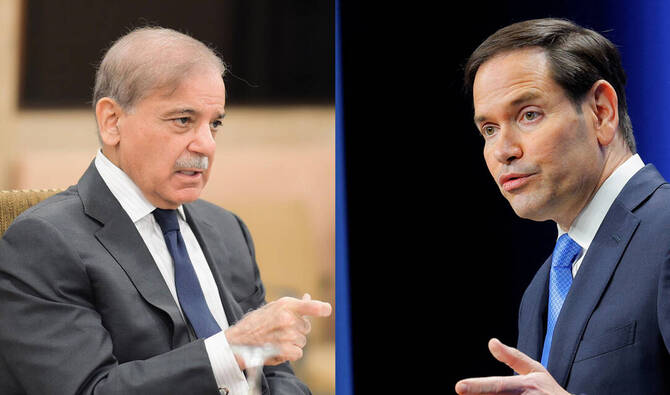
This combination of photos, created on June 27, 2025, shows Pakistan Prime Minister Shehbaz Sharif speaking during the Federal Cabinet meeting at the Parliament House in Islamabad, Pakistan on June 27, 2025, and US Secretary of State Marco Rubio addressing a press conference at the NATO summit in The Hague, Netherlands on June 25, 2025. (Photo courtesy: PMO/REUTERS/File)
Short Url
Updated 27 June 2025
Follow

US, Pakistan agree to work together to promote peace in Middle East

  • The development comes after 12-day war between Iran, Israel raised alarms in the region
  • State Secretary Marco Rubio tells Pakistan PM Iran can never acquire a nuclear weapon

ISLAMABAD: The United States (US) and Pakistan have agreed to work together for peace in the Middle East, the US State Department said on Thursday, following a telephone call between US State Secretary Marco Rubio and Pakistan Prime Minister Shehbaz Sharif.

The development comes after a 12-day war between Iran and Israel, which began with June 13 Israeli airstrikes on Iranian nuclear facilities and military leadership, raising alarms in a region that was already on edge since the start of Israel’s war on Gaza in October 2023.

The Israeli strikes came at a time when Iranian officials were engaged in nuclear negotiations with the US and the conflict worsened after the US struck three Iranian nuclear sites on June 22. President Donald Trump claimed the strikes set back Iran’s nuclear program by years.

Pakistan has remained engaged in talks with regional partners like Saudi Arabia, Iran, China and Qatar to de-escalate tensions in the Middle East after Iran conducted retaliatory strikes on a US base in Qatar, raising fears the conflict could draw in other regional states.

“Secretary Rubio emphasized Iran can never develop or acquire a nuclear weapon,” State Department spokesperson Tammy Bruce said in a statement after Rubio-Sharif call. “The two leaders acknowledged the importance of working together to promote a durable peace between Israel and Iran and maintaining regional stability.”

Israel, the only Middle Eastern country widely believed to have nuclear weapons, said its war against Iran aimed to prevent Tehran from developing its own nuclear weapons. Iran is a party to the Nuclear Non-Proliferation Treaty while Israel is not.

Pakistan condemned Israeli and US strikes on Iran, and expressed concern over Iranian strikes on the US base in Qatar, calling for all parties to adhere to international law and the United Nations (UN) charter principles.

“While exchanging views on the current situation in the Middle East, the prime minister stated that Pakistan would continue to play a constructive role for bringing peace to the Middle East,” Sharif’s office said in a statement after his telephonic talk with Rubio.

In recent weeks, Pakistan has also repeatedly thanked Trump for his mediation during Islamabad’s four-day military standoff with India last month. Both countries had pounded each other with missiles, fighter jets, artillery fire and drone strikes that killed over 70 on both sides before the US announced a ceasefire on May 10.

While the May 10 ceasefire continues to hold, New Delhi has refused to budge from its earlier stance of suspending a decades-old water-sharing treaty with Pakistan. Islamabad has previously said any attempts to stop or divert its water will be regarded as an “act of war” and is also exploring a challenge to the Indian move.

During his conversation with Rubio, Sharif appreciated the “key role” Washington played in the Pakistan-India ceasefire, according to his office.

“The Prime Minister and Secretary Rubio agreed to continue working closely to strengthen Pakistan-US relations, particularly through enhanced trade,” it said.


ADB, Pakistan sign over $300 million agreements to undertake climate resilience initiatives

Updated 30 December 2025
Follow

ADB, Pakistan sign over $300 million agreements to undertake climate resilience initiatives

  • Pakistan ranks among nations most vulnerable to climate change and has seen erratic changes in weather patterns
  • The projects in Sindh and Punjab will restore nature-based coastal defenses and enhance agricultural productivity

ISLAMABAD: The Pakistani government and the Asian Development Bank (ADB) have signed more than $300 million agreements to undertake two major climate resilience initiatives, Pakistan’s Press Information Department (PID) said on Tuesday.

The projects include the Sindh Coastal Resilience Sector Project (SCRP), valued at Rs50.5 billion ($180.5 million), and the Punjab Climate-Resilient and Low-Carbon Agriculture Mechanization Project (PCRLCAMP), totaling Rs34.7 billion ($124 million).

Pakistan ranks among nations most vulnerable to climate change and has seen erratic changes in its weather patterns. In 2022, monsoon floods killed over 1,700 people, displaced another 33 million and caused over $30 billion losses, while another 1,037 people were killed in floods this year.

The South Asian country is ramping up climate resilience efforts, with support from the ADB and World Bank, and investing in climate-resilient infrastructure, particularly in vulnerable areas.

“Both sides expressed their commitment to effectively utilize the financing for successful and timely completion of the two initiatives,” the PID said in a statement.

The Sindh Coastal Resilience Project (SCRP) will promote integrated water resources and flood risk management, restore nature-based coastal defenses, and strengthen institutional and community capacity for strategic action planning, directly benefiting over 3.8 million people in Thatta, Sujawal, and Badin districts, according to ADB.

The Punjab project will enhance agricultural productivity and climate resilience across 30 districts, improving small farmers’ access to climate-smart machinery, introducing circular agriculture practices to reduce residue burning, establishing testing and training facilities, and empowering 15,000 women through skills development and livelihood diversification.

Earlier this month, the ADB also approved $381 million in financing for Pakistan’s Punjab province to modernize agriculture and strengthen education and health services, including concessional loans and grants for farm mechanization, Science, Technology, Engineering and Mathematics (STEM) education, and nursing sector reforms.