Saudi Arabia deploys drones to monitor coastlines, protect marine resources

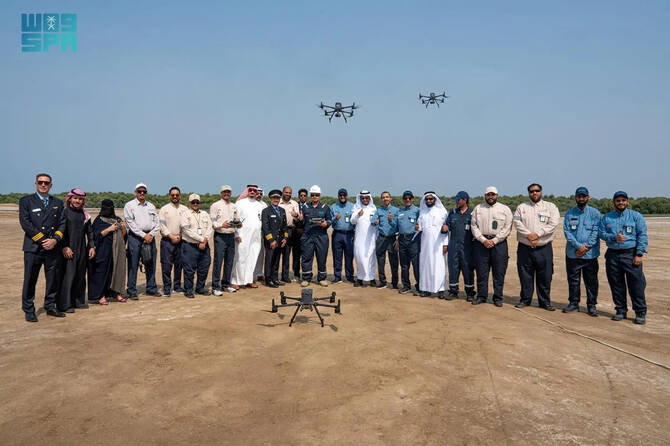
Drones will provide live video feeds for real-time analysis, helping detect activities that threaten marine resources. (SPA)
Short Url
Updated 27 June 2025
Follow

Saudi Arabia deploys drones to monitor coastlines, protect marine resources

  • Drones to provide live video of 2,480km coastline
  • Quicker to spot pollution, says watchdog’s official

RIYADH: Saudi Arabia’s National Center for Environmental Compliance has launched a drone-based program to monitor the Kingdom’s 2,480-km-long coastal areas, according to the Saudi Press Agency.

The NCEC will carry out the initiative in cooperation with the Marine Operations for Environmental Services organization.

Drones will provide live video feeds for real-time analysis, to help detect activities that threaten marine resources, the SPA reported recently.

Saudi Arabia’s Red Sea coastline in the west extends from the Gulf of Aqaba in the north to Jazan province in the south, measuring 1,830 km.

In the west, the coastline is 630 km, stretching from the northern border with Kuwait to the southern border with Qatar.

Amer Bamoneef, director-general for network monitoring at the NCEC, said each drone will operate for up to 55 minutes per sortie, covering 20 km, with data transmitted instantly to control rooms.

“By leveraging advanced technology, we can expand coverage and detect harmful practices more efficiently,” he said.

Bamoneef added that drones enable quicker responses, allowing teams to promptly investigate pollution sources and identify those responsible.



Riyadh to host final of Global Minerals Innovation Competition

Updated 23 sec ago
Follow

Riyadh to host final of Global Minerals Innovation Competition

  • 350 people in 70 teams to attend ‘boot camp’ next month
  • Competition attracted more than 1,800 people from 57 countries

JEDDAH: More than 350 people will take part in the final stage of the inaugural Global Minerals Innovation Competition, to be held next month in Riyadh.

The closing event, titled Future Minerals Pioneers, marks the end of a nationwide tour that began in October to find the best talent in the industry, the Saudi Press Agency reported.

The tour was sponsored by Saudi Mining Services Co. and attracted more than 1,800 people from 57 countries. Just over two-thirds of the members of the 70 teams that made it through to the final stage are from Saudi Arabia.

The so-called final boot camp will take place from Jan. 8-10, with the winners announced during the fifth edition of the Future Minerals Forum on Jan. 14.

The camp will comprise workshops and mentoring sessions, after which the teams will make their final presentations to the judges.

Held under the patronage of Minister of Industry and Mineral Resources Bandar Alkhorayef and led by Vice Minister for Mining Affairs Khalid bin Saleh Al-Mudaifer, the contest was organized by the National Industrial Development and Logistics Program in partnership with the Ministry of Industry and Mineral Resources and Saudi Arabian Mining Co.

It features three main tracks: smart technologies, security and safety, and resource sustainability, with the focus on creating practical solutions to challenges across the mining value chain and fostering an integrated innovation ecosystem, the report said.

According to a report by the Canada-based Fraser Institute, the Kingdom rose to 23rd place on the Mining Investment Attractiveness Index in 2024, up from 104th a year earlier. It also rose to 20th (from 82nd) on the Policy Perceptions Index and to 24th (from 58th) on the Geological Potential Index, indicating growing global confidence in the sector.

The indicators also align with national efforts to unlock the country’s vast mineral wealth, estimated at SR9.4 trillion ($2.5 trillion).

That work is being driven by the General Program for Geological Surveying, which aims to stimulate investment and enhance competitiveness through the creation of a national geological database. About two-thirds of the first phase of the program, covering 630,000 sq. km. of the Arabian Shield, has been completed.