BRUSSELS: The EU’s 27 leaders on Thursday agreed to extend sanctions on Russia for another six months, resolving fears that Kremlin-friendly Hungary would let the measures lapse, officials said.
The decision at a summit in Brussels means that the EU’s sweeping sanctions over the war in Ukraine, including the freezing of more than 200 billion euros ($234 billion) in Russian central bank assets, will remain in force until at least early 2026.
It comes after officials said they were preparing contingency plans to keep the bloc’s economic punishment on Moscow in place should Hungarian leader Viktor Orban refuse to budge.
EU counterparts had feared a refusal by Budapest to renew the measures could blow a massive hole in the leverage the bloc holds over Russia as the United States presses peace efforts.
Orban took the decision to the wire the last time the sanctions — which need to be extended every six months — came up for renewal in January.
But while the EU made sure its existing measures will remain in place, it failed to get clearance on a new package of sanctions due to a blockage by Hungary’s ally Slovakia.
Slovakian leader Roberto Fico refused at the summit to greenlight the new round of sanctions due to a separate dispute with Brussels over plans to cut off imports of Russian gas by the end of 2027.
Slovakia remains dependent on Russian gas imports and earns money from transit fees for supplies piped across its territory.
Fico held talks with EU chief Ursula von der Leyen earlier on Thursday but failed to get the concessions he wants and announced he would hold up approval of the sanctions package.
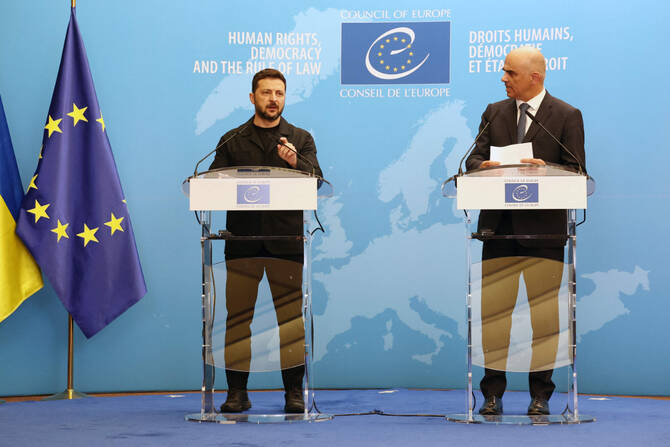
Ukraine’s President Volodymyr Zelensky urged EU leaders in a video address to adopt the strong package “targeting Russia’s oil trade, shadow tanker fleet, banks, and supply chains that bring equipment or parts for making weapons.”
Officials say, however, that a push to lower a price cap on Russian oil exports has been shelved after Washington failed to back the push as part of a broader G7 initiative.

EU leaders agree to prolong Russia sanctions: officials
https://arab.news/44tvm
EU leaders agree to prolong Russia sanctions: officials
- EU’s sweeping sanctions includes freezing of more than 200 billion euros ($234 billion) in Russian central bank assets
US signs new health deals with 9 African countries that mirror Trump’s priorities
- US aid cuts have crippled health systems across the developing world, including in Africa, where many countries relied on the funding for crucial programs, including those responding to outbreaks of disease
- The agreements signed so far, with Kenya, Nigeria and Rwanda among others, are the first under the new global health framework, which makes aid dependent on negotiations between the recipient country and the US
JOHANNESBURG: The US government has signed health deals with at least nine African countries, part of its new approach to global health funding, with agreements that reflect the Trump administration’s interests and priorities and are geared toward providing less aid and more mutual benefits.
The agreements signed so far, with Kenya, Nigeria and Rwanda among others, are the first under the new global health framework, which makes aid dependent on negotiations between the recipient country and the US.
Some of the countries that have signed deals either have been hit by US aid cuts or have separate agreements with the Trump administration to accept and host third-country deportees, although officials have denied any linkage.
The Trump administration says the new “America First” global health funding agreements are meant to increase self-sufficiency and eliminate what it says are ideology and waste from international assistance. The deals replace a patchwork of previous health agreements under the now-dismantled United States Agency for International Development.
US aid cuts have crippled health systems across the developing world, including in Africa, where many countries relied on the funding for crucial programs, including those responding to outbreaks of disease.
The new approach to global health aligns with President Donald Trump’s pattern of dealing with other nations transactionally, using direct talks with foreign governments to promote his agenda abroad. It builds on his sharp turn from traditional US foreign assistance, which supporters say furthered American interests by stabilizing other countries and economies and building alliances.
A different strategy
The deals mark a sharp departure from how the US has provided health care funding over the years and mirrors the Trump administration’s interests.
South Africa, which has lost most of its US funding — including $400 million in annual support — due in part to its disputes with the US, has not signed a health deal, despite having one of the world’s highest HIV prevalence rates.
Nigeria, Africa’s most populous country, reached a deal but with an emphasis on Christian-based health facilities, although it has a slight majority Muslim population. Rwanda and Uganda, which each have deportation deals with the US, have announced the health pacts.
Cameroon, Eswatini, Lesotho, Liberia and Mozambique also are among those that have signed health deals with the US
According to the Center for Global Development, a Washington think tank, the deals “combine US funding reductions, ambitious co-financing expectations, and a shift toward direct government-to-government assistance.”
The deals represent a reduction in total US health spending for each country, the center said, with annual US financial support down 49 percent compared with 2024.
A faith-based deal in Nigeria, a lifeline for several others
Under its deal, Nigeria, a major beneficiary of USAID funds, would get support that has a “strong emphasis” on Christian faith-based health care providers.
The US provided approximately $2.3 billion in health assistance to Nigeria between 2021 and 2025, mostly through USAID, official data shows. The new five-year agreement will see US support at over $2 billion, while Nigeria is expected to raise $2.9 billion to boost its health care programs.
The agreement “was negotiated in connection with reforms the Nigerian government has made to prioritize protecting Christian populations from violence and includes significant dedicated funding to support Christian health care facilities,” the State Department said in a statement.
The department said “the president and secretary of state retain the right to pause or terminate any programs which do not align with the national interest,” urging Nigeria to ensure “that it combats extremist religious violence against vulnerable Christian populations.”
For several other countries, the new deals could be a lifeline after US aid cuts crippled their health care systems and left them racing to fill the gaps.
Under its deal, Mozambique will get US support of over $1.8 billion for HIV and malaria programs. Lesotho, one of the poorest countries in the world, clinched a deal worth over $232 million.
In the tiny kingdom of Eswatini, the US committed to provide up to $205 million to support public health data systems, disease surveillance and outbreak response, while the country agreed to increase domestic health expenditures by $37 million.
No deal for South Africa after disputes
South Africa is noticeably absent from the list of signatories following tensions with the Trump administration.
Trump has said he will cut all financial assistance to South Africa over his widely rejected claims that it is violently persecuting its Afrikaner white minority.
The dismantling of USAID resulted in the loss of over $436 million in yearly financing for HIV treatment and prevention in South Africa, putting the program and thousands of jobs in the health care industry at risk.
Health compacts with countries that signed deportation deals
At least four of the countries that have reached deals previously agreed to receive third-country deportees from the US, a controversial immigration policy that has been a trademark of the Trump administration.
The State Department has denied any linkage between the health care compacts and agreements regarding accepting third-country asylum seekers or third-country deportees from the United States. However, officials have said that political considerations unrelated to health issues may be part of the negotiations.
Rwanda, one of the countries with a deportation deal with the US, signed a $228 million health pact requiring the US to support it with $158 million.
Uganda, another such country, signed a health deal worth nearly $2.3 billion in which the US will provide up to $1.7 billion. Also Eswatini, which has started receiving flights with deported prisoners from the US