Germany scraps funding for sea rescues of migrants

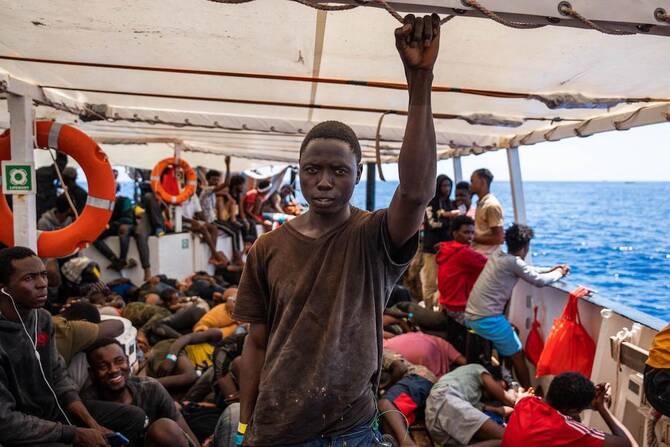
Germany is cutting financial support for charities that rescue migrants at risk of drowning in the Mediterranean, saying it will redirect resources to addressing conditions in source countries that spur people to leave. (AFP/File)
Short Url
Updated 26 June 2025
Follow

Germany scraps funding for sea rescues of migrants

  • “I don’t think it’s the foreign office’s job to finance this kind of sea rescue,” Wadephul said
  • “We need to be active where the need is greatest“

BERLIN: Germany is cutting financial support for charities that rescue migrants at risk of drowning in the Mediterranean, saying it will redirect resources to addressing conditions in source countries that spur people to leave.

For decades, migrants driven by war and poverty have made perilous crossings to reach Europe’s southern borders, with thousands estimated to die every year in their bid to reach a continent grown increasingly hostile to migration.

“Germany is committed to being humane and will help where people suffer but I don’t think it’s the foreign office’s job to finance this kind of sea rescue,” Foreign Minister Johann Wadephul told a news conference.

“We need to be active where the need is greatest,” he added, mentioning the humanitarian emergency in war-shattered Sudan.

Under the previous left-leaning government, Germany began paying around 2 million euros ($2.34 million) annually to non-governmental organizations carrying out rescues of migrant-laden boats in trouble at sea.

For them, it has been a key source of funds: Germany’s Sea-Eye, which said rescue charities have saved 175,000 lives since 2015, received around 10 percent of its total income of around 3.2 million euros from the German government.

Chancellor Friedrich Merz’s conservatives won February’s national election after a campaign promising to curb irregular migration, which some voters in Europe’s largest economy see as being out of control.

Even though the overall numbers have been falling for several years, many Germans blame migration-related fears for the rise of the far-right Alternative for Germany (AfD), now the second largest party in parliament.

Many experts say that migration levels are mainly driven by economic and humanitarian emergencies in the source countries, with the official cold shoulder in destination countries having had little impact in deterring migrants.

Despite this, German officials suggest that sea rescues only incentivise people to risk the sometimes deadly crossings.

“The (government) support made possible extra missions and very concretely saved lives,” said Gorden Isler, Sea-Eye’s chairperson. “We might now have to stay in harbor despite emergencies.”

The opposition Greens, who controlled the foreign office when the subsidies were introduced, criticized the move.

“This will exacerbate the humanitarian crisis and deepen human suffering,” said joint floor leader Britta Hasselmann.


Venezuela swears in 5,600 troops after US military build-up

Updated 58 min 33 sec ago
Follow

Venezuela swears in 5,600 troops after US military build-up

  • American forces have carried out deadly strikes on more than 20 vessels, killing at least 87

CARACAS: The Venezuelan army swore in 5,600 soldiers on Saturday, as the United States cranks up military pressure on the oil-producing country.
President Nicolas Maduro has called for stepped-up military recruitment after the United States deployed a fleet of warships and the world’s largest aircraft carrier to the Caribbean under the pretext of combating drug trafficking.
American forces have carried out deadly strikes on more than 20 vessels, killing at least 87.
Washington has accused Maduro of leading the alleged “Cartel of the Suns,” which it declared a terrorist organization last month.
Maduro asserts the American deployment aims to overthrow him and seize the country’s oil reserves.
“Under no circumstances will we allow an invasion by an imperialist force,” Col. Gabriel Rendon said Saturday during a ceremony at Fuerte Tiuna, Venezuela’s largest military complex, in Caracas.
According to official figures, Venezuela has around 200,000 troops and an additional 200,000 police officers.
A former opposition governor died in prison on Saturday where he had been detained on charges of terrorism and incitement, a rights group said.
Alfredo Diaz was at least the sixth opposition member to die in prison since November 2024.
They had been arrested following protests sparked by last July’s disputed election, when Maduro claimed a third term despite accusations of fraud.
The protests resulted in 28 deaths and around 2,400 arrests, with nearly 2,000 people released since then.
Diaz, governor of Nueva Esparta from 2017 to 2021, “had been imprisoned and held in isolation for a year; only one visit from his daughter was allowed,” said Alfredo Romero, director of the NGO Foro Penal, which defends political prisoners.
The group says there are at least 887 political prisoners in Venezuela.
Opposition leader and Nobel Peace Prize laureate Maria Corina Machado condemned the deaths of political prisoners in Venezuela during “post-electoral repression.”
“The circumstances of these deaths — which include denial of medical care, inhumane conditions, isolation, torture, cruel, inhuman and degrading treatment — reveal a sustained pattern of state repression,” Machado said in a joint statement with Edmundo Gonzalez Urrutia, the opposition candidate she believes won the election.