

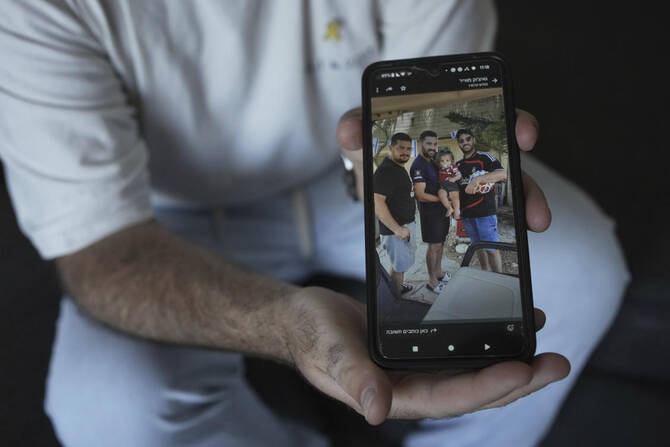

OR AKIVA, Israel: Liran Berman hasn’t had much to keep hopeful over the 629 days of his twin brothers’ captivity in Gaza. Ceasefire deals have collapsed, the war has dragged on, and his siblings remain hostages in the Palestinian enclave.
But the war between Israel and Iran, and the US-brokered ceasefire that halted 12 days of fighting, have sparked fresh hope that his brothers, Gali and Ziv, may finally return home.
With Iran dealt a serious blow over nearly two weeks of fierce Israeli strikes, Berman believes Hamas, armed and financed by Iran, is at its most isolated since the war in Gaza began, and that might prompt the militant group to soften its negotiating positions.
“Now it’s the time to pressure them and tell them, look, you are on your own. No one is coming to your help. This is it,” Berman said. “I think the dominoes fell into place, and it’s time for diplomacy to reign now.”
A long nightmare for the families of hostages
During their Oct. 7, 2023, attack, Hamas-led militants killed some 1,200 people and took 251 hostages. Most have been freed in ceasefire deals, but 50 remain captive, less than half of them believed to still be alive.
The war has killed over 56,000 Palestinians, according to Gaza’s Health Ministry, which does not say how many were civilians or combatants. It says more than half of the dead were women and children.
The families of hostages have faced a 20-month-long nightmare, trying to advocate for their loved ones’ fates while confronted with the whims of Israeli and Hamas leaders and the other crises that have engulfed the Middle East.
Israel’s war with Iran, the first between the two countries, pushed the hostage crisis and the plight of Palestinian civilians in Gaza to the sidelines. Hostage families again found themselves forced to fight for the spotlight with another regional conflagration.
But as the conflict eases, the families are hoping mediators seize the momentum to push for a new ceasefire deal.
“The achievements in Iran are important and welcome, enabling us to end the war from a position of strength with Israel holding the upper hand,” said the Hostages Families Forum, a grassroots organization representing many of the hostage families.
“To conclude this decisive operation against Iran without leveraging our success to bring home all the hostages would be a grave failure.”
Netanyahu may have more room to maneuver
It’s not just a diminished Iran and its impact on Hamas that gives hostage families hope. Israeli Prime Minister Benjamin Netanyahu, riding a wave of public support for the Iran war and its achievements, could feel he has more space to move toward ending the war in Gaza, something his far-right governing partners oppose.
Hamas has repeatedly said it is prepared to free all the hostages in exchange for an end to the war in Gaza. Netanyahu says he will only end the war once Hamas is disarmed and exiled, something the group has rejected.
Berman said the ceasefire between Israel and Iran has left him the most optimistic since a truce between Israel and Hamas freed 33 Israeli hostages earlier this year. Israel shattered that ceasefire after eight weeks, and little progress has been made toward a new deal.
The Israeli government team coordinating hostage negotiations has told the families it now sees a window of opportunity that could force Hamas to be “more flexible in their demands,” Berman said.
Iran’s ‘Axis of Resistance’ is in disarray
Over the past four decades, Iran built up a network of militant proxy groups it called the ” Axis of Resistance ” that wielded significant power across the region, including Hezbollah in Lebanon, the Houthi rebels in Yemen, and militias in Iraq and Syria.
Hamas may have envisioned the Oct. 7, 2023, attack as a catalyst that would see other Iranian-sponsored militants attack Israel. While Hezbollah and the Houthis launched projectiles toward Israel, the support Hamas had counted on never fully materialized. In the past two years, many of those Iranian proxies have been decimated, changing the face of the Middle East.
US President Donald Trump’s involvement in securing a ceasefire between Israel and Iran has also given many hostage families hope that he might exert more pressure for a deal in Gaza.
“We probably need Trump to tell us to end the war in Gaza,” Berman said.
Inseparable twins who remain in captivity
Gali and Ziv Berman, 27, were taken from their homes in Kibbutz Kfar Aza, on the border with Gaza, during the Oct. 7 attack. Seventeen others were also abducted there; of those, only the Berman twins remain captive.
The family has heard from hostages who returned in the previous deal that, as of February, the brothers were alive but being held separately.
Liran Berman said that’s the longest the two have ever spent apart. Until their abduction, they were inseparable, though they are very different, the 38-year-old said.
In Kfar Aza, the twins lived in apartments across from each other. Gali is more outgoing, while Ziv is more reserved and shy with a sharp sense of humor, their brother said. Gali is the handyman who would drive four hours to help a friend hang a shelf, while Ziv would go along and point to where the shelf needed to go.
The war with Iran, during which Iranian missiles pounded Israeli cities for 12 days, gave Liran Berman a sense of what his brothers have endured as bombs rained down on Gaza, he said.
“The uncertainty and the fear for your life for any moment, they are feeling it for 20 months,” he said. “Every moment can be your last.”


