

400,000 Syrian refugees to return home from Lebanon this year, UN agency says

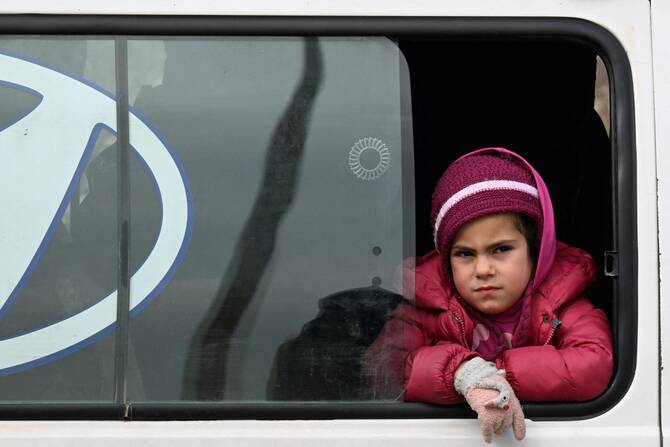
A Syrian child from a displaced family looks out of the window of a bus carrying them back from northern Syria to Homs in central Syria, Feb. 10, 2025. (AFP)
Short Url
Updated 09 October 2025
Follow

400,000 Syrian refugees to return home from Lebanon this year, UN agency says

  • 300,000 have already returned since Assad regime fell in December, and a further 180,000 express desire to go home as part of a UN repatriation program
  • 163 Syrians crossed the border on Thursday and returned to their country as part of the 4th convoy organized by a UN repatriation program

LONDON: The number of Syrian refugees in Lebanon who have returned to their home country is expected to reach 400,000 by the end of this year, the UN’s High Commissioner for Refugees said on Thursday.

About 300,000 Syrians have already returned to their country from Lebanon since the fall of the Assad regime in December 2024, it added.

Lisa Abu Khaled, a spokesperson for the UN agency, said that a further 180,000 refugees have expressed a desire to also return home as part of a UN repatriation program launched in July.

Abu Khaled and officials from the Lebanese General Security and the International Organization for Migration accompanied 163 Syrian refugees, who were part of the fourth convoy organized by the UN program, as they crossed the border north of Tripoli on Thursday and returned to their country.

The Syrians, who were bound for the Idlib and Homs areas, did not have to pay border fees on the Lebanese side, highlighting the country’s commitment to the safe and dignified return of displaced people, Lebanon’s National News Agency reported.

The Lebanese Red Cross and other humanitarian organizations are assisting Lebanon in its efforts to facilitate the return of refugees. Millions of people were displaced from Syria by the civil war in the country, which began in March 2011. An estimated 2.1 million of them ended up in Lebanon, according to the Lebanese Ministry of Social Affairs.


Hamas official says group in final stage of choosing new chief

Updated 1 sec ago
Follow

Hamas official says group in final stage of choosing new chief

CAIRO: A senior Hamas official told AFP on Sunday that the Palestinian movement was in the final phase of selecting a new leader, with two prominent figures competing for the position.
Hamas recently completed the formation of a new Shoura Council, a consultative body largely composed of religious scholars, as well as a new political bureau.
Members of the council are elected every four years by representatives from Hamas’s three branches: the Gaza Strip, the occupied West Bank and the movement’s external leadership.
Hamas prisoners in Israeli jails are also eligible to vote.
The council subsequently elects the political bureau, which in turn selects the head of the movement.
“The movement has completed its internal elections in the three regions and has reached the final stage of selecting the head of the political bureau,” the official said, speaking on condition of anonymity as he was not authorized to speak publicly.
He added that the race for the group’s leadership is now between Khaled Meshaal and Khalil Al-Hayya.
A second Hamas source confirmed the development within the organization, which fought a devastating war with Israel following its October 7, 2023 attack.
Hayya, 65, a Gaza native and Hamas’s chief negotiator in ceasefire talks, has held senior roles since at least 2006, according to the US-based NGO the Counter Extremism Project (CEP).
Meshaal, who led the political bureau from 2004 to 2017, has never lived in Gaza. He was born in the West Bank in 1956.
He joined Hamas in Kuwait and later lived in Jordan, Syria and Qatar. The CEP says he oversaw Hamas’s evolution into a political-military hybrid.
He currently heads the movement’s diaspora office.
Last month, a Hamas source told AFP that Hayya enjoys backing from the group’s armed wing, the Ezzedine Al-Qassem Brigades.
After Israel killed former Hamas leader Ismail Haniyeh in Tehran in July 2024, the group chose its then-Gaza chief Yahya Sinwar as his successor.
Israel accused Sinwar of masterminding the October 7 attack.
He too was killed by Israeli forces in the southern Gaza city of Rafah, three months after Haniyeh’s assassination.
Hamas then opted for an interim five-member leadership committee based in Qatar, postponing the appointment of a single leader until elections, given the risk of the new chief being targeted by Israel.