Iran expressed rare gratitude to Pakistan amid recent Israel war — PM Sharif

In this handout photo, taken and released by Pakistan’s Prime Minister Office, Prime Minister Shehbaz Sharif chairs a meeting of the Federal Cabinet at the Parliament House in Islamabad on June 26, 2025. (Photo courtesy: Handout/PMO)
Short Url
Updated 26 June 2025
Follow

Iran expressed rare gratitude to Pakistan amid recent Israel war — PM Sharif

  • Shehbaz Sharif acknowledges Crown Prince Mohammed bin Salman's ‘significant role’ in defusing tensions
  • He also highlights Field Marshal Asim Munir’s lengthy meetings with the top American and Iranian officials

ISLAMABAD: Prime Minister Shehbaz Sharif on Thursday expressed satisfaction over the ceasefire that brought an end to the recent Israel-Iran conflict, saying Tehran had thanked Pakistan’s political and military leadership for playing a constructive role during the war after Field Marshal Asim Munir’s meetings with both American and Iranian officials.

The 12-day war began after Israel carried out airstrikes on Iranian nuclear facilities, killing several senior military commanders and scientists, while officials in Tehran were engaged in nuclear negotiations with the United States.

Shortly before the ceasefire was announced, US forces struck three Iranian nuclear sites and claimed to have set back Iran’s nuclear program by years.

“For the first time in history — and I am not just talking about the war itself, but on several fronts — Iran openly thanked Pakistan’s political and military leadership in a way that, in my view, has no precedent in recent times,” Sharif told the federal cabinet.

“Our Field Marshal had a luncheon meeting in Washington with President [Donald] Trump,” he continued. “Then in Istanbul, the army chief had a one-and-a-half-hour meeting with [Iranian Foreign Minister] Abbas Araghchi.
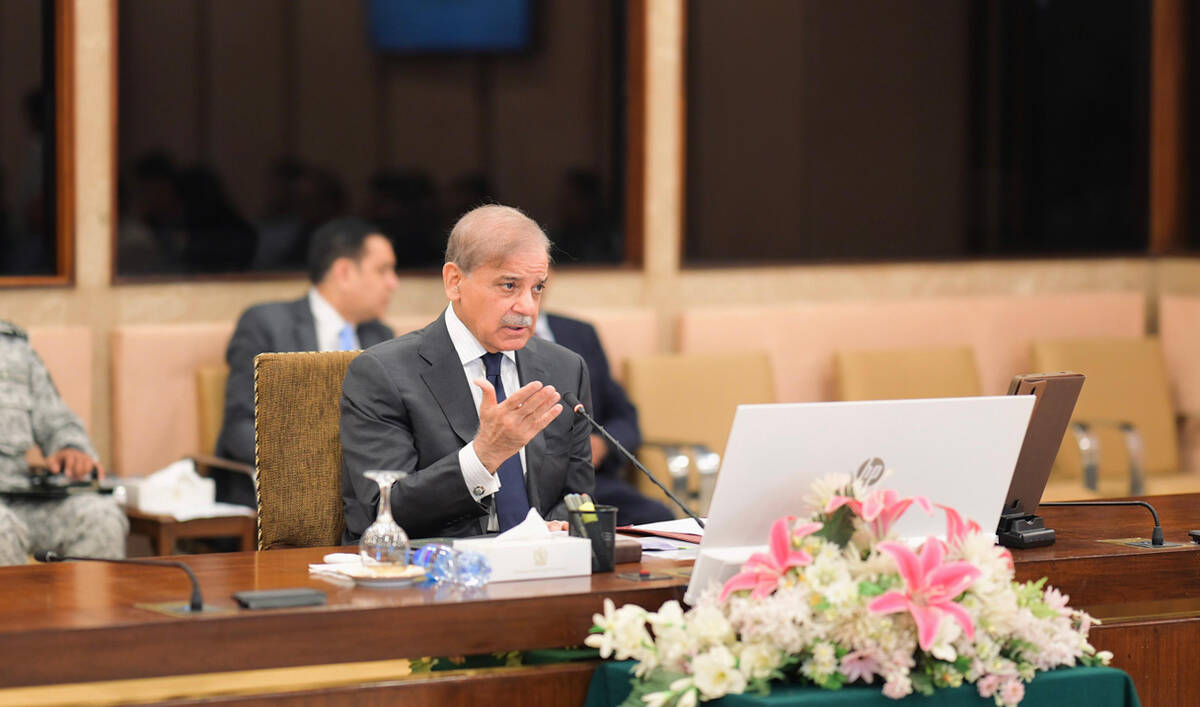


In this handout photo, taken and released by Pakistan’s Prime Minister Office, Prime Minister Shehbaz Sharif chairs a meeting of the Federal Cabinet at the Parliament House in Islamabad on June 26, 2025. (Photo courtesy: Handout/PMO)

During that meeting, he specified Pakistan’s efforts. In response, he [Araghchi] said … ‘We [Iranians] were not the ones who attacked… If Israel stops, then we are ready for dialogue.’”

The prime minister said Pakistan also condemned the missile attacks on US bases in Qatar and had conveyed its position clearly to all sides.

He described Iran’s posture during the war as one of “dignity and restraint,” praising the Iranian people for refusing to capitulate under pressure.

Sharif said Saudi Crown Prince Mohammed bin Salman also played a significant role in defusing tensions.

“I had a phone conversation with the Crown Prince,” he said. “We spoke in great detail. And I say this to you with full sincerity: he played a significant role in helping to stop this war.”

“As soon as Israel launched its attack, Saudi Arabia issued a strong statement of condemnation,” he added. “After that, the Crown Prince personally spoke to the President of Iran [Masoud Pezeshkian].”

As the ceasefire continues to hold between the two Middle Eastern rivals, President Trump has said American and Iranian officials could engage in talks next week, though Tehran has not confirmed any such plans.

Trump, speaking at a NATO summit, said he was not keen to resume formal negotiations but declared the war was over and insisted Iran would not be allowed to acquire a nuclear weapon.

Iran’s parliament, meanwhile, voted to fast-track legislation suspending cooperation with the International Atomic Energy Agency, following US strikes on its nuclear facilities.

With input from AP


Pakistan official vows to address trade challenges arising out of Afghan border closures

Updated 5 sec ago
Follow

Pakistan official vows to address trade challenges arising out of Afghan border closures

  • Pakistan closed key border crossings with Afghanistan in October following fierce clashes
  • Border crossings have led to financial losses, rising unemployment for traders on both sides

KARACHI: Prime Minister’s Coordinator on Commerce Rana Ihsaan Afzal on Wednesday reassured traders in the southwestern Chaman city that Islamabad would address issues arising out of the closure of Pakistan-Afghanistan border crossings since October. 

Pakistan closed its key border crossings with Afghanistan, including the one in Chaman, for trade and movement of people in October after fierce clashes between the two countries. Pakistan and Afghanistan both claimed to have killed scores of each other’s soldiers during the conflict. 

Traders on both sides have urged their governments to reopen the borders, saying that closures have caused financial losses and led to disruptions in perishable goods exports, rising unemployment and hardships for the local community dependent on cross-border trade. 

Afzal chaired a high-level consultative meeting with leaders, traders and community representatives from Chaman District and the Chaman Chamber of Commerce & Industry in Islamabad on Wednesday, the Pakistani commerce ministry said in a statement. 

“The coordinator reaffirmed the government’s commitment to addressing border trade challenges and ensuring that local communities continue to thrive,” the ministry said. 

The statement said Afzal noted the concerns raised by the stakeholders, stressing that resolving the issues of Chaman’s communities is a priority for the government.

Delegates spokes about the socio-econmic impact such as financial losses and rising unemployment due to the suspension of border trade between both sides. 

“The matters discussed will be escalated to relevant national and bilateral forums to seek sustainable solutions, with a focus on establishing predictable, transparent, and efficient border management protocols that balance security with legitimate trade,” the statement said. 

Ties between Islamabad and Kabul have remained strained since the Afghan Taliban seized power in Afghanistan in 2021. Pakistan has since then suffered a surge in militant attacks that it blames on militants based in Afghanistan, a charge Kabul denies. 

Tensions between the two sides have resulted in frequent border closures over the years, hampering trade and commerce. 

Islamabad has repeatedly accused the administration in Kabul of failing to take action against militant outfits such as the Tehreek-e-Taliban Pakistan (TTP) and the separatist Balochistan Liberation Army (BLA), which it alleges carry out attacks targeting Pakistan from Afghan soil. Kabul denies the allegations.

According to figures shared by the Pak-Afghan Joint Chamber of Commerce and Industry (PAJCCI) in October, the annual Pakistan-Afghan trade volume declined from $2.5 billion dollars to $10 million during the last two fiscal years.