

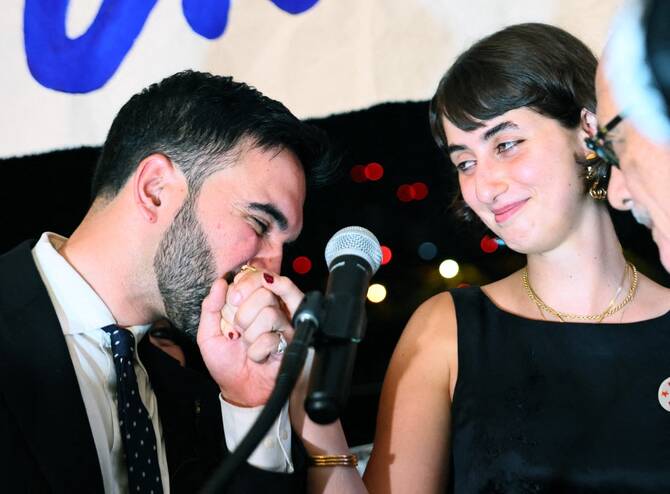
You’ve heard about NYC Democratic candidate for mayor Zohran Mamdani, but what about his US Syrian wife, Rama Duwaji?

Based in Brooklyn, Duwaji creates art that centers on pro-Palestinian and feminist themes. (AFP)
Short Url
Updated 26 June 2025
Follow

You’ve heard about NYC Democratic candidate for mayor Zohran Mamdani, but what about his US Syrian wife, Rama Duwaji?

As the United States turns its attention to New York City’s Democratic candidate for mayor Zohran Mamdani, many are eager to learn more about his wife, Rama Duwaji.

Duwaji is an artist of Syrian descent whose work has been featured by acclaimed outlets such as The New Yorker, The Washington Post, BBC, Apple, Spotify, VICE, and the Tate Modern in London. Now based in Brooklyn, Duwaji creates art that centers on political and feminist themes.

Her digital illustrations—prominently showcased on Instagram—often reflect her political beliefs. Among her recent work, Duwaji criticized the arrest of Mahmoud Khalil, the Columbia University protester detained by US Immigration and Customs Enforcement (ICE) on March 8, 2025. She has also spoken out against police violence toward pro-Palestinian demonstrators and spotlighted human interest stories, including intimate portraits of bakers in Gaza.

The couple made headlines six weeks ago when Mamdani shared their wedding photos from earlier this year, displaying them across New York City, including in the subway system, as a public stand against online harassment.

“Rama isn’t just my wife,” Mamdani said. “She’s an incredible artist who deserves to be known on her own terms. You can critique my views, but not my family.”

The pair met on a dating app in New York City and married in December 2024, according to reports. Following Mamdani’s victory in the Democratic primary yesterday, Duwaji posted a black-and-white photo strip of the couple with a simple caption: “Couldn’t possibly be prouder.” 


Art Cairo spotlights pioneering artist Inji Efflatoun

Updated 23 January 2026
Follow

Art Cairo spotlights pioneering artist Inji Efflatoun

CAIRO: Art Cairo 2026 returned to Egypt’s bustling capital from Jan. 23-26, with visitors treated to gallery offerings from across the Middle East as well as a solo museum exhibition dedicated to pioneering Egyptian artist Inji Efflatoun.

While gallery booths hailed from across the Arab world, guests also had the chance to explore the oeuvre of the politically charged artist, who died in 1989.

Many of the pieces in the 14-work exhibition were drawn from the collection of the Egyptian Museum of Modern Art and cover four main periods of the artist’s work, including her Harvest, Motherhood, Prison and Knoll series.

While gallery booths hailed from across the Arab world, guests also had the chance to explore the oeuvre of the politically charged artist, who died in 1989. (Supplied)

Efflatoun was a pivotal figure in modern Egyptian art and is as well known for her work as her Marxist and feminist activism.

“This is the third year there is this collaboration between Art Cairo and the Ministry of Culture,” Noor Al-Askar, director of Art Cairo, told Arab News.

“This year we said Inji because (she) has a lot of work.”

Born in 1924 to an affluent, Ottoman-descended family in Cairo, Efflatoun rebelled against her background and took part heavily in communist organizations, with her artwork reflecting her abhorrence of social inequalities and her anti-colonial sentiments.

Many of the pieces in the 14-work exhibition were drawn from the collection of the Egyptian Museum of Modern Art and cover four main periods of the artist’s work, including her Harvest, Motherhood, Prison and Knoll series. (Supplied)

One untitled work on show is a barbed statement on social inequalities and motherhood, featuring a shrouded mother crouched low on the ground, working as she hugs and seemingly protects two infants between her legs.

The artist was a member of the influential Art et Liberte movement, a group of staunchly anti-imperialist artists and thinkers.

In 1959, Efflatoun was imprisoned under Gamal Abdel Nasser, the second president of Egypt. The artist served her sentence for four years across a number of women’s prisons in the deserts near Cairo — it was a period that heavily impacted her art, leading to her post-release “White Light” period, marked dynamic compositions and vibrant tones.

Grouped together, four of the exhibited works take inspiration from her time in prison, with powerful images of women stacked above each other in cell bunkbeds, with feminine bare legs at sharp odds with their surroundings.

Art Cairo 2026 returned to Egypt’s bustling capital from Jan. 23-26. (Supplied)

The bars of the prison cells obstruct the onlooker’s view, with harsh vertical bars juxtaposed against the monochrome stripes of the prison garb in some of her works on show.

“Modern art, Egyptian modern art, most people, they really don’t know it very well,” Al-Askar said, adding that there has been a recent uptick in interest across the Middle East, in the wake of a book on the artist by UAE art patron Sultan Sooud Al-Qassemi.

“So, without any reason, all the lights are now on Inji,” Al-Askar added.

Although it was not all-encompassing, Art Cairo’s spotlight on Efflatoun served as a powerful starting point for guests wishing to explore her artistic journey.