

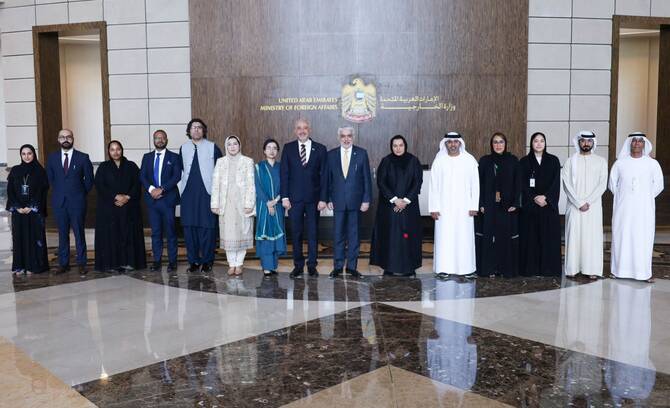
Pakistan, UAE agree to strengthen cooperation during Bilateral Political Consultations

Pakistan and UAE delegation at the second round of Bilateral Political Consultations (BPC) in Abu Dhabi, on June 25, 2025. (MoFA)
Short Url
Updated 25 June 2025
Follow

Pakistan, UAE agree to strengthen cooperation during Bilateral Political Consultations

  • Both sides agree to maintain momentum of high-level exchanges, institutional engagements, says Pakistan’s foreign office
  • UAE is Pakistan’s third-largest trading partner after China and the United States, and a major source of remittances for it

ISLAMABAD: Pakistan and the United Arab Emirates (UAE) on Wednesday agreed to strengthen cooperation in multiple sectors as the two sides took part in the second round of Bilateral Political Consultations (BPC) in Abu Dhabi, Pakistan’s foreign ministry said. 

Pakistan and the UAE held their inaugural BPC session in 2020. The BPC is another forum for strengthening cooperation between the two countries that enjoy cordial ties rooted in shared faith, culture, economic, trade and investment ties. 
In the second round of the consultations, Pakistan’s delegation was led by Shehryar Akbar Khan, the additional foreign secretary (Middle East), while the UAE was led by Reem Ketait, the deputy assistant minister for political affairs.

“During the consultations, both sides reviewed the entire spectrum of bilateral relations and reaffirmed their resolve to further strengthen cooperation across multiple sectors,” Pakistan’s foreign ministry said. 

“The two sides discussed regional and global developments of mutual interest and reiterated their commitment to enhanced coordination and dialogue at multilateral forums.”

Khan stressed further deepening fraternal ties between Pakistan and the UAE while both sides appreciated the positive trajectory of bilateral ties. Pakistan and the UAE also expressed satisfaction at the progress made under existing institutional mechanisms, including the Joint Ministerial Commission (JMC) and regular leadership-level exchanges, the statement said. 

“The Bilateral Political Consultations concluded with both sides agreeing to maintain the momentum of high-level exchanges and institutional engagements, and to convene the next round of consultations in Islamabad on mutually agreed dates,” the foreign ministry said. 

The UAE is Pakistan’s third-largest trading partner after China and the United States. More than 1.5 million Pakistanis live and work in the UAE, sending back over $5 billion in remittances annually.

Bilateral trade reached approximately $10.9 billion in fiscal year 2023–24, including $2.08 billion in exports and $6.33 billion in imports, according to official Pakistani data.

Last year, the UAE pledged $10 billion in future investments in promising sectors of Pakistan’s economy.


Pakistan combing for perpetrators after deadly Balochistan attacks

Updated 5 sec ago
Follow

Pakistan combing for perpetrators after deadly Balochistan attacks

  • Pakistan has been battling a Baloch separatist insurgency for decades, with frequent armed attacks on security forces, foreign nationals and non-locals
  • Militants stormed banks, jails, police stations and military installations, killing 31 civilians and 17 security personnel, the Balochistan chief minister says

QUETTA: Pakistan forces were hunting on Sunday for the separatists behind a string of coordinated attacks in restive Balochistan province, with the government vowing to retaliate after more than 190 people were killed in two days.

Around a dozen sites remained sealed off, with troops combing the area a day after militants stormed banks, jails, police stations and military installations, killing at least 31 civilians and 17 security personnel, according to the chief minister of Balochistan province.

At least 145 attackers were also killed, he added, while an official told AFP that a deputy district commissioner had been abducted.

That figure includes more than 40 militants that security forces said were killed on Friday.

Mobile internet service across the province has been jammed for more than 24 hours, while road traffic is disrupted and train services suspended.

After being rocked by explosions, typically bustling Quetta lay quiet on Sunday, with major roads and businesses deserted, and people staying indoors out of fear.

Shattered metal fragments and mangled vehicles litter some roads.

"Anyone who leaves home has no certainty of returning safe and sound. There is constant fear over whether they will come back unharmed," Hamdullah, a 39-year-old shopkeeper who goes by one name, told AFP in Quetta.

The chief minister, Sarfraz Bugti, told a press conference in Quetta that all the districts under attack were cleared on Sunday.

"We are chasing them, we will not let them go so easily," he said.

"Our blood is not that cheap. We will chase them until their hideouts."

The Baloch Liberation Army (BLA), the province's most active militant separatist group, claimed responsibility for the attacks in a statement sent to AFP.

The group, which the United States has designated a terrorist organisation, said it had targeted military installations as well as police and civil administration officials in gun attacks and suicide bombings.

Interior Minister Mohsin Naqvi, who flew to Quetta late Saturday to join funerals, claimed without offering any evidence that the attackers were supported by India.

"We will not spare a single terrorist involved in these incidents," he said.

In a press conference on Sunday, Pakistan Defence Minister Khawaja Asif likewise claimed the attackers enjoyed links to India and pledged to "completely eliminate these terrorists".

India denied any involvement.

"We categorically reject the baseless allegations made by Pakistan, which are nothing but its usual tactics to deflect attention from its own internal failings," said foreign ministry spokesman Randhir Jaiswal on Sunday.

'BROAD DAYLIGHT'

Pakistan has been battling a Baloch separatist insurgency for decades, with frequent armed attacks on security forces, foreign nationals and non-local Pakistanis in the mineral-rich province bordering Afghanistan and Iran.

Saturday's attacks came a day after the military said it killed 41 insurgents in two separate operations in the province.

The insurgents released a video showing group leader Bashir Zaib leading armed units on motorcycles during the attack.

Another clip claimed to show the abducted senior official from Nushki district.

In another district, militants freed at least 30 inmates from a district jail, while seizing firearms and ammunition. They also ransacked a police station and took ammunition with them.

"It was one of the most audacious attacks in the region in recent years, as unlike other attacks, it took place in broad daylight," Abdul Basit at the S. Rajaratnam School of International Studies in Singapore told AFP.

"It is alarming that militants, with coordinated manpower and strategic acumen, have now reached the provincial capital," he added.

Several of the BLA's videos featured women insurgents, while Defence Minister Asif said at least one of the suicide bombers was a young woman.

"They continue to showcase women strategically in high-visibility attacks," Basit said.

Pakistan's poorest province and largest by landmass, Balochistan lags behind the rest of the country in almost every index, including education, employment and economic development.

Baloch separatists accuse Pakistan's government of exploiting the province's natural gas and abundant mineral resources, without benefiting the local population. The government denies this.

The BLA has intensified attacks on Pakistanis from other provinces working in the region in recent years, as well as foreign energy firms.

Last year, the separatists attacked a train with 450 passengers on board, sparking a deadly two-day siege.