

Education sector leads weekly POS surge with 666% value spike despite overall drop

This sharp increase in educational spending came despite a 1.5 percent decline in the total value of POS transactions. Getty
Short Url
Updated 25 June 2025
Follow

Education sector leads weekly POS surge with 666% value spike despite overall drop

  • Spending on transportation increased by 28.7%
  • Construction and building materials saw a 25.6% uptick

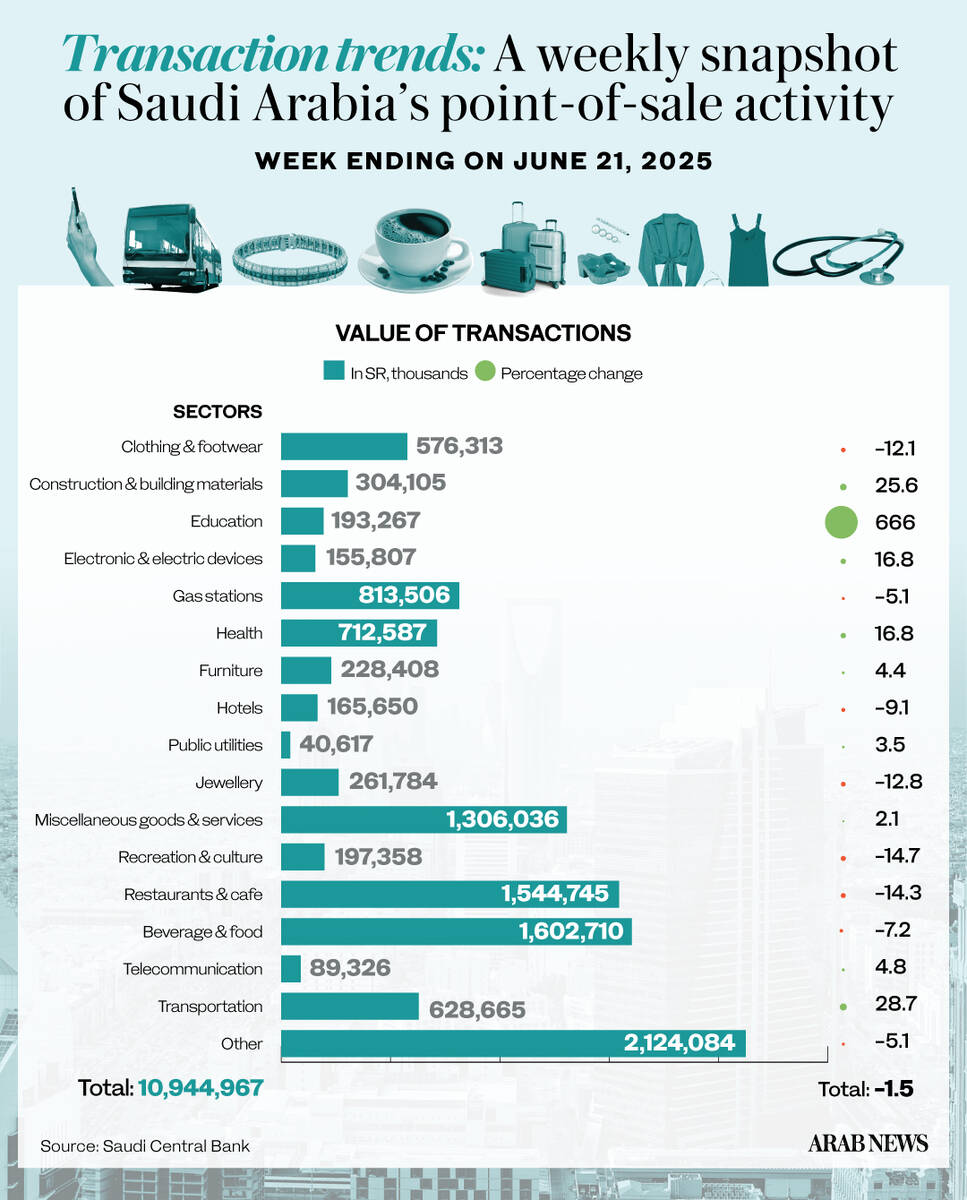
RIYADH: Saudi Arabia’s point-of-sale spending in the education sector saw a weekly rise of 666 percent to reach SR193.26 million ($51.53 million) by June 21, according to official data.

The latest figures from the Saudi Central Bank, known as SAMA, also showed the number of POS transactions in the sector nearly doubled, climbing by 98.1 percent, indicating a significant rebound in consumer activity in this segment.

This sharp increase in educational spending came despite a 1.5 percent decline in the total value of POS transactions across the Kingdom, which dropped from SR11.1 billion to SR10.9 billion over the same period.

The weekly data further showed that transaction values rose in several other sectors, although none matched the scale of growth seen in the education division.

Spending on transportation increased by 28.7 percent, while construction and building materials saw a 25.6 percent uptick in value.

Telecommunication and health sectors both posted gains of 4.8 percent and 16.8 percent, respectively.

The electronics and electric devices segment recorded a 16.8 percent rise in spending value, and the furniture sector grew by 4.4 percent.

Slight increases were also observed in the public utilities and miscellaneous goods and services sectors, which grew by 3.5 percent and 2.1 percent, respectively.

However, several categories experienced downturns. The largest declines in transaction values were reported in the hotels and recreation and culture sectors, which fell by 9.1 percent and 14.7 percent, respectively.

Regionally, Riyadh remained the top city for POS spending, logging over SR3.91 billion in transactions, a 9.1 percent increase from the previous week. Dammam and Khobar also recorded gains, with spending in Dammam up by 8.4 percent and in Khobar by 5.1 percent.
Cities such as Makkah and Madinah recorded double-digit declines, down by 24.2 percent and 11.7 percent, respectively, in total POS transaction values.

Jeddah maintained a steady performance, with spending remaining flat at SR1.6 billion, while Tabuk saw a slight uptick of 3 percent in value.

Spending in restaurants and cafes dropped by 12.8 percent, while beverage and food transactions declined by 7.2 percent.

Jewelry purchases also contracted by 12.8 percent, and clothing and footwear fell by 7.2 percent. Other sectors, such as gas stations and the category, also saw declines of 5.1 percent.

Overall, the total number of POS transactions across all sectors dipped slightly by 0.6 percent week on week, totaling just over 202.5 million transactions during the reporting period.


Egypt’s Suez Canal, Namibian Ports Authority sign MoU to propel port development, training

Updated 17 December 2025
Follow

Egypt’s Suez Canal, Namibian Ports Authority sign MoU to propel port development, training

RIYADH: Egypt’s Suez Canal Authority and the Namibian Ports Authority have signed a memorandum of understanding amid efforts to propel cooperation in development and training.

The agreement aims to exchange expertise and enhance bilateral cooperation in several areas, most notably marine construction, the sale and leasing of marine units, and advanced training through the Suez Canal Authority’s academies, according to a statement.

This is supported by figures from the Suez Canal Authority, which reported revenues of $1.97 billion from 5,874 ship transits since early July, representing a 17.5 percent year-on-year increase, chairman Osama Rabie said during a recent meeting with an International Monetary Fund delegation.

It also aligns well with Rabie’s further forecast that the canal’s revenues would improve during the 2026/2027 fiscal year to around $8 billion, rising to approximately $10 billion the following year, according to a statement issued by the authority.

The newly released statement said: “Rabie affirmed the authority’s readiness for fruitful and constructive cooperation with the Namibian Ports Authority, given the expansion of the entity’s international projects and its efforts to open new markets and engage with the African continent.”

“The chairman explained that the Suez Canal Authority’s efforts succeeded in developing and reopening the Libyan port of Sirte after 14 years of closure, marking a successful start to international projects with friendly and sister nations,” it added.

The chairman instructed that all necessary support and procedures be put in place to initiate practical cooperation on multiple projects, highlighting that the authority offers a comprehensive system for maritime and logistics services through its shipyards and subsidiaries.

For her part, Nangula Hamunyela, chairperson of the Namibian Ports Authority, voiced her enthusiasm for collaborating with the Suez Canal Authority on advancing Namibia’s ambitious port development plan, home to the largest ports in West Africa.

She stressed that this partnership highlights the strong relationship between Egypt and Namibia and will help further deepen bilateral ties.

Hamunyela further highlighted that the Suez Canal Authority’s advanced technology and vast expertise across multiple sectors will play a key role in supporting and speeding up development efforts in Namibian ports, reducing dependence on foreign expertise and technology from outside the region.

Egypt’s Suez Canal generated a total of $40 billion between 2019 and 2024 and remains the country’s most important source of foreign currency.