

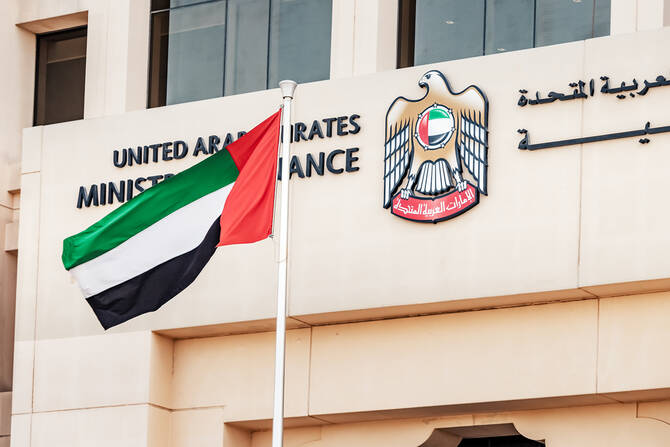
Fitch affirms UAE’s ‘AA-’ rating on strong external buffers, fiscal prudence

UAE’s sizable asset cushion will help shield it from oil price volatility and regional geopolitical tensions. Shutterstock
Short Url
Updated 25 June 2025
Follow

Fitch affirms UAE’s ‘AA-’ rating on strong external buffers, fiscal prudence

  • Outlook benefits from Abu Dhabi’s sovereign net foreign assets — amounting to 157% of GDP
  • Fitch forecasts UAE GDP to grow by 5.2% in 2025

RIYADH: The UAE’s long-term foreign-currency rating has been affirmed at “AA-” with a stable outlook by Fitch, reflecting the country’s consolidated government debt, strong net external asset position, and high gross domestic product per capita. 

The US-based rating agency noted that this outlook benefits from Abu Dhabi’s sovereign net foreign assets — amounting to 157 percent of the UAE’s gross domestic product in 2024 — which rank among the highest of all Fitch-rated sovereigns. 

The agency noted the ongoing regional geopolitical risks, but it assumes the conflict involving Israel, the US, and Iran will be contained and short-lived. 

The report comes as Israel and Iran agreed to a ceasefire brokered by the US, which took effect on June 24, following 12 days of conflict that raised fears of a broader regional escalation. 

In its commentary, Fitch Ratings stated: “A regional conflagration would pose a risk to Abu Dhabi’s hydrocarbon infrastructure and to Dubai as a trade, tourism and financial hub,” 


Fitch estimated the UAE’s consolidated fiscal surplus stood at 7.1 percent of GDP in 2024, following a level of 8.6 percent in 2023. Shutterstock

It emphasized that “the UAE’s ratings could absorb some short-term disruptions given large fiscal and external buffers.” 

Fitch’s assessment follows S&P Global’s recent assignment of “AA/A‑1+” with a stable outlook for its foreign and local currency sovereign credit ratings to the UAE, citing the country’s strong fiscal and external positions. 

The agency also noted that the UAE’s sizable asset cushion would help shield it from oil price volatility and regional geopolitical tensions. 

Fitch estimated the UAE’s consolidated fiscal surplus stood at 7.1 percent of GDP in 2024, following a level of 8.6 percent in 2023, with surpluses in Abu Dhabi and Dubai and budget deficits in Ras Al Khaimah and Sharjah. 

It projected a fiscal breakeven oil price of $45–$50 per barrel in 2025 and 2026, excluding investment income, which Fitch attributed partly to “rising oil production volumes and the significant share of spending by GREs (government-related entities).” 

“We forecast the consolidated surplus at 5.3 percent of GDP in 2025 and 5.9 percent in 2026. Narrower deficits in Sharjah and higher oil production levels in Abu Dhabi will mitigate the forecast drop in oil prices from $79.5 per barrel in 2024 to $65/bbl in 2025 and 2026,” Fitch said. 

It added: “Dubai will retain a budget surplus.” 

With regard to the federal government’s budget, Fitch stated that it remains below 4 percent of GDP and is primarily focused on core services.


Despite moderate direct debt, Fitch views the UAE’s economy as highly leveraged. Shutterstock

The report emphasized that the federal budget must remain balanced by law, leaving limited scope for borrowing or adjustment. From 2026 onward, corporate tax revenue is expected to help offset reduced grants from Abu Dhabi. 

Despite moderate direct debt, Fitch views the UAE’s economy as highly leveraged. “We estimate overall contingent liabilities from GREs of the emirates and the FG in 2023 at about 62 percent of UAE 2023 GDP,” the report said, though it acknowledged that many state-owned entities are financially sound. 

Fitch forecasts UAE GDP to grow by 5.2 percent in 2025, supported by a 9 percent increase in oil production from Abu Dhabi and strong non-oil growth of over 4 percent, driven by investment and population expansion. However, it warned of risks from “lower oil prices and global growth uncertainties.” 

Earlier this month, the UAE Central Bank’s Quarterly Economic Review for December 2024 reported that the country’s GDP reached 1.77 trillion dirhams ($481.4 billion) in 2024, growing 4 percent. Non-oil sectors contributed 75.5 percent of the total — highlighting continued economic diversification. 

The central bank maintained its real GDP growth forecast at 4 percent for 2024, with an anticipated acceleration to 4.5 percent in 2025 and 5.5 percent in 2026. 

On governance, Fitch said the UAE maintains an ESG Relevance Score of “5[+]” for political stability, rule of law, and institutional quality.

The agency credited the UAE’s “record of domestic political stability, strong institutional capacity, effective rule of law and a low level of corruption,” referencing World Bank Governance Indicators, where the country ranks in the 70th percentile.


Middle East AI adoption reaches 75%, beating global average: PwC survey 

Updated 19 December 2025
Follow

Middle East AI adoption reaches 75%, beating global average: PwC survey 

RIYADH: Artificial intelligence is becoming embedded across Middle East workplaces, with 75 percent of employees using AI tools at work over the past year, a higher rate than the 69 percent global average, a new survey showed.

According to PwC’s Middle East Workforce Hopes and Fears Survey 2025, the region is outpacing global peers in adopting AI for everyday work, driven by government and corporate digital transformation efforts.

Based on responses from 1,286 employees, the survey indicates AI use has moved beyond pilot stages, with 32 percent of workers using generative AI tools daily — above the global average of 28 percent and reflecting growing familiarity with AI-driven workflows.

The survey findings align with trends observed in Saudi Arabia, where advanced technologies such as AI are being widely embraced across workplaces.

In November, a report released by KPMG highlighted the Kingdom’s progress in the technology sector, noting that 84 percent of CEOs in Saudi Arabia are ready to deploy AI responsibly — well above the 76 percent global benchmark — supported by the Kingdom’s data governance ecosystem, including national initiatives led by the Saudi Data and Artificial Intelligence Authority. 

Earlier this month, data from the Global AI Index revealed that Saudi Arabia ranked fifth globally and first in the Arab region for growth in the AI sector. 

Commenting on the findings, Randa Bahsoun, partner at PwC Middle East, said: “As employees confidently embrace change, build new capabilities and show remarkable adaptability with AI, they also want to feel secure and supported.” 

She added: “Organizations that provide clarity on how roles will evolve, expand access to learning and protect wellbeing will be the ones that retain talent and get ahead in a fast-changing labor market.” 

Adapting to the tech-driven future 

The latest PwC survey found that the Middle East workforce is confidently leading the integration of AI into daily work, while prioritizing job security and skills development at higher rates than their global counterparts.

According to the report, 49 percent of employees in the region expect technological change — including AI, robotics and automation — to impact their jobs to a large or very large extent over the next three years, compared with 45 percent globally.

PwC said this trend reflects not only higher adoption, but also greater readiness and comfort with next-generation technologies across the region. 

Employees in the Middle East increasingly view emerging technologies as tools that enhance productivity and creativity rather than threats to job security. 

Around eight out of 10 employees said AI has improved their productivity, with 87 percent reporting higher-quality work and 84 percent citing increased creativity. 

Higher confidence among younger employees 

The survey found that younger employees in the region demonstrate significantly higher confidence in AI’s potential, with millennials and Gen Z being the most hands-on users of AI tools. These groups are adopting new technologies quickly and often outpacing older cohorts in both usage and creative application. 

“This puts early career employees in a strong position to adapt to the evolving technological demands of entry-level roles,” said PwC. 

It added: “For employers, this is an opportunity to leverage younger talent to drive digital adoption and performance, while providing guidance, clarity and support as AI continues to reshape the future of work.” 

Acquiring the tools

Skills development remains a defining priority for the Middle East workforce, according to the survey. 

The report found that 69 percent of employees in the region gained new skills over the past 12 months, compared with 56 percent globally. 

Some 81 percent of respondents said they would prefer a job that offers opportunities to build transferable skills — higher than the 69 percent global average. 

Job security has also emerged as the top priority, with 85 percent of employees saying it is very important. 

“As employees in the Middle East seek balance and flexibility, their expectations of career progression and reward are also evolving. Fewer employees are asking for a pay rise than last year, signalling a more cautious labor market,” said PwC. 

The report found that engagement levels among the Middle East workforce remain among the highest globally, with 78 percent of regional employees saying they look forward to going to work, compared with 64 percent globally. 

Despite this high level of engagement, 45 percent of employees said they feel fatigued at least once a week, and nearly half reported feeling overwhelmed, indicating that workload intensity is becoming a significant pressure point. 

Converting momentum to benefits 

PwC highlighted several actions organizations should prioritize to convert the current AI momentum into a lasting advantage. 

The firm said companies should communicate clearly and consistently about where AI technologies are being deployed, what will change across processes, how job roles will be affected and where new value will be created. 

The report also emphasized the importance of building a continuously evolving, future-ready, skills-first workforce that can fully harness AI’s potential. 

“Leaders need to ensure upskilling, reskilling and capability building move 22 beyond periodic initiatives and become a key element of their organizations’ forward-looking business strategy,” said PwC. 

It added: “This means identifying future skill needs early, assessing current capabilities to understand gaps and using those insights to create development pathways tailored to roles, seniority and diverse career trajectories.” 

Companies should also foster a culture of agility and innovation and equip managers to effectively support AI-enabled teams. 

PwC said managers must have the clarity, tools and protected time needed to coach teams, support skill development and manage workloads in ways that sustain employee engagement and wellbeing. 

“This can be achieved by setting clear performance expectations for managers around employee development and wellbeing and supporting them with the knowledge and guidance needed to fulfil these responsibilities,” added PwC. 

Organizations should also prioritize flexibility, autonomy and balanced workloads to sustain high performance, giving employees the freedom and clarity to manage their work effectively. 

The report suggested that expanding flexible work arrangements, strengthening autonomy in day-to-day decision-making and giving teams a greater voice in how work gets done could help employees perform at their best. 

“The Middle East’s workforce continues to demonstrate a powerful blend of optimism, ambition and adaptability. The challenge now is for leaders to amplify these strengths through vision, transparency and care – ensuring that technology, trust and talent progress together,” concluded the report. 

Earlier this month, a KPMG report echoed similar views, saying UAE CEOs are accelerating investment in artificial intelligence while prioritizing people, skills and responsible innovation as core drivers of future growth. 

The report said 84 percent of CEOs in the UAE expect to expand headcount over the next three years, while 80 percent are already redesigning roles to integrate AI collaboration across their businesses.