THE HAGUE: US President Donald Trump swept into NATO’s Hague summit Tuesday, with allies hoping a pledge to ramp up defense spending will keep the mercurial leader of the military superpower committed to protecting them.
Trump joined leaders from NATO’s 31 other members to kick off the two-day gathering with a dinner hosted by Dutch King Willem-Alexander in the ornate Orange Hall at his royal residence.
The alliance hopes to keep Trump bound to its mutual defense vow by meeting his demand for a headline figure of five percent of GDP on defense spending.
But Trump refused to say he was committed to NATO’s Article Five clause and protecting Europe in comments that will likely rattle his counterparts on the continent.
“Depends on your definition. There’s numerous definitions of Article Five,” Trump told journalists aboard Air Force One. “I’m committed to being their friend.”
To keep Trump on board, NATO members have thrashed out a compromise deal to dedicate 3.5 percent to core military needs by 2035, and 1.5 percent to broader security-related areas such as cybersecurity and infrastructure.
NATO says the military build-up is crucial to deter Russia, which officials warn is rapidly rebuilding its forces depleted by the war in Ukraine and could be ready to attack the alliance in five years.
But it is just as important for keeping Trump engaged as Washington warns it may shift forces from Europe to face the threat from China.
“They’re going to be lifting it to five percent, that’s good,” Trump said. “It gives them much more power.”
But while the promise of more spending could win Trump over, deep divisions remain over the approach to Europe’s key security issue: Russia’s war in Ukraine.
Trump said he would probably meet Ukraine’s President Volodymyr Zelensky while in The Hague, with Kyiv hoping it can avoid a repeat of the pair’s infamous Oval Office bust-up.
European Commission chief Ursula von der Leyen told an audience in The Hague that NATO’s “historic” spending pledge showed that “the Europe of defense has finally awakened.”
Alliance leaders meanwhile — many of whom are struggling to find the money that will be required — lined up to argue that the threats facing the continent required bold steps.
“We must navigate this era of radical uncertainty with agility,” British Prime Minister Keir Starmer said in announcing the UK’s commitment to meet the target.
Starmer on Wednesday will formally announce that his country is buying a dozen F-35A fighters, capable of carrying atomic weapons to support NATO’s nuclear mission.
The purchase marks an expansion of Britain’s nuclear deterrence, which is currently limited to submarine-launched missiles.
A statement late Tuesday from Starmer’s office quoted Rutte as saying: “I strongly welcome today’s announcement,” calling it “yet another robust British contribution to NATO.”
Separately, powerhouse Germany announced plans to hit the 3.5-percent figure for core defense needs by 2029 — six years before the timeline.
At the other end of the scale, Spanish Prime Minister Pedro Sanchez has risked Trump’s ire by insisting his country doesn’t have to meet the five percent target.
For its part, the Kremlin attacked NATO for its “rampant militarization,” with spokesman Dmitry Peskov saying: “This is the reality that surrounds us.”
Since storming back to power, Trump has upended the West’s approach to the three-year conflict by turning his back on Kyiv and opening the door to closer ties with Moscow.
Zelensky was set to play less of a central role than at recent NATO gatherings and will not attend the main working session.
But Ukraine’s president said he would discuss with Trump buying a package of weapons made up mainly of air defenses.
Zelensky would also push Trump on imposing new sanctions on Russia as Moscow has stalled peace efforts being pressed by Washington, Kyiv said.
“There are no signs that Putin wants to stop this war. Russia rejects all peace proposals including those from the US. Putin only thinks about war,” the Ukrainian leader told a defense forum held alongside the summit.
Trump did briefly meet on the sidelines of the summit late Tuesday with Turkiye’s Recep Tayyip Erdogan, who urged “close dialogue” to end the Russia-Ukraine conflict.
Rutte said allies would send the message that support for Kyiv was “unwavering and will persist.”
But despite his insistence that Ukraine’s bid for membership remains “irreversible,” NATO will avoid any mention of Kyiv’s push to join after Trump ruled it out.


![]()

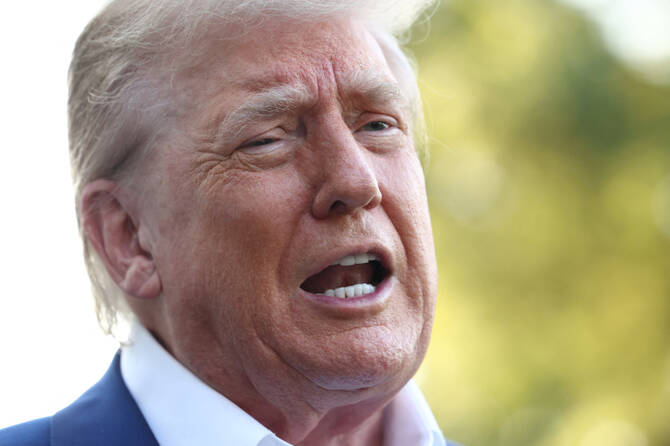
Trump rattles NATO allies as he descends on summit
Short Url
https://arab.news/myjdw
Trump rattles NATO allies as he descends on summit
- The alliance hopes to keep Trump bound to its mutual defense vow by meeting his demand for a headline figure of five percent of GDP on defense spending


Latest updates


© 2026 SAUDI RESEARCH & PUBLISHING COMPANY, All Rights Reserved And subject to Terms of Use Agreement.