

‘Aramcorama’ at Ithra: A living archive of energy, culture, memory

‘Aramcorama’ exhibition at Ithra explores how the oil industry helped shape cities, communities and modern life in Saudi Arabia. (AN photo)
Short Url
Updated 26 June 2025
Follow

‘Aramcorama’ at Ithra: A living archive of energy, culture, memory

  • Exhibition showcases how ordinary items can help make extraordinary transformations

DHAHRAN: “Aramcorama,” within Ithra’s museum, reimagines the exhibition experience, turning the Kingdom’s industrial history into a personal and immersive journey.

Rather than simply documenting the rise of the country’s oil industry, the exhibition explores how it shaped cities, communities, and modern life.


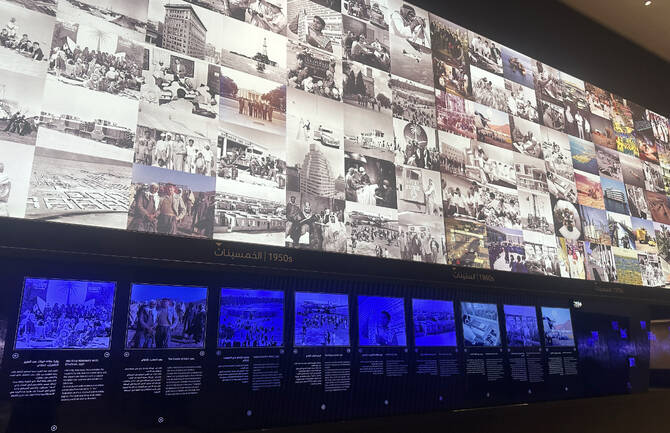
The Aramcorama exhibition at Ithra explores how the oil industry helped shape cities, communities and modern life in Saudi Arabia. (AN photo)

It encourages visitors to reflect on how past events changed people’s sense of identity.

“Aramcorama” tells the story through a rich selection of visuals. Geological maps, handwritten notes, internal messages, and photographs trace nearly a century of growth and change.

HIGHLIGHTS

• At ‘Aramcorama’ exhibition, Geological maps, handwritten notes, internal messages, and photographs trace nearly a century of growth and change. 

• Visitors can explore how Aramco’s global outlook has influenced not only individual lives but also the nation’s perspective.

Visitors can explore a timeline highlighting each decade and framed by hanging prints and illuminated media displays. This setup creates an engaging environment that feels dynamic and full of discovery.


The Aramcorama exhibition at Ithra explores how the oil industry helped shape cities, communities and modern life in Saudi Arabia. (AN photo)

Abdullah Alshammasi, a longtime engineer at Aramco, spoke to Arab News about how the company influenced more than just the oil and gas industry and impacted generations of employees and locals.

He said: “The company certainly had lasting consequences on the earliest generations that worked in it.

Aramco’s history is the modern history of the communities that lived in the Eastern Province.

Abdullah Alshammasi, Aramco engineer

“The fact is, since the company was established it needed a knowledgeable workforce, so a campaign of education was also established, and it steadily increased in depth from manual skills to softer, more intellectual skills.”

The exhibition also showcases vintage safety posters that were originally used to display workplace rules. These posters show how design and language have changed over the years, highlighting the changes in style and communication.


The Aramcorama exhibition at Ithra explores how the oil industry helped shape cities, communities and modern life in Saudi Arabia. (AN photo)

This section of the exhibition captures the story’s understated honesty, letting ordinary items like posters, letters, and tools tell the story of values, habits, and shifting responsibilities.

As visitors explore the exhibition, they can see how the company’s global outlook has influenced not only individual lives but also the nation’s perspective.

Alshammasi explained: “Generations have now been everywhere around the globe, studying at the best institutions, bringing back with them a better sense of the world, widening their horizons and, therefore, our societies and culture.”

“Aramcorama” ultimately reflects how modern Saudi society was built; not just through buildings and oil fields, but also through education, progress, and mindset.

Alshammasi said: “It tells me that Aramco is as old as our modern lives.”

This fact is especially evident in the Eastern Province, where the company’s presence reshaped daily life, and Alshammasi added: “Aramco’s history is the modern history of the communities that lived in the Eastern Province. Their lives were directly affected by the company, for good and for ill.”

The exhibition does not hide that tension, but invites reflection on both progress and its costs, what was gained and what may have been lost.

“Aramcorama” does not ask visitors to celebrate or criticize, but to notice, reflect, and form their own opinions.

It respects the complexity of history and shows how innovation, labor, infrastructure, and community are all deeply connected.


Decoder

Aramcorama

At Ithra museum in Dhahran, visitors will have the chance to explore the rise of Saudi Arabia’s oil industry through an exhibition named “Aramcorama.” The exhibition, which runs from June 26 to July 2, explores how the industry shaped cities, communities, and modern life. It tells the story through a rich selection of visuals, including Geological maps, handwritten notes, internal messages, and photographs that trace nearly a century of growth and change.


Ramadan is a time to train smarter, not harder

Updated 7 sec ago
Follow

Ramadan is a time to train smarter, not harder

  • Experts advise between six and eight hours of rest and steady fluid intake between sunset and dawn

RIYADH: Whether you’re a newcomer to the gym or a veteran, Ramadan is a time when everyone needs to reassess their workout regime: from calorie intake to the intensity of your exercise, from rep range to cardio zones, everything is up for alteration during the holy month.

One of the main priorities when it comes to maximizing training in general is to allow for muscle recovery through rest and sleep, which is why Calo, a Bahraini food and health startup, recommends prioritizing sahoor and sufficient rest; both of which will aid in physical recovery for the following day.

Cycling tracks in AlUla have witnessed increased turnout from various age groups seeking to engage in physical activity at suitable times during the blessed month. (SPA/Supplied)

Gym hours also differ during Ramadan. A GymTech representative told Arab News: “The highest attendance is usually in the late evening hours, mostly starting from 9 p.m.”

A representative from The Pilates Studio also spoke to Arab News and said its members are both “calmer and fitter” during Ramadan.

HIGHLIGHTS

• One of the main priorities when it comes to maximizing training in general is to allow for muscle recovery through rest and sleep. • Calo, a Bahraini food and health startup, recommends prioritizing sahoor and sufficient rest; both of which will aid in physical recovery for the following day. • Both GymTech and The Pilates Studio recommend cardio exercise during Ramadan.

Both GymTech and The Pilates Studio recommend cardio exercise during Ramadan. The Pilates Studio rep said: “Cardio pre-iftar and strength training after iftar.” 

Coach Jap in Riyadh explained why workout routines need to change during the holy month.

“The role of hydration and sleep is essential. Hydration is a must so your body will function properly and cleanse; and you should sleep at least six-to-eight hours, depending on your age. It’s essential, because this is when the body recovers and repairs,” he said.

He also discussed the necessary adjustments for those looking to maintain their energy and physical activity levels, as well as how those adjustments are altered for those looking to gain or lose weight throughout their fasting.

“If your goal is losing weight, it’s better to train before iftar, because your body is in the healing process wherein you’re able to burn the fats and lose some weight,” he said, adding that there are “some precautions” to take, such as only undertaking “light to moderate” exercise.

“You may need to have an average heart rate of 120-140 so you’ll be able to burn more calories and fats. Take note: there will be muscle wastage during this time as well,” he said. “For gaining weight, the best time to work out is after iftar, two-to-three hours after a good meal.”

When it comes to the link between dieting and muscle recovery or fat loss, Coach Jap had a warning. “The biggest mistake I see from people training in Ramadan is their food consumption. They fast and then binge eat during iftar,” he said. “Discipline is key; eat a medium meal and then, after a few hours, you can eat small frequent meals again, so your body will not be overloaded with food.” 

He added that a diet high in protein and carbohydrates (around 100-200 grams of the latter) is necessary, and added that, in the second half of Ramadan, the intensity of a person’s workouts usually decreases as their energy levels drop.