

UK government says Chinese spying on the rise

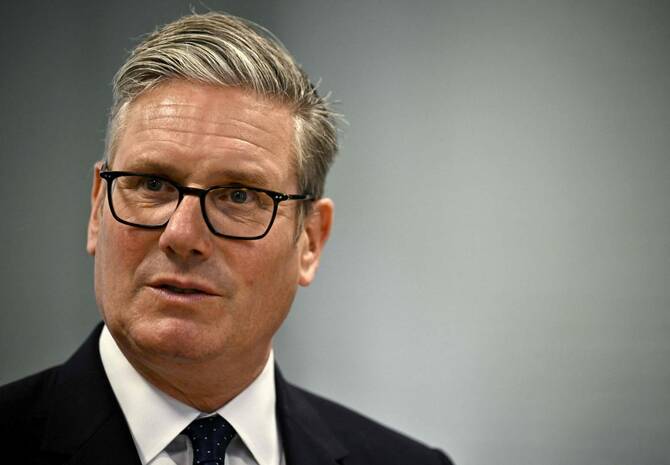
Prime Minister Keir Starmer commissioned an “audit” of Britain’s relations with Beijing after he swept to power in landslide general election win last July. (AFP)
Short Url
Updated 24 June 2025
Follow

UK government says Chinese spying on the rise

  • Prime Minister Keir Starmer commissioned an “audit” of Britain’s relations with Beijing
  • The report, published on Tuesday, recommended high-level engagement with China but also building “resilience” against threats

LONDON: Chinese spying and attempts by Beijing to undermine Britain’s democracy and economy have risen in recent years, the UK government said Tuesday in a report on the Asian giant.

Foreign minister David Lammy told parliament the Labour administration would invest £600 million ($818 million) in its intelligence services as a result of the findings.

Prime Minister Keir Starmer commissioned an “audit” of Britain’s relations with Beijing after he swept to power in landslide general election win last July.

The report, published on Tuesday, recommended high-level engagement with China for a “trade and investment relationship” but also building “resilience” against threats posed by Beijing.

“We understand that China is a sophisticated and persistent threat,” but “not engaging with China is therefore no choice at all,” Lammy told MPs.

“Like our closest allies, we will co-operate where we can and we will challenge where we must,” he said, vowing that meant “never compromising on our national security.”

Starmer has vowed to pursue a “consistent” relationship after the previous Conservative government first trumpeted a “golden era” of close diplomatic ties before relations became increasingly strained.

The British PM hopes Chinese investment can help him achieve his main mission of firing up Britain’s economy.

But differences over Russia’s war in Ukraine, Beijing’s treatment of Uyghurs and Hong Kong — including the imprisonment of media mogul Jimmy Lai — pose hurdles to repairing relations.

In a joint letter coordinated by Reporters Without Borders, 33 organizations around the globe wrote to Starmer on Tuesday asking him to meet Lai’s son Sebastian.

“As a British citizen facing an unthinkable ordeal, Sebastien Lai deserves to hear first-hand from the Prime Minister what the UK is doing to secure his father’s release,” said the letter, which was signed by groups including Amnesty International UK and Human Rights Foundation.

Espionage allegations have also blighted the relationship in recent years, including claims that a Chinese businessman used his links with Britain’s Prince Andrew to spy for the Communist Party.The report noted that “instances of China’s espionage, interference in our democracy and the undermining of our economic security have increased in recent years.”

“Our national security response will therefore continue to be threat-driven, bolstering our defenses and responding with strong counter-measures,” the government said.

Starmer’s administration is due to rule on whether to approve Beijing’s controversial plans to open the biggest embassy in Britain at a new London location.

Residents, rights groups and China hawks oppose the development, fearing it could be used for the surveillance and harassment of dissidents.


US will respond to Rwanda’s violation of peace pact, says Rubio

Secretary of State Marco Rubio. (AP file photo)
Updated 58 min 34 sec ago
Follow

US will respond to Rwanda’s violation of peace pact, says Rubio

  • Waltz told the Security Council meeting that the US “is deeply concerned and increasingly disappointed” by this resurgence of violence

WASHINGTON: Top US diplomat Marco Rubio said on Saturday that Rwanda had clearly violated the peace agreement it signed with the Democratic Republic of Congo in Washington last week and vowed unspecified “action” in response.
The Rwandan-backed M23 armed group advanced in eastern DRC and seized the key border city of Uvira, just days after the leaders signed the “Washington Accords” on Dec. 4.

Mike Waltz, US ambassador to the UN. (REUTERS)

“Rwanda’s actions in eastern DRC are a clear violation of the Washington Accords, and the US will take action to ensure promises made to the President are kept,” Secretary of State Rubio wrote on X.

FASTFACT

UN peacekeeping chief Jean-Pierre Lacroix warned the new offensive ‘has revived the specter of a regional conflagration with incalculable consequences.’

The capture of Uvira, along the border with Burundi, has raised fears that the conflict could escalate into a regional war.
As part of an offensive launched at the beginning of December in South Kivu province, the armed group’s takeover follows its earlier this year capture of Goma and Bukavu, other major cities in the DRC’s mineral-rich east.

On Friday, US Ambassador to the UN Mike Waltz accused Rwanda of “leading the region toward more instability and toward war.”
“The Rwandan defense forces have provided materiel, logistics, and training support to M23 as well as fighting alongside M23 in DRC with roughly 5,000 to 7,000 troops,” not including possible reinforcements during the latest offensive, Waltz told the UN Security Council.
The Rwandan firepower has included surface-to-air missiles, drones, and artillery, he added.
Since taking up arms again in 2021, the M23 has seized swaths of territory, displacing tens of thousands and leading to a spiraling humanitarian crisis.
Earlier this month, UN experts said Rwanda’s army and the M23 had carried out summary executions and forced mass displacements of people in the region.
Waltz told the Security Council meeting that the US “is deeply concerned and increasingly disappointed” by this resurgence of violence. 
The envoy denounced “the scale and sophistication” of Rwanda’s involvement in eastern DRC.
UN peacekeeping chief Jean-Pierre Lacroix warned the new offensive “has revived the specter of a regional conflagration with incalculable consequences.”
“Recent developments pose a serious risk of the progressive fragmentation of the Democratic Republic of Congo, particularly its eastern part,” he said.
Burundi on Friday accused Rwanda of bombing its territory, and its ambassador, Zephyrin Maniratanga, told the council it “reserves the right to use self-defense.”
He warned that if the attacks continue, it would be extremely difficult to avoid an escalation between the two African countries.
“Rwanda is not waging war against the Republic of Burundi and has no intention of doing that,” Ambassador Martin Ngoga said.
Meanwhile, Congolese Foreign Minister Therese Kayikwamba Wagner criticized the Security Council for its “lack of action” and called for sanctions against Rwanda.

Despite a resolution adopted in February demanding the withdrawal of Rwandan troops and a ceasefire, “the situation is undeniable: another city has fallen, a parallel administration has consolidated itself, thousands more families have fled, and others have been killed, raped, and terrorized,” she said.