

Pakistan reaches out to key allies amid ‘serious escalation’ in Middle East tensions

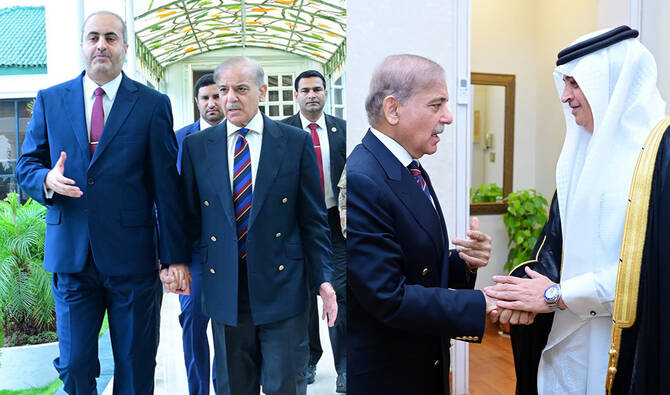
A collage created on June 24, 2025, shows Pakistan's Prime Minister, Shehbaz Sharif meeting Ambassador of Qatar, Ali Mubarak Ali Essa Al-Khater (left) and Ambassador of Saudi Arabia, Nawaf bin Said Al-Malki (right), in Islamabad, Pakistan. (@CMShehbaz/X)
Short Url
Updated 24 June 2025
Follow

Pakistan reaches out to key allies amid ‘serious escalation’ in Middle East tensions

  • PM meets envoys of China, Saudi Arabia and Qatar as Iran-Israel conflict risks wider regional war
  • Iran fired missiles at US base in Qatar on Monday, triggering fears of escalation despite ceasefire call

ISLAMABAD: Prime Minister Shehbaz Sharif on Tuesday met with the ambassadors of Pakistan’s key allies China, Saudi Arabia and Qatar in Islamabad, as the foreign office expressed concern over a “serious escalation” in Middle East tensions.

Sharif’s meetings with the envoys took place a day after Iran launched missiles against a US air base in Qatar on Monday, causing no casualties, in retaliation for the US dropping 30,000-pound bunker-buster bombs on Iranian underground nuclear facilities over the weekend. Hours later, US President Donald Trump made a surprise announcement of an Israel-Iran ceasefire agreement, suggesting he may have bombed Tehran’s rulers back to the negotiating table.

Tensions have remained high since June 13, when Israel struck Iran’s nuclear facilities and targeted senior military leadership. Iran has since retaliated with repeated missile strikes against Israel, raising fears of a wider regional conflict and prompting international calls for restraint.

“Pakistan expresses its deep concern and alarm at the serious escalation in the security situation in the region as a result of attacks against USA’s Al-Udeid Air Base in Qatar,” the Pakistani foreign office said in a statement on Tuesday, urging all sides to exercise restraint and respect fundamental principles of international law.

On Monday morning, Sharif held separate meetings with Saudi Ambassador Nawaf bin Said Al-Malki and Qatari envoy Ali Mubarak Ali Essa Al-Khater.

“Pakistan will continue to work closely with the Kingdom of Saudi Arabia for peace in the region through dialogue and diplomacy” the PM said on his X account. 

Sharif also met Qatari envoy Al-Khater to express solidarity with the Gulf country following Iran’s attack on the air base.

In the afternoon, the premier met China’s Ambassador to Pakistan, Jiang Zaidong, who, according to a statement from Sharif’s office, “lauded the proactive and positive role being played by Pakistan at every diplomatic forum, including at the UN Security Council, for a peaceful settlement of the [Middle East] crisis through dialogue and diplomacy.” 

China has sought to expand its diplomatic footprint in the Middle East in recent years and notably brokered the Saudi Arabia–Iran rapprochement in 2023, which boosted its credibility as a regional peacemaker. It has also offered to help mediate the current crisis, though it plays a more behind-the-scenes role compared to the US or regional states like Qatar or Oman.

Pakistan has condemned Israel’s strikes against Iran and repeatedly called for de-escalation in the region.

Islamabad has also offered diplomatic support to Tehran at international forums and defended Iran’s right to respond to Israeli and US aggression under the UN Charter, carefully balancing this stance with its close security cooperation and economic partnership with the United States, a major backer of Israel.

The US and Israel say their goal is to cripple Tehran’s nuclear program. 


Uzbekistan president arrives in Pakistan to increase trade, defense, energy cooperation

Updated 5 sec ago
Follow

Uzbekistan president arrives in Pakistan to increase trade, defense, energy cooperation

  • Uzbek President Shavkat Mirziyoyev leads high-level delegation of ministers, business leaders on Feb. 5-6 visit, says state media 
  • Visit takes place days after Pakistan, Uzbekistan reaffirmed $2 billion trade target during intergovernmental commission meeting

ISLAMABAD: Uzbekistan President Shavkat Mirziyoyev arrived in Pakistan’s capital Islamabad on Thursday, with a high-level delegation to identify new avenues for bilateral cooperation in trade, defense, energy and other avenues, state-run media reported. 

The visit takes place after the 10th session of the Pakistan–Uzbekistan Intergovernmental Commission (IGC) on Trade, Economic and Scientific-Technical Cooperation was held in Islamabad on Feb. 2. Both sides reaffirmed their $2 billion trade target and agreed to push for regional connectivity, develop trade routes and accelerate cooperation in several sectors. 

Mirziyoyev was given a red-carpet welcome when his aircraft landed at the Nur Khan Airbase, the state-run Associated Press of Pakistan (APP) said. He was welcomed by President Asif Ali Zardari, Prime Minister Shehbaz Sharif and senior members of the cabinet. 

“Discussions will focus on reviewing the entire gamut of bilateral relations and identifying new avenues to further deepen cooperation in diverse sectors, including trade, energy, defense, education, people-to-people exchange and regional connectivity,” APP reported. 

The Uzbek president will meet President Zardari, hold delegation-level talks with Prime Minister Sharif, and address the Pakistan-Uzbekistan Business Forum during his visit. 

Mirziyoyev’s visit takes place two days after Kazakhstan President Kassym-Jomart Tokayev arrived in Islamabad to hold talks on trade, business and connectivity. 

Pakistan and Kazakhstan signed 37 memoranda of understanding (MoUs) and set a target of raising bilateral trade to $1 billion within a year during Tokayev’s visit. 

Pakistan and Uzbekistan have steadily increased economic ties in recent years as Islamabad seeks greater access to landlocked Central Asian markets, aiming to position itself as a regional transit and trade hub linking South Asia with Central Asia.

Pakistan was the first Central Asian partner with which Uzbekistan signed a bilateral Transit Trade Agreement, along with a Preferential Trade Agreement in March 2022, covering 17 items, which became operational in 2023.

Pakistan’s finance ministry said last month that Azerbaijan’s state energy company SOCAR was set to finalize an investment in the country’s oil and gas sector following high-level engagements at the World Economic Forum in Davos.