

Fitch affirms Abu Dhabi rating at ‘AA’ with stable outlook

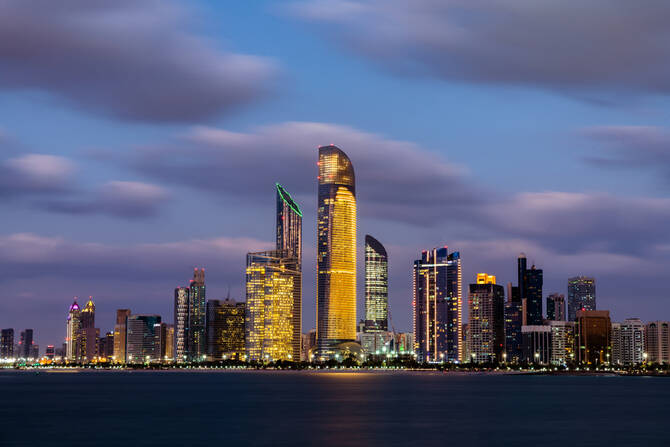
Abu Dhabi’s fiscal position remains one of the strongest among Fitch-rated sovereigns. Shutterstock
Short Url
Updated 24 June 2025
Follow

Fitch affirms Abu Dhabi rating at ‘AA’ with stable outlook

RIYADH: Abu Dhabi’s long-term foreign-currency rating has been affirmed at “AA” with a stable outlook by Fitch, supported by the emirate’s robust fiscal surpluses, vast sovereign assets, and low debt levels.

The US-based rating agency noted that while Abu Dhabi maintains a strong fiscal position, factors such as its dependence on hydrocarbon revenues, a still-evolving policy framework, and governance metrics that lag behind some of its counterparts present ongoing considerations.

This follows S&P Global’s recent assignment of a “AA/A‑1+” with a stable outlook for its foreign and local currency sovereign credit ratings to the UAE, citing the country’s strong fiscal and external positions. The agency also noted that the UAE’s sizable asset cushion would help shield it from oil price volatility and regional geopolitical tensions.

Despite these structural limitations, Abu Dhabi’s fiscal position remains one of the strongest among Fitch-rated sovereigns. At the end of 2024, government debt stood at 17.4 percent of gross domestic product, well below the peer median of 48.8 percent, and is expected to rise only marginally to 18.2 percent by 2026 due to local currency issuance aimed at supporting domestic debt market development.

In its latest report, Fitch stated: “We project a budget surplus of 7.0 percent of GDP in 2025 (3.1 percent excluding investment income) based on Fitch’s oil price (Brent USD65/b) and production (3.2m b/d) forecasts, and some spending under-execution, down from 9.9 percent in 2024.

It added: “For 2026, higher oil production, modest spending growth and the start of corporate income tax receipts will widen the surplus to 8 percent (4.3 percent excluding investment income).”

The report noted that Abu Dhabi’s fiscal breakeven oil price is estimated at $42.60 per barrel in 2025, or $54.30 excluding investment income, highlighting the emirate’s resilience to oil market fluctuations.

If oil prices decline, the government can maintain economic stability by adjusting spending or drawing on dividends from Abu Dhabi National Oil Co.

According to Fitch, sovereign net foreign assets are estimated to have reached 255 percent of GDP at the end of 2024, with a substantial portion of surpluses allocated to government-related entities such as Abu Dhabi Developmental Holding Co. and Mubadala. Some funds are also expected to support MGX, a joint venture focused on artificial intelligence investments.

Fitch added that contingent liabilities stemming from government-related entities debt, estimated at 48.3 percent of GDP in 2023, remain manageable given their asset bases, profitability, and the state’s fiscal strength.

Borrowing by government-related entities is anticipated to rise gradually as Abu Dhabi accelerates investment in non-oil sectors.

The agency also highlighted strong non-oil growth, which reached 6.2 percent in 2024. Overall GDP growth stood at 3.8 percent last year, tempered by lower oil output in line with OPEC+ quotas.

Fitch forecasts headline growth to rise to 6.3 percent in 2025 and 4 percent in 2026, driven by easing oil production constraints and increasing population levels.

The ratings agency warned that elevated geopolitical risks, particularly regional tensions involving Iran, Israel, and the US, pose a downside risk.

“A regional conflagration would pose a risk to Abu Dhabi’s hydrocarbon infrastructure and to Dubai as a trade, tourism and financial hub. Gulf maritime trade is a vital interest of the UAE,” the report said, though it added that the emirate’s large reserves provide protection against short-term disruptions.

Fitch’s sovereign rating model assigned Abu Dhabi a score equivalent to “AA+.” However, the agency applied a negative qualitative adjustment of one notch due to the emirate’s high dependence on oil revenues and geopolitical vulnerability.

The UAE’s country ceiling was affirmed at “AA+,” two notches above the sovereign rating, supported by strong constraints against capital controls, a dollarized financial system, and ample external buffers.

The agency stated that a downgrade could be triggered by a significant erosion of fiscal and external positions or a geopolitical shock that undermines macroeconomic stability. Conversely, an upgrade would require structural improvements such as reduced oil dependence and enhanced governance metrics.


‘The future is renewables,’ Indian energy minister tells World Economic Forum

Updated 22 January 2026
Follow

‘The future is renewables,’ Indian energy minister tells World Economic Forum

  • ‘In India, I can very confidently say, affordability (of renewables) is better than fossil fuel energy,’ says Pralhad Venkatesh Joshi during panel discussion
  • Renewables are an increasingly important part of the energy mix and the technology is evolving rapidly, another expert says at session titled ‘Unstoppable March of Renewables?’

BEIRUT: “The future is renewables,” India’s minister of new and renewable energy told the World Economic Forum in Davos on Wednesday.
“In India, I can very confidently say, affordability (of renewables) is better than fossil fuel energy,” Pralhad Venkatesh Joshi said during a panel discussion titled “Unstoppable March of Renewables?”
The cost of solar power has has fallen steeply in recent years compared with fossil fuels, Joshi said, adding: “The unstoppable march of renewables is perfectly right, and the future is renewables.”
Indian authorities have launched a major initiative to install rooftop solar panels on 10 million homes, he said. As a result, people are not only saving money on their electricity bills, “they are also selling (electricity) and earning money.”
He said that this represents a “success story” in India in terms of affordability and “that is what we planned.”
He acknowledged that more work needs to be done to improve reliability and consistency of supplies, and plans were being made to address this, including improved storage.
The other panelists in the discussion, which was moderated by Godfrey Mutizwa, the chief editor of CNBC Africa, included Marco Arcelli, CEO of ACWA Power; Catherine MacGregor, CEO of electricity company ENGIE Group; and Pan Jian, co-chair of lithium-ion battery manufacturer Contemporary Amperex Technology.
Asked by the moderator whether she believes “renewables are unstoppable,” MacGregor said: “Yes. I think some of the numbers that we are now facing are just proof points in terms of their magnitude.
“In 2024, I think it was 600 gigawatts that were installed across the globe … in Europe, close to 50 percent of the energy was produced from renewables in 2024. That has tripled since 2004.”
Renewables are an increasingly important and prominent part of the energy mix, she added, and the technology is evolving rapidly.
“It’s not small projects; it’s the magnitude of projects that strikes me the most, the scale-up that we are able to deliver,” MacGregor said.
“We are just starting construction in the UAE, for example. In terms of solar size it’s 1.5 gigawatts, just pure solar technology. So when I see in the Middle East a round-the-clock project with just solar and battery, it’s coming within reach.
“The technology advance, the cost, the competitiveness, the size, the R&D, the technology behind it and the pace is very impressive, which makes me, indeed, really say (renewables) is real. It plays a key role in, obviously, the energy demand that we see growing in most of the countries.
“You know, we talk a lot about energy transition, but for a lot of regions now it is more about energy additions. And renewables are indeed the fastest to come to market, and also in terms of scale are really impressive.”
Mutizwa asked Pan: “Are we there yet, in terms of beginning to declare mission accomplished? Are renewables here to stay?”
“I think we are on the road but (its is) very promising,” Pan replied. There is “great potential for future growth,” he added, and “the technology is ready, despite the fact that there are still a lot of challenges to overcome … it is all engineering questions. And from our perspective, we have been putting in a lot of resources and we are confident all these engineering challenges will be tackled along the way.”
Responding to the same question, Arcelli said: “Yes, I think we are beyond there on power, but on other sectors we are way behind … I would argue today that the technology you install by default is renewables.
“Is it a universal truth nowadays that renewables are the cheapest?” asked Mutizwa.
“It’s the cheapest everywhere,” Arcelli said.