

Gender not main factor in attacks on Egyptian woman pharaoh: study

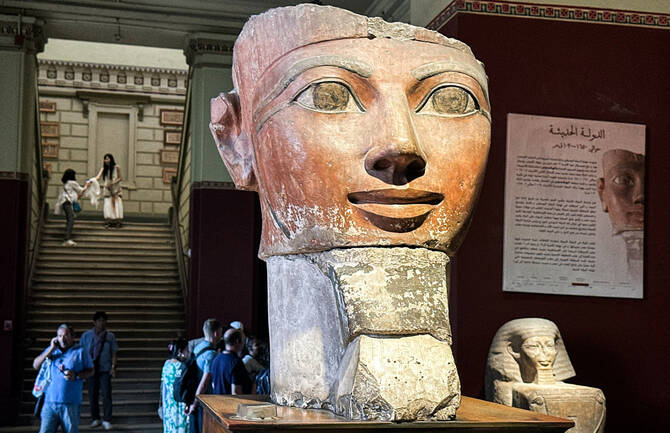
Visitors stand behind the bust of the ancient Egyptian queen Hatshepsut (1479-1458 BC) at the Egyptian Museum in Cairo's central Tahrir Square on June 11, 2025. (AFP)
Short Url
Updated 24 June 2025
Follow

Gender not main factor in attacks on Egyptian woman pharaoh: study

  • Earlier scholars believed Queen Hatshepsut’s stepson Thutmose III unleashed a posthumous campaign of defilement against her out of revenge and hatred, including because he wanted to purge any notion that a woman could successfully rule

TORONTO, Canada: She was one of ancient Egypt’s most successful rulers, a rare female pharaoh who preceded Cleopatra by 1,500 years, but Queen Hatshepsut’s legacy was systematically erased by her stepson successor after her death.
The question of why her impressive reign was so methodically scrubbed has attracted significant debate, but in new research published Monday, University of Toronto scholar Jun Wong argues far too much emphasis has been placed on her gender.
“It’s quite a romantic question: why was this pharaoh attacked after her death?” Wong told AFP, explaining his interest in a monarch who steered ancient Egypt through a period of extraordinary prosperity.
Earlier scholars believed Queen Hatshepsut’s stepson Thutmose III unleashed a posthumous campaign of defilement against her out of revenge and hatred, including because he wanted to purge any notion that a woman could successfully rule.
“The way in which (Hatshepsut’s) reign has been understood has always been colored by her gender,” Wong said, referencing beliefs that Thutmose III may have viewed her as “a kind of an evil stepmother.”
His research, which builds on other recent scholarship and is being published in the journal Antiquity, argues Thutmose III’s motivations were far more nuanced, casting further doubt on the theory of backlash against a woman in charge.
Hatshepsut ruled Egypt roughly 3,500 years ago, taking over following the death of her husband Thutmose II.
She first served as regent to her stepson, the king-in-waiting, but successfully consolidated power in her own right, establishing herself as a female pharaoh.
Experts say she expanded trade routes and commissioned extraordinary structures, including an unparallelled mortuary in the Valley of the Kings on the Nile’s west bank.
Wong reassessed a range of material from damaged statues uncovered during excavations from 1922 to 1928.
He said there is no doubt Thutmose III worked to eliminate evidence of Hatshepsut’s achievements, but his efforts were “perhaps driven by ritual necessity rather than outright antipathy,” Wong said.
Thutmose III may have been trying to neutralize the power of his predecessor in a practical and common way, not out of malice.
He also found that some of the statues depicting Hatshepsut were likely damaged because later generations wanted to reuse them as building materials.
“For a long time, it has been assumed that Hatshepsut’s statuary sustained a vindictive attack,” Wong said, arguing that a fresh look at the archives suggests “this is not the case.”


Turkish-language drama ‘Yellow Letters’ wins Berlin Film Festival’s top prize

Updated 22 February 2026
Follow

Turkish-language drama ‘Yellow Letters’ wins Berlin Film Festival’s top prize

  • The report ⁠did ⁠not say who was to blame for the attacks

BERLIN: “Yellow Letters,” a Turkish-language drama about what happens to a marriage put under extraordinary political pressure, ​won the Berlin Film Festival’s Golden Bear top prize on Saturday night.
The drama filmed in Germany but set in Turkiye follows a married actor and playwright who have to leave behind their comfortable lives after the husband is targeted by the state for posting critical content online.
“I know what (this win) means to my cast and crew who came from Turkiye, who now are getting a visibility that is on an international scale,” Turkish-German director Ilker Catak told Reuters after the award ceremony.
The director, whose previous Berlin entry “The Teachers’ Lounge” was nominated for an Oscar, said it was important that the film was not just about Turkiye, but Germany as well.
“There is a ‌sign that says ‌1933 and what we’ve seen in this country before, we must never ​forget,” ‌he ⁠said, referring ​to ⁠the year that Adolf Hitler came to power.
This year’s jury president, legendary German director Wim Wenders, praised the winner as “a movie that speaks up very clearly about the political language of totalitarianism.”
In total, 22 films had been in the running.

POLITICAL FESTIVAL
The festival maintained its reputation as the most overtly political of its peers, Venice and Cannes, with the war in Gaza in particular dominating public discussions about the films.
“If this Berlinale has been emotionally charged, that’s not a failure of the Berlinale, and it’s not a failure of cinema,” said festival director Tricia Tuttle at the opening ⁠ceremony, using the festival’s nickname.
Wenders used his final appearance as jury president to ‌urge filmmakers and activists to act as allies, not rivals, after ‌his comment that filmmakers should not be political caused Indian novelist Arundhati Roy ​to pull out.
Several award winners used their speech ‌to express solidarity with the Palestinians and other oppressed peoples.
“The least we can do here is to ‌break the silence and remind them that they are not really alone,” said Turkish filmmaker Emin Alper, whose film “Salvation” took the second-place Silver Bear Grand Jury Prize.
Palestinian-Syrian director Abdallah Al-Khatib, whose “Chronicles From the Siege” won the Perspectives section for emerging filmmakers, criticized the German government for its stance on Gaza despite concerns about crossing a red line.
“I was under a lot of ‌pressure to participate in Berlinale for one reason only, to stand here and say: ‘The Palestinians will be free,’” he said.

SANDRA HUELLER WINS AGAIN
German actor Sandra Hueller, ⁠who starred in 2024 Oscar-winning ⁠films “Anatomy of a Fall” and “Zone of Interest,” continued her winning streak by taking home best actor for the period piece “Rose,” in which she dresses as a man.
“To me, it’s special because I won my first-ever recognition as an actor in a film at this festival 20 years ago,” Hueller told Reuters, who won best actress in 2006 for “Requiem.”
“Queen at Sea,” a drama that follows French star Juliette Binoche as she deals with her mother’s advanced dementia and its effects on her marriage, won two prizes: the third-place jury prize and best supporting actor, shared by its two elderly performers, Anna Calder-Marshall and Tom Courtenay.
Director Lance Hammer, who last competed at the festival in 2008, said he hoped that maybe “people will see this and feel some comfort or relief that they’re not alone.”
Director Grant Gee won best director for “Everybody Digs Bill Evans,” a black-and-white biographical drama starring Norwegian actor ​Anders Danielsen Lie as the US jazz pianist.
“Nina ​Roza,” about an art curator who returns to Bulgaria to verify whether a child painting prodigy is genuine, won best screenplay while “Yo (Love is a Rebellious Bird)” took the prize for outstanding artistic contribution.