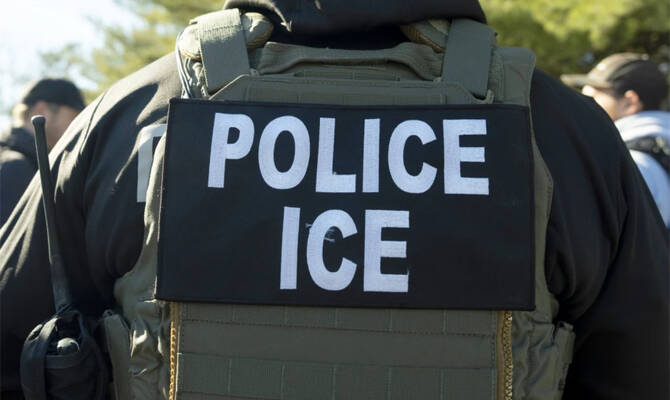
WASHINGTON: A divided Supreme Court on Monday allowed the Trump administration to restart swift removals of migrants to countries other than their homelands, lifting for now a court order requiring they get a chance to challenge the deportations.
The high court majority did not detail its reasoning in the brief order, as is typical on its emergency docket. All three liberal justices dissented from the order.
It came after immigration officials put eight people on a plane to South Sudan in May. US District Judge Brian E. Murphy in Boston found that violated his court order giving people a chance to argue they could be in danger of torture if sent away from their home countries.
The migrants from countries including Myanmar, Vietnam and Cuba had been convicted of serious crimes in the US and immigration officials have said that they were unable to return them quickly to their home countries.
Authorities instead landed the plane at a US naval base in Djibouti, where the migrants were housed in a converted shipping container and the officers guarding them faced rough conditions even as immigration attorneys waited for word from their clients.
The case comes amid a sweeping immigration crackdown by Republican President Donald Trump’s administration, which has pledged to deport millions of people who are living in the United States illegally.
Since some countries do not accept US deportations, the administration has reached agreements with other countries, including Panama and Costa Rica, to house them. South Sudan, meanwhile, has endured repeated waves of violence since gaining independence in 2011.
Murphy’s order doesn’t prohibit deportations to third countries. But it says migrants must have a real chance to argue they could be in serious danger if sent to another country.
The justices have confronted a similar issue in Trump’s effort to send Venezuelans accused of being gang members to a notorious prison in El Salvador with little chance to challenge the deportations in court.
In that case, the court said migrants must get a “reasonable time” to file a court challenge before being removed, and the majority blocked the administration from resuming the deportations while lower courts worked out exactly how long they should get.
The conservative-majority court has sided with Trump in other immigration cases, however, clearing the way for his administration to end temporary legal protections affecting a total of nearly a million immigrants.
The third-country deportation case has been one of several legal flashpoints as the administration rails against judges whose rulings have slowed the president’s policies.
Another order from Murphy, who was appointed by President Joe Biden, resulted in the Trump administration returning a gay Guatemalan man who had been wrongly deported to Mexico, where he says he had been raped and extorted. The man, identified in court papers as O.C.G, was the first person known to have been returned to US custody after deportation since the start of Trump’s second term.

Supreme Court allows Trump to restart swift deportation of migrants away from their home countries
https://arab.news/7633m
Supreme Court allows Trump to restart swift deportation of migrants away from their home countries
- Since some countries do not accept US deportations, the administration has reached agreements with other countries, including Panama and Costa Rica, to house them
Myanmar, Afghan hopeful scholars mourn UK study visa ban
- Myanmar, Afghanistan, Sudan and Cameroon citizens will be barred from obtaining university visas
- Britain’s travel block is “really painful” for Afghan women hoping to escape to an education abroad, said one female
YANGON, Myanmar: Aspiring students are lamenting Britain’s ban on education visas for their war-weary countries — dashing dreams of bettering themselves and their home nations.
Myanmar, Afghanistan, Sudan and Cameroon citizens will be barred from obtaining university visas, London announced this week, saying asylum applications by visiting students had “rocketed” nearly 500 percent from 2021 to 2025.
“It’s like the country is punishing the weak, the most vulnerable people,” said one woman from Myanmar.
She was preparing for a scholarship interview for a master’s in climate change finance when her plans were upended by Downing Street’s decree on Wednesday.
“I could not focus the whole morning,” the 28-year-old told AFP from Yangon, speaking on condition of anonymity for security reasons in a country riven by civil war since a 2021 military coup.
“I can’t picture my future.”
Like in much of the developed world, immigration has become a divisive issue in Britain.
Efforts to beat back arrivals mirror the sweeping travel bans issued by US President Donald Trump which have shut out citizens of Myanmar, Sudan and Afghanistan.
Since the chaotic military withdrawal of Britain, the United States and other NATO nations in 2021, Afghanistan has been ruled by a resurgent Taliban government which has banned women over age 12 from attending school.
Britain’s travel block is “really painful” for Afghan women hoping to escape to an education abroad, said one female child social worker in Ghazni province, who asked to remain anonymous for security reasons.
She has now canceled her plans to study for a master’s in both the US and the UK.
“Now I am trying to be hopeful, but I think it would also be a mistake,” said the 27-year-old.
In the summer of 2024, Arefa Mohammadi fled to neighboring Pakistan, living in limbo as she applied to universities.
She got an offer to study public health in England but now cannot accept it.
“It was truly shocking for me,” said the 24-year-old.
“This situation put me in a place where I haven’t any goals, because all my goals and all my futures are unpredictable.”
- ‘Cruel and short-sighted’ -
In Kabul, a 39-year-old man faces similar heartbreak.
He was accepted to study specialist subjects related to water management at three universities in England and Scotland.
“When I was a child I witnessed several challenges like flash floods, water scarcity, environmental neglect, inefficient irrigation systems,” he said, asking to remain anonymous for security reasons. “To address these challenges I made my application.”
“I hoped to acquire modern knowledge. It’s impossible to acquire in Afghanistan,” he added.
Some 33 million people in the country face severe water shortages, aid agencies say, a result of compounding multi-year droughts, climate change and infrastructure battered by decades of war.
Britain’s Labour government made the decision to curb visas as the right-wing Reform UK party surges in opinion polls with its hard-line stance against immigration.
The UK Home Office said almost 135,000 asylum seekers had entered the country through legal routes since 2021.
Activist organization Burma Campaign UK called the visa ban “exceptionally cruel and shortsighted.”
“The opportunity to come to the UK to study is life-changing for the individual student but also an investment in the future of Myanmar,” said program director Zoya Phan in a statement.
One exiled Myanmar journalist has been living over the border in Thailand after escaping the military rule which has clamped down on press freedoms.
“When the military coup happened I was just 22, so I had a lot of dreams,” she said. “But over the past five years there have been a lot of struggles — I couldn’t complete my dreams.”
Every year since the junta takeover she applied for further education to buoy her spirits.
But she received an email Thursday morning canceling her place to study for a master’s at a London university.
“Everything is gone,” she said. “My UK dream is all disappeared.”


