

What to know about the Islamic New Year and how Muslims observe it

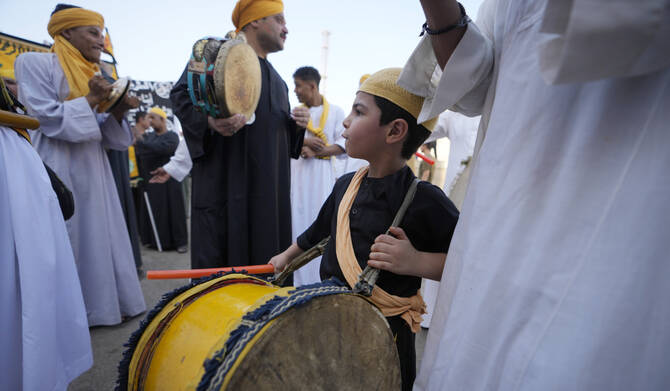
Sufi Muslims perform Zikr, or remembrance of God, as they sing Islamic songs during a parade to commemorate the beginning of the Islamic new year, 1446 Hijri, in Cairo, Egypt, July 7, 2024. (AP)
Short Url
Updated 23 June 2025
Follow

What to know about the Islamic New Year and how Muslims observe it

  • Muharram is one of four sacred months during which Islam forbids warfare, a condition that encourages increased prayer, charity and reflection throughout the month

CAIRO: Muslims will soon welcome a new year in the Islamic lunar calendar, known as the Hijri calendar.
The Hijri New Year, beginning on the first day of the month of Muharram, signals a chance for spiritual reflection and religious resolutions, set in the month following the annual Hajj in Makkah, Saudi Arabia.
Here’s what to know about the holiday and how Muslims observe it:
The Hijri New Year will begin around Thursday
This Hijri New Year is expected to fall on or around June 26, ushering in the year 1447 A.H. (which stands for “anno hegirae” or “the year of the Hijrah” in Latin).
The exact date can vary depending on when regional Islamic authorities see the crescent moon.
Because the Hijri calendar is lunar, the dates of Islamic months and holidays — such as Ramadan and Eid Al-Fitr — change annually. The new year corresponds with the first sighting of the crescent moon during Muharram, the first of 12 months in the Hijri calendar.
The calendar began in year 622
The Hijri calendar begins counting from 622 C.E., the year the Prophet Muhammad emigrated from Makkah to Medina, fleeing persecution.
This journey, known as the Hijrah or migration in Arabic, led to the religious, social and political consolidation of the then-nascent Muslim community.
The day is more solemn than festive
Muharram is one of four sacred months during which Islam forbids warfare, a condition that encourages increased prayer, charity and reflection throughout the month. More than 20 countries, including the United Arab Emirates, Morocco and Syria, have designated the Hijri New Year a national holiday.
While the passage of the Islamic New Year is generally more solemn and introspective than festive, Muslims may observe the holiday differently, according to their school of thought.
For Shiite Muslims especially, the first 10 days of Muharram mark a significant period of mourning: On the 10th of Muharram in 680 C.E., the Prophet Muhammad’s grandson Hussein was killed in battle.
Ten days into the new year on Ashoura, waves of Shiite mourners walk the streets dressed in black, beating their chests or self-flagellating in public grief.
Sunni Muslims commemorate Ashoura through voluntary fasting, as the day for them marks Moses’ parting of the Red Sea.
The wars in Iran and Gaza will impact observations of the new year
Mass demonstrations of mourning on Ashoura are known to unfold in Tehran and other cities in the Shiite-majority Iran.
But more than a week into a campaign of strikes by Israel, the streets of Tehran have been largely deserted, businesses are closed, and with no bomb shelters open, many shelter on the floor of metro stations. Thousands have fled the city.
Israel launched a major attack on Iran on June 13, striking the heart of Iran’s nuclear and military structure in Tehran and triggering a war between the two longtime foes.
Ashoura demonstrations in Pakistan, Lebanon and Iraq have also been a site of tributes to Palestinians.
This Hijri New Year is the second to pass since the Israel-Hamas war began in October 2023. Israel’s military offensive in Gaza has since killed more than 55,000 Palestinians in the predominantly Muslim area, according to the Gaza Health Ministry. It does not distinguish between civilians and combatants but has said most of the dead are women and children.


A month on, flood-struck Aceh still reels from worst disaster since 2004 tsunami

Men wait to receive privately donated aid in in eastern Aceh regency of Aceh Tamiang, on Dec. 14, 2025. (AFP)
Updated 58 min 35 sec ago
Follow

A month on, flood-struck Aceh still reels from worst disaster since 2004 tsunami

  • Aceh accounts for almost half of death toll in Sumatra floods that struck in November
  • Over 450,000 remain displaced as of Friday, as governor extended state of emergency

JAKARTA: Four weeks since floodwaters and torrents of mud swept across Aceh province, villages are still overwhelmed with debris while communities remain inundated, forced to rely on each other to speed up recovery efforts.

The deadly floods and landslides, triggered by extreme weather linked to Cyclone Senyar, hit the provinces of North Sumatra, West Sumatra and Aceh in late November.

Aceh, the westernmost province of Indonesia, was the worst-hit. Accounting for almost half of the 1,137 death toll, a month later more than 450,000 people are still unable to return to their homes, as many struggle to access clean water, food, electricity and medical supplies.

“We saw how people resorted to using polluted river water for their needs,” Ira Hadiati, Aceh coordinator for the Medical Emergency Rescue Committee, or MER-C, told Arab News on Friday.

Many evacuation shelters were also lacking toilets and washing facilities, while household waste was “piling up on people’s lawns,” she added.

In many regions, people’s basic needs “were still unmet,” said Annisa Zulkarnain, a volunteer with Aceh-based youth empowerment organization Svara.

“Residents end up helping each other and that’s still nowhere near enough, and even with volunteers there are still some limitations,” she told Arab News. 

Volunteers and aid workers in Aceh have grown frustrated with the central government’s response, which many have criticized as slow and ineffective.

And Jakarta continues to ignore persistent calls to declare the Sumatra floods a national disaster, which would unlock emergency funds and help streamline relief efforts.

“It seems like there’s a gap between the people and the government, where the government is saying that funds and resources have been mobilized … but the fact on the ground shows that even to fix the bridges, it’s been ordinary people working together,” Zulkarnain said.

After spending the past two weeks visiting some of the worst-affected areas, she said that the government “really need to speed up” their recovery efforts.

Aceh Gov. Muzakir Manaf extended the province’s state of emergency for another two weeks starting Friday, while several district governments have declared themselves incapable of managing the disasters.

Entire villages were wiped out by the disastrous floods, which have also damaged more than 115,000 houses across Aceh, along with 141 health facilities, 49 bridges, and over 1,300 schools.

The widespread damage to roads and infrastructure continue to isolate many communities, with residents traveling for hours on foot or with motorbikes in search of basic supplies.

“Even today, some areas are still inundated by thick mud and there are remote locations still cut off because the bridges collapsed. For access, off-road vehicles are still required or we would use small wooden boats to cross rivers,” Al Fadhil, director of Geutanyoe Foundation, told Arab News.

“From our perspective, disaster management this time around is much worse compared to how it was when the 2004 tsunami happened.”

When the Indian Ocean earthquake and tsunami struck in 2004, Aceh was the hardest-hit of all, with the disasters killing almost 170,000 people in the province.

But MER-C’s Hadiati said that the impact of the November floods and landslides is “more extensive and far worse than the tsunami,” as 18 Acehnese cities and regencies have been affected — about twice more than in the 2004 disaster.

As Friday marks 21 years since the cataclysmic tsunami, Fadhil said the current disaster management was “disorganized,” and lacked leadership and coordination from the central government, factors that played a crucial role after 2004. 

“The provincial and district governments in Aceh, they’ve now done all they could with what they have,” he said.

“But their efforts stand against the fact that there’s no entry of foreign aid, no outside support, and a central government insisting they are capable.”